The Architecture of Israel’s Genocide in Gaza
Foreign Policy

Foreign Policy
Original Source
A groundbreaking book by Israeli architect and activist Eyal Weizman meticulously documents Israel's systematic destruction of Palestinian life in Gaza through forensic analysis and rigorous investigation. By shifting the debate from definitional disputes to material evidence, the work reframes the question from whether genocide occurred to what must be understood about a destructive campaign designed to permanently transform the land itself.
A New Book Details Israel’s Destruction of Palestinian Life in Gaza
By using this website, you agree to our use of cookies. This use includes personalization of content and ads, and traffic analytics. Review our Privacy Policy for more information.
!Foreign Policy
Foreign Policy
Get analysis and alerts more quickly in the mobile app.
Install
Back to Foreign Policy Magazine home page
* Latest
* Regions
+ Asia & the Pacific
+ China
+ Middle East & Africa
+ Americas
+ Europe
* Newsletters
Editors’ Picks
Evening roundup with our editors’ favorite stories of the day
!World Brief Icon
World Brief
Your guide to the most important world stories of the day
!China Brief Icon
China Brief
The latest news, analysis, and data from the country each week
Situation Report
Weekly update on what’s driving U.S. national security policy
FP Weekend
A curation of our best book reviews, deep dives, and other reads
!Africa Brief Icon
Africa Brief
Essential analysis of the stories shaping geopolitics on the continent
!South Asia Brief Icon
South Asia Brief
Weekly update on developments in India and its neighbors
The Reading List
Curated guides on geopolitics and current affairs
FP Bookshelf
A monthly guide to FP’s book reviews, excerpts, and reading recommendations
!Latin America Brief Icon
Latin America Brief
One-stop digest of politics, economics, and culture
!Southeast Asia Brief Icon
Southeast Asia Brief
A weekly dispatch with news from the region’s 11 countries
The New Geopolitics
A five-part masterclass in IR theory with Harvard Professor Stephen M. Walt
View All Newsletters
* FP Live
* Latest
* Trending:
* Iran war
* Britain's new prime minister
Search this website
* Preferences
* My FP Feed
* Saved Articles
* Newsletters
* Magazine Archive
* Subscription Settings
* FAQs
* Log Out
Sign In
Sign In
Equip your team with FP Enterprise Equip your team with FP Enterprise
SUBSCRIBE SUBSCRIBEUpgrade & get a limited-edition tote Upgrade & get a limited-edition tote
Review:
The Architecture of Israel’s Genocide in Gaza
*
*
* Facebook
* Bluesky
* X
* LinkedIn
* WhatsApp
* Reddit
Save
Save
1. Create an FP account to save articles to read later.
Sign Up
ALREADY AN FP SUBSCRIBER? LOGIN
PDF
PDF
1. **Downloadable PDFs** are a benefit of an FP subscription.
Subscribe Now
ALREADY AN FP SUBSCRIBER? LOGIN
Gift
Gift
*
*
* WhatsApp
1. Gifting articles is a subscriber benefit.
Subscribe Now
ALREADY AN FP SUBSCRIBER? LOGIN
2. This article is an Insider exclusive.
Contact us at [email protected] to learn about upgrade options, unlocking the ability to gift this article.
Review
The Architecture of Israel’s Genocide in Gaza
A new book describes the destruction of Palestinian life street by street.
August 4, 2026, 6:00 AM
By **Marc Lynch**, a professor of political science and international affairs at the George Washington University and the director of the Project on Middle East Political Science.
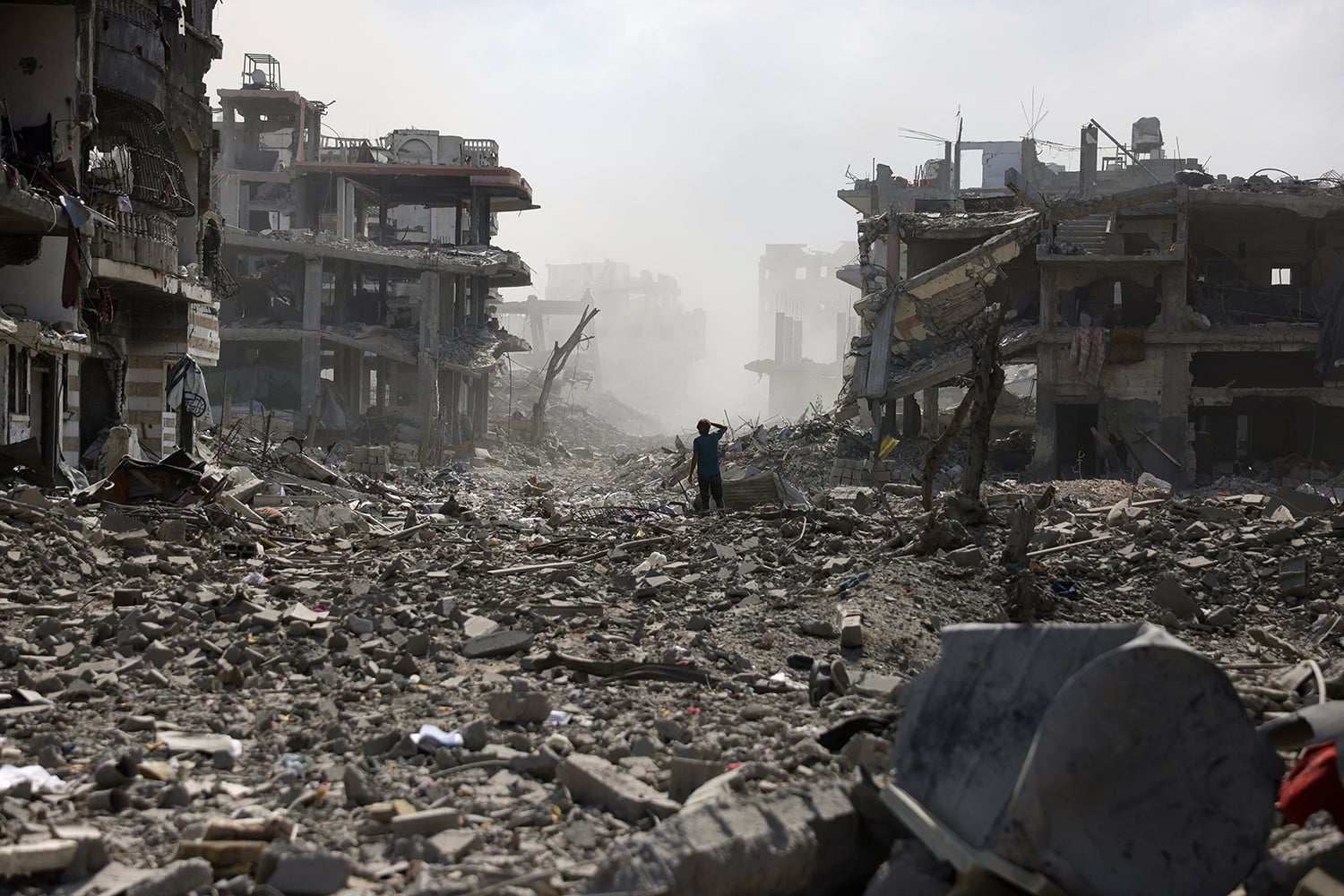
!A Palestinian youth stands on a street strewn with rubble following an explosion in the Saftawi neighborhood, west of Jabalia in the northern Gaza Strip.
*A Palestinian youth stands on a street strewn with rubble following an explosion in the Saftawi neighborhood, west of Jabalia in the northern Gaza Strip.*
A Palestinian youth stands on a street strewn with rubble following an explosion in the Saftawi neighborhood, west of Jabalia in the northern Gaza Strip, on Aug. 25, 2025. Bashar Taleb/AFP via Getty Images
My FP:
Follow topics and authors to get straight to what you like. Exclusively for FP subscribers. Subscribe Now | Log In
*
While many Americans believe that Israel has committed a genocide against Palestinians in Gaza over the past three years, attempts to understand what really happened there and hold Israel accountable have fallen short so far. The legal case at the International Court of Justice has been stalled by American and European opposition. The ferocious debate over the term itself has degenerated into partisan flamethrowing and definitional nitpicking. The campus protests that erupted in the spring of 2024 were violently repressed and have largely gone away.
A new book by the British Israeli architect and political activist Eyal Weizman tries to fill that void by telling the story of Israel’s systematic destruction of Gaza street by street, farm by farm, and hospital by hospital. What sets *Ungrounding: The Architecture of Genocide* apart from this polarized discourse is its determined focus on the physical and its analytical tone. The evidence, collected by Weizman and his team from audios, videos, and interviews and subjected to rigorous analysis, is overwhelming. Their efforts produced the “Cartography of Genocide,” an interactive and constantly evolving digital map that details “an organized and designed campaign to destroy Palestinian life in Gaza.” By the end of the book, the question is less whether Israel’s actions should be regarded as genocide and more what to make of a genocidal process that seeks to not only remove a people but to fundamentally and permanently transform the land.
While many Americans believe that Israel has committed a genocide against Palestinians in Gaza over the past three years, attempts to understand what really happened there and hold Israel accountable have fallen short so far. The legal case at the International Court of Justice has been stalled by American and European opposition. The ferocious debate over the term itself has degenerated into partisan flamethrowing and definitional nitpicking. The campus protests that erupted in the spring of 2024 were violently repressed and have largely gone away.
***Ungrounding: The Architecture of Genocide***, Eyal Weizman, Penguin Press, 416 pp., $38, July 2026
A new book by the British Israeli architect and political activist Eyal Weizman tries to fill that void by telling the story of Israel’s systematic destruction of Gaza street by street, farm by farm, and hospital by hospital. What sets *Ungrounding: The Architecture of Genocide* apart from this polarized discourse is its determined focus on the physical and its analytical tone. The evidence, collected by Weizman and his team from audios, videos, and interviews and subjected to rigorous analysis, is overwhelming. Their efforts produced the “Cartography of Genocide,” an interactive and constantly evolving digital map that details “an organized and designed campaign to destroy Palestinian life in Gaza.” By the end of the book, the question is less whether Israel’s actions should be regarded as genocide and more what to make of a genocidal process that seeks to not only remove a people but to fundamentally and permanently transform the land.
Weizman is the author of the acclaimed *Hollow Land*, which dissected Israeli methods of settlement and physical control in the West Bank in the 2000s. He is also one of the creators and driving forces behind Forensic Architecture, a research agency whose investigations have played critical roles in documenting genocide from Guatemala to Namibia, torture prisons in Syria, and human rights abuses in Mexico. Weizman worked closely with South Africans in their petition against Israel to the International Court of Justice, providing detailed reconstructions of Israeli actions, which are scattered through the text of his new book. His outrage over state violence is not confined to Israel, but it is personal: Multiple members of his team were killed over the course of the war—victims of the very campaign that they worked to document.
!Three side-by-side data maps of a coastal strip showing color-coded data points, symbols, and routes indicating infrastructure damage, movement paths, and facility statuses.
*Three side-by-side data maps of a coastal strip showing color-coded data points, symbols, and routes indicating infrastructure damage, movement paths, and facility statuses.*
Maps from the “Cartography of Genocide” interactive site sho
By using this website, you agree to our use of cookies. This use includes personalization of content and ads, and traffic analytics. Review our Privacy Policy for more information.
!Foreign Policy
Foreign Policy
Get analysis and alerts more quickly in the mobile app.
Install
Back to Foreign Policy Magazine home page
* Latest
* Regions
+ Asia & the Pacific
+ China
+ Middle East & Africa
+ Americas
+ Europe
* Newsletters
Editors’ Picks
Evening roundup with our editors’ favorite stories of the day
!World Brief Icon
World Brief
Your guide to the most important world stories of the day
!China Brief Icon
China Brief
The latest news, analysis, and data from the country each week
Situation Report
Weekly update on what’s driving U.S. national security policy
FP Weekend
A curation of our best book reviews, deep dives, and other reads
!Africa Brief Icon
Africa Brief
Essential analysis of the stories shaping geopolitics on the continent
!South Asia Brief Icon
South Asia Brief
Weekly update on developments in India and its neighbors
The Reading List
Curated guides on geopolitics and current affairs
FP Bookshelf
A monthly guide to FP’s book reviews, excerpts, and reading recommendations
!Latin America Brief Icon
Latin America Brief
One-stop digest of politics, economics, and culture
!Southeast Asia Brief Icon
Southeast Asia Brief
A weekly dispatch with news from the region’s 11 countries
The New Geopolitics
A five-part masterclass in IR theory with Harvard Professor Stephen M. Walt
View All Newsletters
* FP Live
* Latest
* Trending:
* Iran war
* Britain's new prime minister
Search this website
* Preferences
* My FP Feed
* Saved Articles
* Newsletters
* Magazine Archive
* Subscription Settings
* FAQs
* Log Out
Sign In
Sign In
Equip your team with FP Enterprise Equip your team with FP Enterprise
SUBSCRIBE SUBSCRIBEUpgrade & get a limited-edition tote Upgrade & get a limited-edition tote
Review:
The Architecture of Israel’s Genocide in Gaza
*
*
* Bluesky
* X
Save
Save
1. Create an FP account to save articles to read later.
Sign Up
ALREADY AN FP SUBSCRIBER? LOGIN
1. **Downloadable PDFs** are a benefit of an FP subscription.
Subscribe Now
ALREADY AN FP SUBSCRIBER? LOGIN
Gift
Gift
*
*
1. Gifting articles is a subscriber benefit.
Subscribe Now
ALREADY AN FP SUBSCRIBER? LOGIN
2. This article is an Insider exclusive.
Contact us at [email protected] to learn about upgrade options, unlocking the ability to gift this article.
Review
The Architecture of Israel’s Genocide in Gaza
A new book describes the destruction of Palestinian life street by street.
August 4, 2026, 6:00 AM
By **Marc Lynch**, a professor of political science and international affairs at the George Washington University and the director of the Project on Middle East Political Science.
!A Palestinian youth stands on a street strewn with rubble following an explosion in the Saftawi neighborhood, west of Jabalia in the northern Gaza Strip.
*A Palestinian youth stands on a street strewn with rubble following an explosion in the Saftawi neighborhood, west of Jabalia in the northern Gaza Strip.*
A Palestinian youth stands on a street strewn with rubble following an explosion in the Saftawi neighborhood, west of Jabalia in the northern Gaza Strip, on Aug. 25, 2025. Bashar Taleb/AFP via Getty Images
My FP:
Follow topics and authors to get straight to what you like. Exclusively for FP subscribers. Subscribe Now | Log In
*
While many Americans believe that Israel has committed a genocide against Palestinians in Gaza over the past three years, attempts to understand what really happened there and hold Israel accountable have fallen short so far. The legal case at the International Court of Justice has been stalled by American and European opposition. The ferocious debate over the term itself has degenerated into partisan flamethrowing and definitional nitpicking. The campus protests that erupted in the spring of 2024 were violently repressed and have largely gone away.
A new book by the British Israeli architect and political activist Eyal Weizman tries to fill that void by telling the story of Israel’s systematic destruction of Gaza street by street, farm by farm, and hospital by hospital. What sets *Ungrounding: The Architecture of Genocide* apart from this polarized discourse is its determined focus on the physical and its analytical tone. The evidence, collected by Weizman and his team from audios, videos, and interviews and subjected to rigorous analysis, is overwhelming. Their efforts produced the “Cartography of Genocide,” an interactive and constantly evolving digital map that details “an organized and designed campaign to destroy Palestinian life in Gaza.” By the end of the book, the question is less whether Israel’s actions should be regarded as genocide and more what to make of a genocidal process that seeks to not only remove a people but to fundamentally and permanently transform the land.
While many Americans believe that Israel has committed a genocide against Palestinians in Gaza over the past three years, attempts to understand what really happened there and hold Israel accountable have fallen short so far. The legal case at the International Court of Justice has been stalled by American and European opposition. The ferocious debate over the term itself has degenerated into partisan flamethrowing and definitional nitpicking. The campus protests that erupted in the spring of 2024 were violently repressed and have largely gone away.
***Ungrounding: The Architecture of Genocide***, Eyal Weizman, Penguin Press, 416 pp., $38, July 2026
A new book by the British Israeli architect and political activist Eyal Weizman tries to fill that void by telling the story of Israel’s systematic destruction of Gaza street by street, farm by farm, and hospital by hospital. What sets *Ungrounding: The Architecture of Genocide* apart from this polarized discourse is its determined focus on the physical and its analytical tone. The evidence, collected by Weizman and his team from audios, videos, and interviews and subjected to rigorous analysis, is overwhelming. Their efforts produced the “Cartography of Genocide,” an interactive and constantly evolving digital map that details “an organized and designed campaign to destroy Palestinian life in Gaza.” By the end of the book, the question is less whether Israel’s actions should be regarded as genocide and more what to make of a genocidal process that seeks to not only remove a people but to fundamentally and permanently transform the land.
Weizman is the author of the acclaimed *Hollow Land*, which dissected Israeli methods of settlement and physical control in the West Bank in the 2000s. He is also one of the creators and driving forces behind Forensic Architecture, a research agency whose investigations have played critical roles in documenting genocide from Guatemala to Namibia, torture prisons in Syria, and human rights abuses in Mexico. Weizman worked closely with South Africans in their petition against Israel to the International Court of Justice, providing detailed reconstructions of Israeli actions, which are scattered through the text of his new book. His outrage over state violence is not confined to Israel, but it is personal: Multiple members of his team were killed over the course of the war—victims of the very campaign that they worked to document.
!Three side-by-side data maps of a coastal strip showing color-coded data points, symbols, and routes indicating infrastructure damage, movement paths, and facility statuses.
*Three side-by-side data maps of a coastal strip showing color-coded data points, symbols, and routes indicating infrastructure damage, movement paths, and facility statuses.*
Maps from the “Cartography of Genocide” interactive site sho
🔗 Share Article
Tags:#غزة#الإبادة الجماعية#إسرائيل#حقوق الإنسان#الشرق الأوسط#توثيق جرائم الحرب
Source: Foreign Policy
For Context
Related reads from the same topic or latest developments


