ViewsAvailable in English
The Geography of Maximum Pressure: Can Washington Sustain Coercion Against Iran?
Editorial
Cross Lines editing
Source
CROSS LINES

Dr.Kamran Yeganegi
Writer at CROSS LINES
Iran enters the confrontation with significant structural advantages: strategic geography, territorial depth, control over critical regional corridors, extensive borders and decades of experience adapting to sanctions. Washington retains formidable financial power, but converting that power into decisive strategic leverage against Iran is a far more difficult and costly proposition.
For decades, U.S. policy toward Iran has rested heavily on the assumption that sufficient economic pressure can eventually produce strategic concessions.
Sanctions have undoubtedly imposed costs on Iran, restricting access to finance, complicating oil exports and raising the price of participation in the global economy.
Yet the more consequential question is not whether Washington can inflict economic pain. It can.
The question is whether that pain can be translated into political outcomes against a state whose geography, strategic depth and accumulated capacity for adaptation make sustained coercion unusually difficult.
Iran is not simply an economy under sanctions. It is also a major regional state occupying one of the most consequential pieces of strategic geography in Eurasia.
# Geography is an Iranian strategic asset
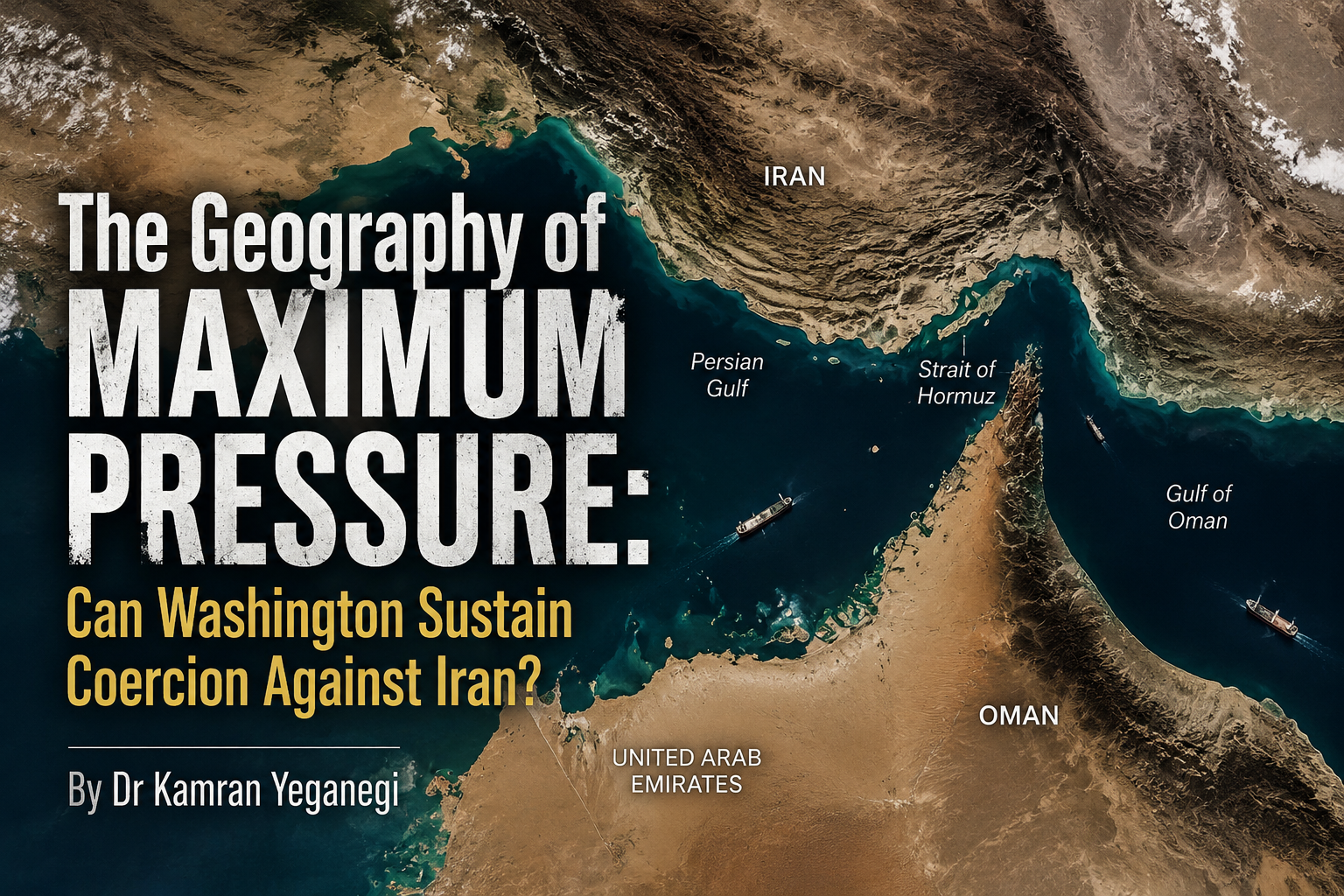
Iran covers roughly 1.65 million square kilometres and sits at the intersection of the Persian Gulf, the Caucasus, Central Asia, South Asia and the wider Middle East.
It shares land borders with seven countries and possesses a long coastline stretching across the Persian Gulf and Gulf of Oman.
This geography gives Tehran options that financial indicators alone cannot capture.
Extensive borders facilitate regional commerce; neighbouring markets provide alternative economic channels; and multiple transport corridors complicate attempts to impose comprehensive isolation.
Iran also possesses considerable strategic depth. Mountain ranges, difficult terrain, a large territorial interior and dispersed infrastructure make the country fundamentally different from a small state whose strategic assets are concentrated in a limited geographic space.
Iran's geography therefore does more than increase the cost of coercion. It gives Tehran leverage over the strategic environment in which that coercion must operate.
# Adaptation has become a strategic capability
Decades of sanctions have also produced something Washington must increasingly reckon with: institutional experience in operating under pressure.
Iran has developed networks involving alternative payment arrangements, regional trade, intermediaries, front companies, ship-to-ship transfers and shadow-fleet shipping.
Commercial relationships beyond conventional Western financial channels have expanded, while China has played a particularly important role in absorbing Iranian energy exports.
These mechanisms are costly and imperfect.
Sanctions circumvention imposes transaction costs, oil discounts reduce revenue, and restricted access to Western finance and technology creates long-term economic disadvantages.
But that is only half the equation.
Iran's adaptation mechanisms do not need to make sanctions irrelevant. Their strategic purpose is to prevent sanctions from becoming decisive.
Tehran does not need to reproduce the benefits of unrestricted integration into the global economy; it needs to maintain sufficient economic functionality to preserve strategic autonomy.
After decades of sanctions, adaptation itself has therefore become a strategic asset.
# Iran's location makes pressure difficult to contain
Recent maritime disruption has demonstrated both the power and the limits of intensified coercion.
Iranian crude and condensate loadings have fallen sharply amid a wider crisis involving U.S. efforts to restrict exports, blockades, military escalation and insecurity across Gulf shipping routes.
Physical disruption can clearly impose pressure beyond conventional financial sanctions.
But it also changes the geography of the confrontation.
The Strait of Hormuz is not merely an Iranian export route. It is a critical artery of the global energy system.
Prolonged instability around it can affect Gulf producers, Asian importers, shipping companies, insurance markets and global energy prices.
This reveals one of Iran's most consequential geopolitical advantages: the consequences of coercion against Iran are difficult to contain within Iran.
As pressure moves from financial restrictions toward maritime enforcement and military deterrence, the number of actors potentially affected by the confrontation expands.
What begins as an attempt to restrict Iranian revenues can generate costs for energy markets, neighbouring economies and states whose cooperation Washington itself requires.
# The tyranny of distance
There is another asymmetry that conventional comparisons of American and Iranian economic power tend to obscure.
Iran operates in its immediate strategic environment.
The United States must project power into that environment from thousands of kilometres away.
Washington possesses overwhelming conventional military capabilities, but sustained power projection requires far more than superior weapons.
It requires regional bases, naval deployments, air and missile defence, intelligence and surveillance, logistics, refuelling, protection of personnel, maritime security and cooperation from regional partners.
This is the tyranny of distance: military superiority does not disappear with distance, but maintaining that superiority becomes more complex and costly the farther and longer power must be projected.
Iran, by contrast, operates from its own territory, close to the theatres in which escalation would occur.
This does not create military parity. It creates something strategically different: an asymmetry in the cost of endurance.
# Maximum pressure is not cost-free for Washington
The same principle applies to sanctions.
Placing an Iranian entity on a sanctions list is relatively inexpensive.
Maintaining a system capable of translating those sanctions into sustained strategic pressure is not.
As Iran replaces sanctioned ships, intermediaries, companies and payment channels, Washington must identify the replacements and enforce restrictions against them.
Effective maximum pressure increasingly requires financial intelligence, maritime surveillance, secondary sanctions, diplomatic pressure on third countries and, under conditions of escalation, military assets to protect bases and shipping routes.
The costs are therefore asymmetric rather than one-sided.
Iran absorbs economic pressure, while Washington must continuously finance, enforce, protect and politically sustain the architecture that produces it.
China further complicates this equation.
Beijing has an interest in stable Gulf energy flows but little strategic incentive to accept indefinitely a system in which Washington determines which suppliers Chinese companies may access.
Regional states also have their own calculations, particularly when prolonged confrontation threatens shipping, energy exports, investment or domestic economic stability.
Maximum pressure consequently depends on more than American economic power.
It requires an ecosystem of enforcement, military presence, third-country compliance and geopolitical tolerance.
# From financial superiority to strategic endurance
This is where the central question changes.
The issue is not whether the United States can continue sanctioning Iran.
It can, potentially for many years.
The real question is whether Washington can sustain sanctions at the intensity required to produce strategic concessions.
Prolonged coercion creates a dynamic contest.
Each new layer of enforcement increases costs for Iran, but also creates incentives for further adaptation.
New intermediaries emerge, trade routes shift, payment mechanisms evolve and relationships with non-Western partners deepen.
Washington can tighten enforcement again, but doing so requires additional effort.
The result can be diminishing strategic returns: increasingly sophisticated and costly enforcement may generate progressively smaller additions to political leverage.
Iran therefore does not need to match the United States economically.
Nor does it need to eliminate the economic costs of sanctions.
It needs to prevent those costs from becoming strategically decisive.
That distinction matters.
# The balance that matters
Iran has economic vulnerabilities, but it also possesses advantages that sanctions cannot easily erase: strategic geography, territorial depth, regional proximity, extensive borders, access to critical maritime space and decades of accumulated adaptation.
The United States possesses superior financial and conventional military capabilities.
But those capabilities must be translated into effective pressure across thousands of kilometres and sustained through sanctions enforcement, military deployments, maritime security, diplomatic coordination and cooperation from other states.
The contest therefore cannot be understood simply as American strength confronting Iranian weakness.
It is better understood as a confrontation between financial power and strategic geography, coercive capacity and adaptive capacity, distance and proximity - and ultimately between two different forms of endurance.
Washington may command the stronger financial instruments, but Tehran possesses something sanctions cannot easily erase: geography, strategic depth, regional proximity and decades of accumulated adaptation.
The longer maximum pressure must be enforced through military deployments, maritime control, secondary sanctions and coalition management, the more the contest shifts from financial superiority toward strategic endurance.
In that contest, Iran is not simply the object of pressure.
Its geography makes it an active variable in determining how costly, sustainable and ultimately effective that pressure can be.
Sanctions have undoubtedly imposed costs on Iran, restricting access to finance, complicating oil exports and raising the price of participation in the global economy.
Yet the more consequential question is not whether Washington can inflict economic pain. It can.
The question is whether that pain can be translated into political outcomes against a state whose geography, strategic depth and accumulated capacity for adaptation make sustained coercion unusually difficult.
Iran is not simply an economy under sanctions. It is also a major regional state occupying one of the most consequential pieces of strategic geography in Eurasia.
# Geography is an Iranian strategic asset
Iran covers roughly 1.65 million square kilometres and sits at the intersection of the Persian Gulf, the Caucasus, Central Asia, South Asia and the wider Middle East.
It shares land borders with seven countries and possesses a long coastline stretching across the Persian Gulf and Gulf of Oman.
This geography gives Tehran options that financial indicators alone cannot capture.
Extensive borders facilitate regional commerce; neighbouring markets provide alternative economic channels; and multiple transport corridors complicate attempts to impose comprehensive isolation.
Iran also possesses considerable strategic depth. Mountain ranges, difficult terrain, a large territorial interior and dispersed infrastructure make the country fundamentally different from a small state whose strategic assets are concentrated in a limited geographic space.
Iran's geography therefore does more than increase the cost of coercion. It gives Tehran leverage over the strategic environment in which that coercion must operate.
# Adaptation has become a strategic capability
Decades of sanctions have also produced something Washington must increasingly reckon with: institutional experience in operating under pressure.
Iran has developed networks involving alternative payment arrangements, regional trade, intermediaries, front companies, ship-to-ship transfers and shadow-fleet shipping.
Commercial relationships beyond conventional Western financial channels have expanded, while China has played a particularly important role in absorbing Iranian energy exports.
These mechanisms are costly and imperfect.
Sanctions circumvention imposes transaction costs, oil discounts reduce revenue, and restricted access to Western finance and technology creates long-term economic disadvantages.
But that is only half the equation.
Iran's adaptation mechanisms do not need to make sanctions irrelevant. Their strategic purpose is to prevent sanctions from becoming decisive.
Tehran does not need to reproduce the benefits of unrestricted integration into the global economy; it needs to maintain sufficient economic functionality to preserve strategic autonomy.
After decades of sanctions, adaptation itself has therefore become a strategic asset.
# Iran's location makes pressure difficult to contain
Recent maritime disruption has demonstrated both the power and the limits of intensified coercion.
Iranian crude and condensate loadings have fallen sharply amid a wider crisis involving U.S. efforts to restrict exports, blockades, military escalation and insecurity across Gulf shipping routes.
Physical disruption can clearly impose pressure beyond conventional financial sanctions.
But it also changes the geography of the confrontation.
The Strait of Hormuz is not merely an Iranian export route. It is a critical artery of the global energy system.
Prolonged instability around it can affect Gulf producers, Asian importers, shipping companies, insurance markets and global energy prices.
This reveals one of Iran's most consequential geopolitical advantages: the consequences of coercion against Iran are difficult to contain within Iran.
As pressure moves from financial restrictions toward maritime enforcement and military deterrence, the number of actors potentially affected by the confrontation expands.
What begins as an attempt to restrict Iranian revenues can generate costs for energy markets, neighbouring economies and states whose cooperation Washington itself requires.
# The tyranny of distance
There is another asymmetry that conventional comparisons of American and Iranian economic power tend to obscure.
Iran operates in its immediate strategic environment.
The United States must project power into that environment from thousands of kilometres away.
Washington possesses overwhelming conventional military capabilities, but sustained power projection requires far more than superior weapons.
It requires regional bases, naval deployments, air and missile defence, intelligence and surveillance, logistics, refuelling, protection of personnel, maritime security and cooperation from regional partners.
This is the tyranny of distance: military superiority does not disappear with distance, but maintaining that superiority becomes more complex and costly the farther and longer power must be projected.
Iran, by contrast, operates from its own territory, close to the theatres in which escalation would occur.
This does not create military parity. It creates something strategically different: an asymmetry in the cost of endurance.
# Maximum pressure is not cost-free for Washington
The same principle applies to sanctions.
Placing an Iranian entity on a sanctions list is relatively inexpensive.
Maintaining a system capable of translating those sanctions into sustained strategic pressure is not.
As Iran replaces sanctioned ships, intermediaries, companies and payment channels, Washington must identify the replacements and enforce restrictions against them.
Effective maximum pressure increasingly requires financial intelligence, maritime surveillance, secondary sanctions, diplomatic pressure on third countries and, under conditions of escalation, military assets to protect bases and shipping routes.
The costs are therefore asymmetric rather than one-sided.
Iran absorbs economic pressure, while Washington must continuously finance, enforce, protect and politically sustain the architecture that produces it.
China further complicates this equation.
Beijing has an interest in stable Gulf energy flows but little strategic incentive to accept indefinitely a system in which Washington determines which suppliers Chinese companies may access.
Regional states also have their own calculations, particularly when prolonged confrontation threatens shipping, energy exports, investment or domestic economic stability.
Maximum pressure consequently depends on more than American economic power.
It requires an ecosystem of enforcement, military presence, third-country compliance and geopolitical tolerance.
# From financial superiority to strategic endurance
This is where the central question changes.
The issue is not whether the United States can continue sanctioning Iran.
It can, potentially for many years.
The real question is whether Washington can sustain sanctions at the intensity required to produce strategic concessions.
Prolonged coercion creates a dynamic contest.
Each new layer of enforcement increases costs for Iran, but also creates incentives for further adaptation.
New intermediaries emerge, trade routes shift, payment mechanisms evolve and relationships with non-Western partners deepen.
Washington can tighten enforcement again, but doing so requires additional effort.
The result can be diminishing strategic returns: increasingly sophisticated and costly enforcement may generate progressively smaller additions to political leverage.
Iran therefore does not need to match the United States economically.
Nor does it need to eliminate the economic costs of sanctions.
It needs to prevent those costs from becoming strategically decisive.
That distinction matters.
# The balance that matters
Iran has economic vulnerabilities, but it also possesses advantages that sanctions cannot easily erase: strategic geography, territorial depth, regional proximity, extensive borders, access to critical maritime space and decades of accumulated adaptation.
The United States possesses superior financial and conventional military capabilities.
But those capabilities must be translated into effective pressure across thousands of kilometres and sustained through sanctions enforcement, military deployments, maritime security, diplomatic coordination and cooperation from other states.
The contest therefore cannot be understood simply as American strength confronting Iranian weakness.
It is better understood as a confrontation between financial power and strategic geography, coercive capacity and adaptive capacity, distance and proximity - and ultimately between two different forms of endurance.
Washington may command the stronger financial instruments, but Tehran possesses something sanctions cannot easily erase: geography, strategic depth, regional proximity and decades of accumulated adaptation.
The longer maximum pressure must be enforced through military deployments, maritime control, secondary sanctions and coalition management, the more the contest shifts from financial superiority toward strategic endurance.
In that contest, Iran is not simply the object of pressure.
Its geography makes it an active variable in determining how costly, sustainable and ultimately effective that pressure can be.
Share Article
For Context
Related reads from the same topic or latest developments