ViewsAvailable in English
From Arrests to Asset Recovery: How Far Has Iraq’s Anti-Corruption Campaign Gone?
Editorial
Cross Lines editing
Source
CROSS LINES

Mohammed Al-Aqili
Writer at CROSS LINES
The report examines the latest developments in Iraq’s anti-corruption campaign, the results achieved so far, and the measures needed to ensure that it does not become a short-lived reaction that fails to dismantle the country’s deeply entrenched system of corruption.
Iraq’s current anti-corruption campaign is no longer merely another government pledge added to the long list of slogans raised by successive administrations since 2003. During the first three months of Ali Faleh al-Zaidi’s government, the state appears to have entered a somewhat different phase, moving from rhetoric about combating corruption to carrying out arrests of political and administrative figures, tracing money, property and gold, and opening files extending from the Ministry of Oil to other institutions and state bodies.
But after one hundred days of the new government, the most important question is no longer: How many people have been arrested? Or how many millions of dollars have been seized?
The real question is whether the state has actually begun dismantling the system of corruption, or whether Iraq is witnessing a powerful campaign in its early stages that still needs to evolve from arrests and seizures into a permanent institutional system capable of preventing corruption from being reproduced.
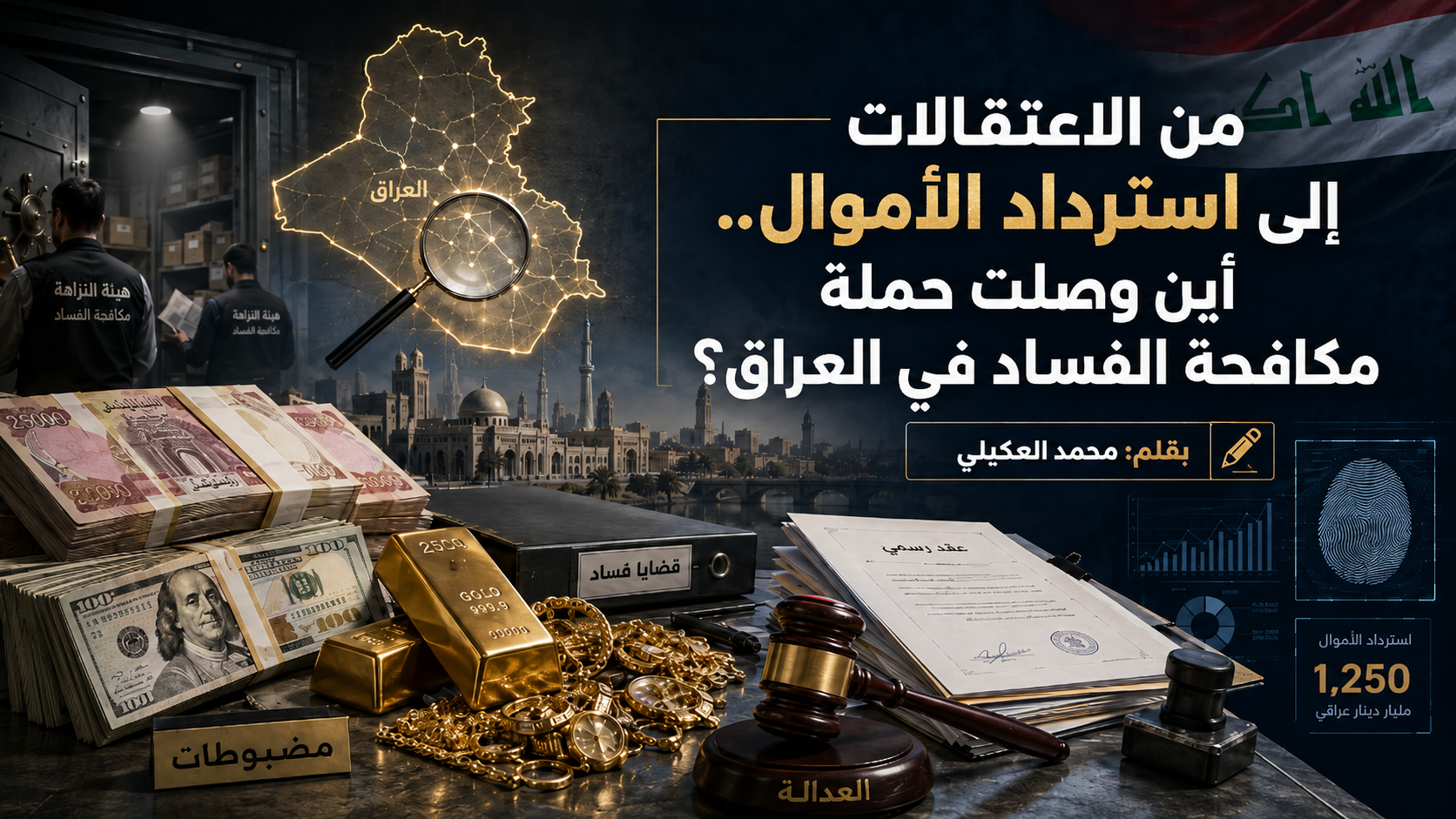
Recent developments have clearly added momentum to the campaign. On August 16, Iraq’s judiciary announced, in coordination with the Kurdistan Region, the seizure of $20.34 million and 200 million Iraqi dinars, as well as the recovery of 60 kilograms of gold and seven vehicles, as part of the investigation into the detained Deputy Minister of Oil for Refining Affairs, Adnan al-Jumaili, and other parties implicated in the case. The investigating judge at the Central Anti-Corruption Criminal Court confirmed that efforts were continuing to pursue those involved and complete the necessary legal procedures.
This development is significant not only because of the size of the assets seized, but also because it came after weeks of successive operations. This suggests that the case did not stop with the initial arrest, but developed into an ongoing effort to trace money, assets and individuals linked to the investigation.
The Case That Opened Wider Doors
The case of Adnan al-Jumaili can be regarded as the most significant turning point in the current campaign. Following his arrest, investigations reportedly expanded to include a broader circle of officials and politicians, culminating in the large-scale operation that took place inside the Green Zone on June 28.
Reuters reported that forces from the Counter Terrorism Service executed judicial arrest warrants that led to the detention of 47 politicians and senior officials, while the Associated Press reported that the list included 12 sitting members of parliament after their parliamentary immunity had been lifted, in addition to current and former officials. The investigating judge said the original investigation concerned suspicions that state resources had been exploited for electoral activity and that government contracts had been used, directly or indirectly, to obtain commissions and personal benefits.
This is precisely what distinguishes the current campaign from many previous ones. The investigations have not remained confined to junior employees or low-level implementing officials, but have reached senior political, legislative and administrative positions.
From Seizing Money to Tracing Wealth
The second major development is that the authorities have not limited themselves to pursuing individuals. They have clearly begun tracing what is believed to be the financial proceeds of corruption.
On July 6, the Supreme Judicial Council announced the seizure of an additional 25 billion Iraqi dinars, $1 million and around five kilograms of gold jewellery in the al-Jumaili case. It said that, by that date, the total assets already seized amounted to 127 billion dinars and $24 million, in addition to real estate, vehicles and gold jewellery.
On July 13, the judiciary announced, in coordination with the Kurdistan Region, the recovery of 358 kilograms of gold in the same case, as well as the seizure of another 17 kilograms in a separate case. The total quantity of gold placed under legal control that day therefore reached 375 kilograms. The recovered gold was later handed over to the Central Bank of Iraq’s Issuance and Treasury Department.
On July 26, the judiciary announced the seizure of another 27 billion dinars that had been hidden with several individuals, stressing that investigations were continuing in order to identify the remaining parties involved.
Then came the August 16 operation, which resulted in the seizure of additional cash, gold and vehicles.
It is important not to simply add all these figures together in order to produce a single total, because some judicial statements used cumulative figures, while some newly seized assets may already have been included in later totals. What matters more than the final number is the pattern revealed by the sequence of announcements: the investigation has increasingly focused on following the financial trail of corruption instead of stopping at the arrest of suspects.
This may be the most important positive feature of the campaign so far. Financial corruption is not truly confronted merely by putting people in prison, but by depriving the networks benefiting from corruption of the money, property and assets they have accumulated.
What Has the Campaign Actually Achieved?
After roughly one hundred days, four clear shifts can be identified.
The first is the breaking of the political barrier. Judicial warrants have reached lawmakers and senior officials, sending the message that official position or political immunity does not constitute an absolute shield against investigation.
The second is the move toward asset recovery. The campaign is no longer based solely on arrests, but increasingly on tracing cash, gold, property, vehicles and other assets.
The third is the use of several state institutions within a single process, including the judiciary, security agencies, the Central Bank and coordination mechanisms with the Kurdistan Region.
The fourth is that the campaign has succeeded, within a relatively short period, in placing anti-corruption efforts at the centre of Iraq’s political debate. In its assessment of the government’s first one hundred days, the administration argued that the issue had moved from political rhetoric to a process based on oversight, recovery of public funds and accountability for those involved.
However, this remains the government’s own assessment and that of its advisers. It will ultimately need to be measured against the independent results produced by the courts and oversight institutions.
But Where Is the Main Weakness?
Despite the scale of the arrests and assets seized, there remains a fundamental gap between an anti-corruption campaign driven by security and judicial action and a genuine structural reform programme.
Arresting an official accused of inflating a government contract addresses the result of corruption, but does not necessarily reform the system that allowed the contract to be inflated in the first place.
Recovering millions of dollars returns money to the state, but it does not prevent another official from using the same mechanism years later if procurement systems, oversight procedures and political financing remain unchanged.
The Greatest Risk: Political Selectivity
The greatest test for the campaign will not be whether it can arrest political opponents, but whether it can reach suspects regardless of their position, alliances or affiliations.
For years, corruption in Iraq has been closely linked to a broad system of power-sharing, influence, government contracts and political financing. Any campaign that creates the impression that it is targeting one political faction while protecting another will lose public confidence, no matter how much money it recovers.
This concern is not theoretical. The Associated Press has noted that corruption cases in Iraq have frequently intersected with struggles over political power and influence. That makes judicial independence, evidentiary transparency and procedural clarity central to protecting the campaign from accusations of political retaliation.
The principle should therefore be simple: no immunity for corruption, no conviction before a court ruling, and no exemptions based on political affiliation.
Numbers Alone Do Not Mean Iraq Has Overcome the Problem
Despite the improvement recorded by Iraq in the 2025 Corruption Perceptions Index, the country still scored only 28 out of 100 and ranked 136th out of 182 countries. This confirms that corruption remains a structural problem rather than merely a collection of individual cases.
The United Nations Development Programme described Iraq’s improvement in the index as the beginning of a reform process that needs to be translated into institutional trust, while Transparency International has stressed that combating corruption across the region requires strong and independent oversight institutions, greater transparency, reforms concerning beneficial ownership, and stronger accountability mechanisms.
This means that the al-Zaidi government’s campaign, regardless of how forceful it becomes, will not be able to eliminate corruption if it remains an exceptional effort tied to the political will of a single prime minister.
The campaign’s true value will be measured by whether it builds a system capable of continuing after he leaves office.
From an Anti-Corruption “Campaign” to an Anti-Corruption “System”
The next phase should move in three parallel directions.
First, judicial prosecutions and the recovery of assets must continue, while the results of completed cases should be published in a way that allows the public to understand what happened and how state funds were wasted.
Second, contracts and projects that investigations have identified as problematic should be reviewed, while the government procurement system should be redesigned so that tenders, winning companies, contract values and subsequent amendments become more transparent.
Third, Iraq needs a financial information framework capable of linking an official’s declared assets with property, companies, bank accounts, vehicles and other assets registered either in their own name or in the names of associated individuals. Greater attention should also be given to unexplained wealth and illicit enrichment investigations.
The Federal Commission of Integrity has already launched a 2026 campaign encouraging the reporting of inflated wealth and illicit enrichment across state institutions, including the oil sector. This could become the preventive arm that complements the judiciary’s enforcement role.
Recovering Money Matters More Than Images of Seized Cash
There is an important distinction between “seizing” assets and permanently “recovering” them for the state treasury.
Assets seized during an investigation remain tied to legal proceedings and may require final court rulings before their illicit origin can be established and they can be legally confiscated. Images of piles of dollars and gold should therefore not become the sole measure of success.
Success should ultimately be measured by how much money is actually returned to the state treasury once trials are concluded, how many wasteful contracts are stopped, and how much public money is prevented from being stolen in the first place.
Institutionally, preventing the theft of one billion dinars before it happens is more valuable than recovering the same billion after years of investigation.
Why Does the Campaign Look Different So Far?
The most encouraging indicator is not the volume of assets seized, but the speed with which investigations have moved from an individual to a wider network, from that network to financial assets, from Baghdad to other provinces and the Kurdistan Region, and from confessions to arrest warrants and the lifting of parliamentary immunity.
The continued emergence of newly seized assets weeks after the first operations also suggests that the investigations did not end when the initial media attention faded.
Yet this strength also carries a risk. If the campaign becomes tied to a single case or to the testimony of one individual, it may lose momentum once that particular network has been exhausted.
The government therefore needs to transform the experience accumulated in the current case into a permanent model that can be applied across electricity, customs, border crossings, banking, public procurement, land, investment projects and other sectors.
A successful anti-corruption battle is not one in which prisons are simply filled with corrupt officials.
It is one in which state institutions are designed in a way that makes corruption harder to commit, faster to detect, and almost impossible to conceal financially.
But after one hundred days of the new government, the most important question is no longer: How many people have been arrested? Or how many millions of dollars have been seized?
The real question is whether the state has actually begun dismantling the system of corruption, or whether Iraq is witnessing a powerful campaign in its early stages that still needs to evolve from arrests and seizures into a permanent institutional system capable of preventing corruption from being reproduced.
Recent developments have clearly added momentum to the campaign. On August 16, Iraq’s judiciary announced, in coordination with the Kurdistan Region, the seizure of $20.34 million and 200 million Iraqi dinars, as well as the recovery of 60 kilograms of gold and seven vehicles, as part of the investigation into the detained Deputy Minister of Oil for Refining Affairs, Adnan al-Jumaili, and other parties implicated in the case. The investigating judge at the Central Anti-Corruption Criminal Court confirmed that efforts were continuing to pursue those involved and complete the necessary legal procedures.
This development is significant not only because of the size of the assets seized, but also because it came after weeks of successive operations. This suggests that the case did not stop with the initial arrest, but developed into an ongoing effort to trace money, assets and individuals linked to the investigation.
The Case That Opened Wider Doors
The case of Adnan al-Jumaili can be regarded as the most significant turning point in the current campaign. Following his arrest, investigations reportedly expanded to include a broader circle of officials and politicians, culminating in the large-scale operation that took place inside the Green Zone on June 28.
Reuters reported that forces from the Counter Terrorism Service executed judicial arrest warrants that led to the detention of 47 politicians and senior officials, while the Associated Press reported that the list included 12 sitting members of parliament after their parliamentary immunity had been lifted, in addition to current and former officials. The investigating judge said the original investigation concerned suspicions that state resources had been exploited for electoral activity and that government contracts had been used, directly or indirectly, to obtain commissions and personal benefits.
This is precisely what distinguishes the current campaign from many previous ones. The investigations have not remained confined to junior employees or low-level implementing officials, but have reached senior political, legislative and administrative positions.
From Seizing Money to Tracing Wealth
The second major development is that the authorities have not limited themselves to pursuing individuals. They have clearly begun tracing what is believed to be the financial proceeds of corruption.
On July 6, the Supreme Judicial Council announced the seizure of an additional 25 billion Iraqi dinars, $1 million and around five kilograms of gold jewellery in the al-Jumaili case. It said that, by that date, the total assets already seized amounted to 127 billion dinars and $24 million, in addition to real estate, vehicles and gold jewellery.
On July 13, the judiciary announced, in coordination with the Kurdistan Region, the recovery of 358 kilograms of gold in the same case, as well as the seizure of another 17 kilograms in a separate case. The total quantity of gold placed under legal control that day therefore reached 375 kilograms. The recovered gold was later handed over to the Central Bank of Iraq’s Issuance and Treasury Department.
On July 26, the judiciary announced the seizure of another 27 billion dinars that had been hidden with several individuals, stressing that investigations were continuing in order to identify the remaining parties involved.
Then came the August 16 operation, which resulted in the seizure of additional cash, gold and vehicles.
It is important not to simply add all these figures together in order to produce a single total, because some judicial statements used cumulative figures, while some newly seized assets may already have been included in later totals. What matters more than the final number is the pattern revealed by the sequence of announcements: the investigation has increasingly focused on following the financial trail of corruption instead of stopping at the arrest of suspects.
This may be the most important positive feature of the campaign so far. Financial corruption is not truly confronted merely by putting people in prison, but by depriving the networks benefiting from corruption of the money, property and assets they have accumulated.
What Has the Campaign Actually Achieved?
After roughly one hundred days, four clear shifts can be identified.
The first is the breaking of the political barrier. Judicial warrants have reached lawmakers and senior officials, sending the message that official position or political immunity does not constitute an absolute shield against investigation.
The second is the move toward asset recovery. The campaign is no longer based solely on arrests, but increasingly on tracing cash, gold, property, vehicles and other assets.
The third is the use of several state institutions within a single process, including the judiciary, security agencies, the Central Bank and coordination mechanisms with the Kurdistan Region.
The fourth is that the campaign has succeeded, within a relatively short period, in placing anti-corruption efforts at the centre of Iraq’s political debate. In its assessment of the government’s first one hundred days, the administration argued that the issue had moved from political rhetoric to a process based on oversight, recovery of public funds and accountability for those involved.
However, this remains the government’s own assessment and that of its advisers. It will ultimately need to be measured against the independent results produced by the courts and oversight institutions.
But Where Is the Main Weakness?
Despite the scale of the arrests and assets seized, there remains a fundamental gap between an anti-corruption campaign driven by security and judicial action and a genuine structural reform programme.
Arresting an official accused of inflating a government contract addresses the result of corruption, but does not necessarily reform the system that allowed the contract to be inflated in the first place.
Recovering millions of dollars returns money to the state, but it does not prevent another official from using the same mechanism years later if procurement systems, oversight procedures and political financing remain unchanged.
The Greatest Risk: Political Selectivity
The greatest test for the campaign will not be whether it can arrest political opponents, but whether it can reach suspects regardless of their position, alliances or affiliations.
For years, corruption in Iraq has been closely linked to a broad system of power-sharing, influence, government contracts and political financing. Any campaign that creates the impression that it is targeting one political faction while protecting another will lose public confidence, no matter how much money it recovers.
This concern is not theoretical. The Associated Press has noted that corruption cases in Iraq have frequently intersected with struggles over political power and influence. That makes judicial independence, evidentiary transparency and procedural clarity central to protecting the campaign from accusations of political retaliation.
The principle should therefore be simple: no immunity for corruption, no conviction before a court ruling, and no exemptions based on political affiliation.
Numbers Alone Do Not Mean Iraq Has Overcome the Problem
Despite the improvement recorded by Iraq in the 2025 Corruption Perceptions Index, the country still scored only 28 out of 100 and ranked 136th out of 182 countries. This confirms that corruption remains a structural problem rather than merely a collection of individual cases.
The United Nations Development Programme described Iraq’s improvement in the index as the beginning of a reform process that needs to be translated into institutional trust, while Transparency International has stressed that combating corruption across the region requires strong and independent oversight institutions, greater transparency, reforms concerning beneficial ownership, and stronger accountability mechanisms.
This means that the al-Zaidi government’s campaign, regardless of how forceful it becomes, will not be able to eliminate corruption if it remains an exceptional effort tied to the political will of a single prime minister.
The campaign’s true value will be measured by whether it builds a system capable of continuing after he leaves office.
From an Anti-Corruption “Campaign” to an Anti-Corruption “System”
The next phase should move in three parallel directions.
First, judicial prosecutions and the recovery of assets must continue, while the results of completed cases should be published in a way that allows the public to understand what happened and how state funds were wasted.
Second, contracts and projects that investigations have identified as problematic should be reviewed, while the government procurement system should be redesigned so that tenders, winning companies, contract values and subsequent amendments become more transparent.
Third, Iraq needs a financial information framework capable of linking an official’s declared assets with property, companies, bank accounts, vehicles and other assets registered either in their own name or in the names of associated individuals. Greater attention should also be given to unexplained wealth and illicit enrichment investigations.
The Federal Commission of Integrity has already launched a 2026 campaign encouraging the reporting of inflated wealth and illicit enrichment across state institutions, including the oil sector. This could become the preventive arm that complements the judiciary’s enforcement role.
Recovering Money Matters More Than Images of Seized Cash
There is an important distinction between “seizing” assets and permanently “recovering” them for the state treasury.
Assets seized during an investigation remain tied to legal proceedings and may require final court rulings before their illicit origin can be established and they can be legally confiscated. Images of piles of dollars and gold should therefore not become the sole measure of success.
Success should ultimately be measured by how much money is actually returned to the state treasury once trials are concluded, how many wasteful contracts are stopped, and how much public money is prevented from being stolen in the first place.
Institutionally, preventing the theft of one billion dinars before it happens is more valuable than recovering the same billion after years of investigation.
Why Does the Campaign Look Different So Far?
The most encouraging indicator is not the volume of assets seized, but the speed with which investigations have moved from an individual to a wider network, from that network to financial assets, from Baghdad to other provinces and the Kurdistan Region, and from confessions to arrest warrants and the lifting of parliamentary immunity.
The continued emergence of newly seized assets weeks after the first operations also suggests that the investigations did not end when the initial media attention faded.
Yet this strength also carries a risk. If the campaign becomes tied to a single case or to the testimony of one individual, it may lose momentum once that particular network has been exhausted.
The government therefore needs to transform the experience accumulated in the current case into a permanent model that can be applied across electricity, customs, border crossings, banking, public procurement, land, investment projects and other sectors.
A successful anti-corruption battle is not one in which prisons are simply filled with corrupt officials.
It is one in which state institutions are designed in a way that makes corruption harder to commit, faster to detect, and almost impossible to conceal financially.
Share Article
For Context
Related reads from the same topic or latest developments