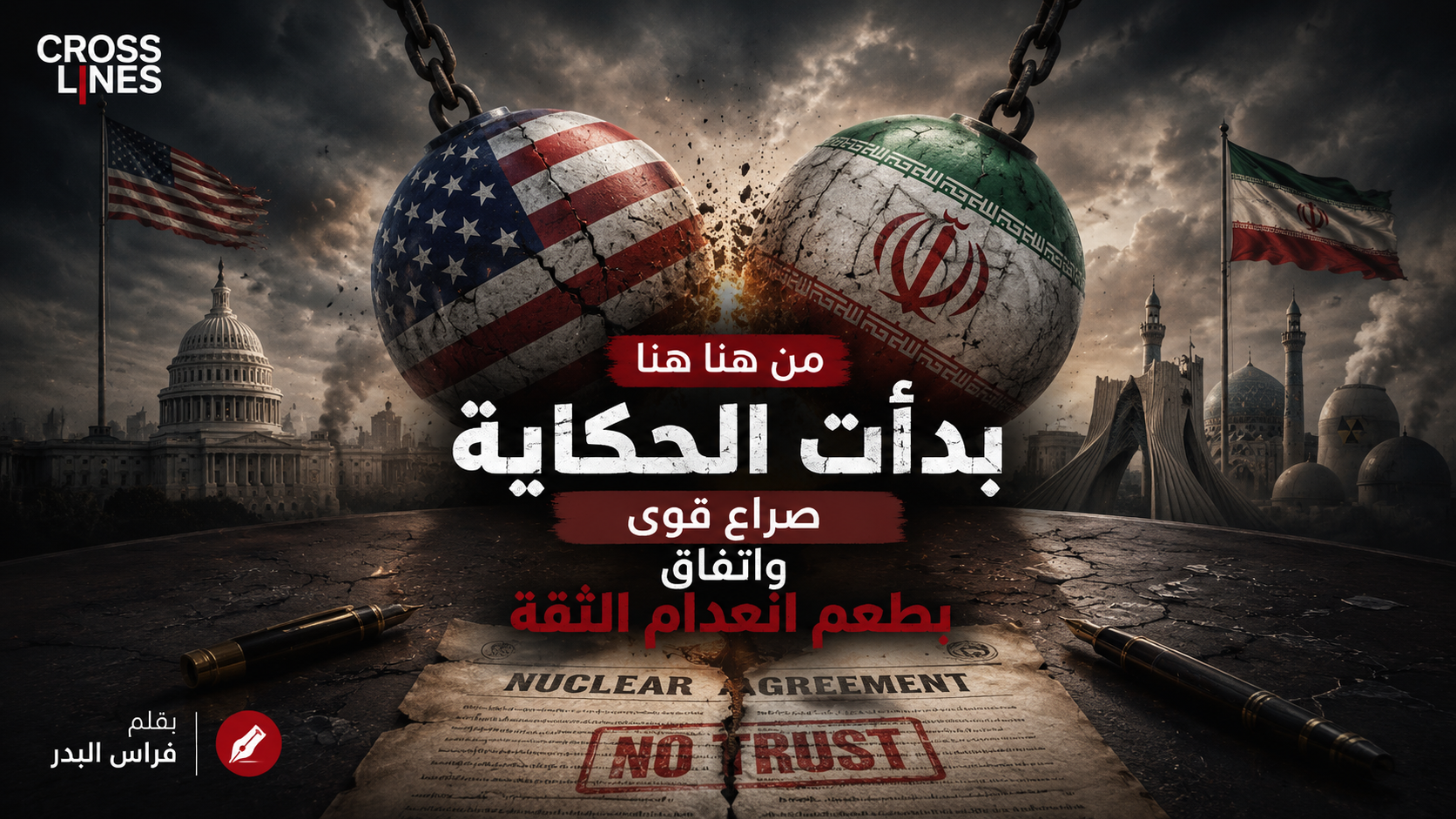
This is where the story began... a power struggle and an agreement tinged with mistrust.

Firas Majid Al-Badr
Writer at CROSS LINES
Who is maneuvering against whom? Who is playing whom? Who holds the reins of power and who doesn't?
Who is maneuvering against whom? Who is playing whom? Who holds the reins of power and who doesn't? These are questions that require us to look back a little to the roots of this historical conflict between the two sides, going back 73 years, specifically to 1953, when the CIA supported a military coup that overthrew the democratically elected government of Prime Minister Mohammad Mosaddegh and reinstated Shah Mohammad Reza Pahlavi to power. This was done to secure its oil interests and distance Iran from Soviet influence during the war. This arrangement didn't last long, however, after the Islamic Revolution in Iran, which seized power and ousted the Shah in 1979, followed by the American break in relations after the infamous hostage crisis. This is where the story began.
Fast forward to the year 2026, which we are currently living through. After about 100 days of war in the Middle East, both sides have suffered its consequences, particularly the Gulf states, Europe, and Asia, and ultimately everyone, due to the closure of the Strait of Hormuz and the rise in fuel and oil prices. The escalating energy crisis, coupled with soaring prices for imported goods and commodities, and the resulting travel restrictions and movement limitations, are among the many consequences of the war.
The turning point in this war was not Iranian ballistic missiles, nor precise American airstrikes. Even the Israeli army, with its advanced aircraft and smart weapons—ranked 15th globally and second regionally after Turkey according to the latest Global Firepower ranking, which assesses conventional military capabilities—did not succeed. Rather, the most significant challenge was the Strait of Hormuz, the quagmire in which Trump found himself entangled, its closed waterways to ships and tankers unable to reopen even after forming an international coalition. This strait became Iran's winning card, the one it used in negotiations, making it the primary bargaining chip in the nuclear issue, which is the core of the conflict.
Anyone examining the origins of Trump's decision to wage war on Iran will find traces of his actions dating back to his first term in office. This began with his withdrawal from the nuclear agreement signed by Obama and the reimposition of harsh economic sanctions, a policy known as "maximum pressure." The intention was fundamentally to antagonize Tehran, extract concessions from it, or at least to humiliate and diminish it, turning it into a pliable tool in Washington's hands in the Middle East. The United States seeks to dominate and control this region, seizing its resources, including oil, and defending its ally Israel without encountering any rival power.
Now, as we approach the final stages of the agreement between the two sides, what can we conclude from these events, and what will America gain from the deal? First, Washington will transfer nuclear waste and enriched uranium to the United States, preventing Tehran from reaching high enrichment levels. Second, the agreement will fully reopen the Strait of Hormuz and jointly manage it with Iran. Furthermore, the issue of proxies and the ballistic missile program will be curtailed. On the other hand, what will Iran gain? Let's see. Iran will succeed in ending the war that has drained it economically, militarily, and logistically, and this will give it a new opportunity to continue its ideological mobilization in the region and to promote that ideology for the benefit of other countries. It will also receive $24 billion in frozen assets as an initial step, according to the Washington Post, in addition to the $300 billion Iran reconstruction plan, the implementation mechanism of which will be determined in the final agreement. Furthermore, it has forced Israel to end the war in Lebanon and for the Gaza agreement to take effect.
On paper and on the ground, the United States and Iran have not achieved a strategic victory. Rather, both sides have suffered greatly as a result of this futile war, as described by analysts and security experts. Iran has the advantage in confronting American and Israeli military and technological superiority with an Iranian doctrine based on "war of attrition and endurance." We see that Iran has maintained its air and missile capabilities and has been a strong rival to the two strongest military powers in the world today in terms of combat readiness and advanced capabilities. It has also significantly damaged American bases in the Middle East, closed the Strait of Hormuz, and was not forced into diplomatic negotiations but rather invited to them. On the other hand, we see that America has not escaped the mistakes of the Vietnam, Afghanistan, and Iraq wars, from which it did not achieve gains contrary to what it expected. According to military data, its ally Israel was unable to achieve what it aspired to in southern Lebanon against its traditional ally Hezbollah, which played a major role in this battle, which has not ended here but will have future repercussions and may be renewed in the near future.
Fast forward to the year 2026, which we are currently living through. After about 100 days of war in the Middle East, both sides have suffered its consequences, particularly the Gulf states, Europe, and Asia, and ultimately everyone, due to the closure of the Strait of Hormuz and the rise in fuel and oil prices. The escalating energy crisis, coupled with soaring prices for imported goods and commodities, and the resulting travel restrictions and movement limitations, are among the many consequences of the war.
The turning point in this war was not Iranian ballistic missiles, nor precise American airstrikes. Even the Israeli army, with its advanced aircraft and smart weapons—ranked 15th globally and second regionally after Turkey according to the latest Global Firepower ranking, which assesses conventional military capabilities—did not succeed. Rather, the most significant challenge was the Strait of Hormuz, the quagmire in which Trump found himself entangled, its closed waterways to ships and tankers unable to reopen even after forming an international coalition. This strait became Iran's winning card, the one it used in negotiations, making it the primary bargaining chip in the nuclear issue, which is the core of the conflict.
Anyone examining the origins of Trump's decision to wage war on Iran will find traces of his actions dating back to his first term in office. This began with his withdrawal from the nuclear agreement signed by Obama and the reimposition of harsh economic sanctions, a policy known as "maximum pressure." The intention was fundamentally to antagonize Tehran, extract concessions from it, or at least to humiliate and diminish it, turning it into a pliable tool in Washington's hands in the Middle East. The United States seeks to dominate and control this region, seizing its resources, including oil, and defending its ally Israel without encountering any rival power.
Now, as we approach the final stages of the agreement between the two sides, what can we conclude from these events, and what will America gain from the deal? First, Washington will transfer nuclear waste and enriched uranium to the United States, preventing Tehran from reaching high enrichment levels. Second, the agreement will fully reopen the Strait of Hormuz and jointly manage it with Iran. Furthermore, the issue of proxies and the ballistic missile program will be curtailed. On the other hand, what will Iran gain? Let's see. Iran will succeed in ending the war that has drained it economically, militarily, and logistically, and this will give it a new opportunity to continue its ideological mobilization in the region and to promote that ideology for the benefit of other countries. It will also receive $24 billion in frozen assets as an initial step, according to the Washington Post, in addition to the $300 billion Iran reconstruction plan, the implementation mechanism of which will be determined in the final agreement. Furthermore, it has forced Israel to end the war in Lebanon and for the Gaza agreement to take effect.
On paper and on the ground, the United States and Iran have not achieved a strategic victory. Rather, both sides have suffered greatly as a result of this futile war, as described by analysts and security experts. Iran has the advantage in confronting American and Israeli military and technological superiority with an Iranian doctrine based on "war of attrition and endurance." We see that Iran has maintained its air and missile capabilities and has been a strong rival to the two strongest military powers in the world today in terms of combat readiness and advanced capabilities. It has also significantly damaged American bases in the Middle East, closed the Strait of Hormuz, and was not forced into diplomatic negotiations but rather invited to them. On the other hand, we see that America has not escaped the mistakes of the Vietnam, Afghanistan, and Iraq wars, from which it did not achieve gains contrary to what it expected. According to military data, its ally Israel was unable to achieve what it aspired to in southern Lebanon against its traditional ally Hezbollah, which played a major role in this battle, which has not ended here but will have future repercussions and may be renewed in the near future.
🔗 Share Article
For Context
Related reads from the same topic or latest developments