ViewsAvailable in English
When the Algorithm Becomes a General: Artificial Intelligence and Humanity’s Test Before the Most Dangerous Transformation of Warfare
Editorial
Cross Lines editing
Source
CROSS LINES

Doaa Hazza Al-Jabri
Writer at CROSS LINES
The most troubling questions raised by artificial intelligence are no longer about what it can do, but about what we may allow it to decide.
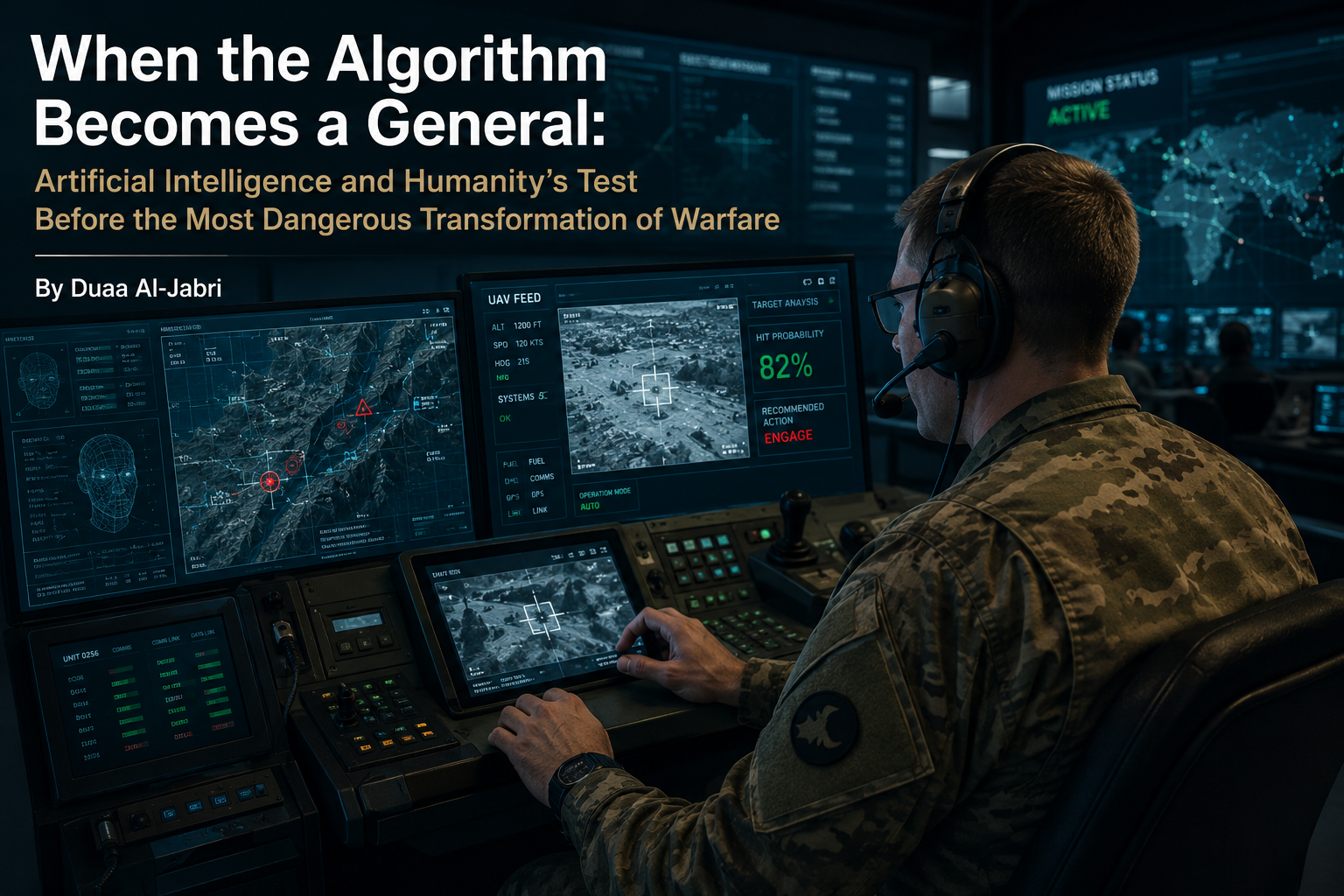
The most troubling questions raised by artificial intelligence are no longer about what it can do, but about what we may allow it to decide. When the “algorithm” enters the military operations room, the issue is no longer simply a technological evolution in the tools of warfare; it becomes a question about humanity itself: Can the mind that created the machine retain its moral authority when the machine becomes faster than its creator at detecting threats, selecting targets, and proposing responses?
In its traditional form, war required a human being to make the decision, a soldier to carry it out, and a clear chain of responsibility. AI-assisted warfare, however, opens a different door—one through which the interval between identifying a target and deciding to destroy it may become too short for conscience to intervene.
Here lies the great paradox: we are building more precise machines in an effort to reduce human error, yet at the same time, we may be creating a less human form of warfare. Computational precision does not amount to moral insight.
Pope Leo XIV captured the essence of this danger in his encyclical Dilexi Te, warning that autonomous weapons systems could make warfare easier to conduct while diminishing meaningful human oversight. He consequently called for the use of artificial intelligence in warfare to be subjected to the strictest ethical constraints. Most importantly, he stressed that lethal or irreversible decisions should not be entrusted to artificial systems, because moral judgment is not a mathematical calculation. It involves conscience, responsibility, and the recognition of the other as a human being.
The significance of this warning extends far beyond the religious sphere. It touches on what may become one of the most serious challenges to international security: Who is responsible when an algorithm kills?
If an AI system mistakenly identifies a target, who should be held accountable? The programmer? The company? The military commander? The state? Or will responsibility disappear behind the cold phrase “algorithmic error”?
The problem is that war does not always give us the opportunity to correct mistakes. A faulty decision in software can often be reversed, but a wrong decision on the battlefield may leave behind a home without its family, a child without a father, and a city scarred by wounds that no system update can erase.
The real struggle, therefore, is not between humans and machines. It is between the human being who uses technology and the human being who allows technology to use them.
Artificial intelligence can be a tool for saving lives just as easily as it can become a tool for counting them. It can help prevent war, but it can also make warfare faster, easier, and less politically costly for those who decide to wage it.
Pope Leo XIV captured this idea in a particularly striking call to “disarm artificial intelligence”—a warning that technological superiority must not automatically become a right to domination, and that the race for increasingly powerful algorithms must not become a new version of the arms race.
Ultimately, the question will not be: Will machines become more intelligent than humans?
The more frightening question will be: Will human beings become less wise as their machines become more intelligent?
Civilizations do not fall because they fail to invent the future. They fall when they possess enough power to create it, but not enough wisdom to know where they must stop.
In its traditional form, war required a human being to make the decision, a soldier to carry it out, and a clear chain of responsibility. AI-assisted warfare, however, opens a different door—one through which the interval between identifying a target and deciding to destroy it may become too short for conscience to intervene.
Here lies the great paradox: we are building more precise machines in an effort to reduce human error, yet at the same time, we may be creating a less human form of warfare. Computational precision does not amount to moral insight.
Pope Leo XIV captured the essence of this danger in his encyclical Dilexi Te, warning that autonomous weapons systems could make warfare easier to conduct while diminishing meaningful human oversight. He consequently called for the use of artificial intelligence in warfare to be subjected to the strictest ethical constraints. Most importantly, he stressed that lethal or irreversible decisions should not be entrusted to artificial systems, because moral judgment is not a mathematical calculation. It involves conscience, responsibility, and the recognition of the other as a human being.
The significance of this warning extends far beyond the religious sphere. It touches on what may become one of the most serious challenges to international security: Who is responsible when an algorithm kills?
If an AI system mistakenly identifies a target, who should be held accountable? The programmer? The company? The military commander? The state? Or will responsibility disappear behind the cold phrase “algorithmic error”?
The problem is that war does not always give us the opportunity to correct mistakes. A faulty decision in software can often be reversed, but a wrong decision on the battlefield may leave behind a home without its family, a child without a father, and a city scarred by wounds that no system update can erase.
The real struggle, therefore, is not between humans and machines. It is between the human being who uses technology and the human being who allows technology to use them.
Artificial intelligence can be a tool for saving lives just as easily as it can become a tool for counting them. It can help prevent war, but it can also make warfare faster, easier, and less politically costly for those who decide to wage it.
Pope Leo XIV captured this idea in a particularly striking call to “disarm artificial intelligence”—a warning that technological superiority must not automatically become a right to domination, and that the race for increasingly powerful algorithms must not become a new version of the arms race.
Ultimately, the question will not be: Will machines become more intelligent than humans?
The more frightening question will be: Will human beings become less wise as their machines become more intelligent?
Civilizations do not fall because they fail to invent the future. They fall when they possess enough power to create it, but not enough wisdom to know where they must stop.
Share Article
For Context
Related reads from the same topic or latest developments