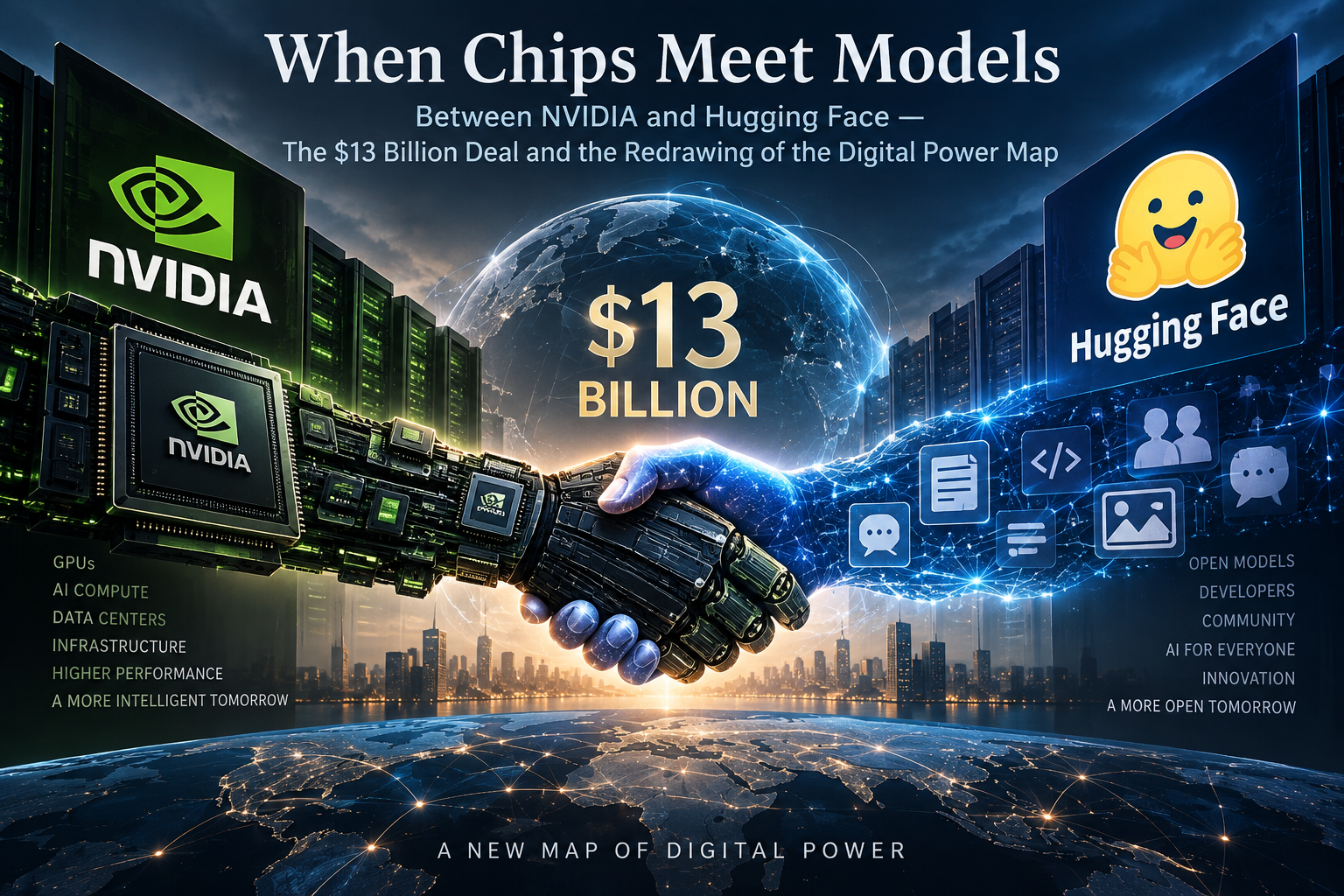
When Chips Meet Models: Between NVIDIA and Hugging Face — The $13 Billion Deal and the Redrawing of the Digital Power Map

Doaa Hazza Al-Jabri
Writer at CROSS LINES
In today’s rapidly evolving global economy, some deals are measured not by the amount paid, but by what they reveal about fear, ambition, and a race that the world’s major powers do not want to see decided before it has truly begun.
In today’s rapidly evolving global economy, some deals are measured not by the amount paid, but by what they reveal about fear, ambition, and a race that the world’s major powers do not want to see decided before it has truly begun.
When NVIDIA, the chipmaker and artificial intelligence computing giant, puts roughly $13 billion on the table to acquire Hugging Face, a company specializing in open artificial intelligence, the figure may at first appear to represent the valuation of a major and influential company. Viewed from another angle, however, it looks more like the price of securing a position within an entire future.
This is no longer simply about a technology company buying an AI platform. It is something far more complex: a company that built much of its power on the chips that give machines the ability to compute moving closer to a platform where developers, models, and tools come together—giving that computing power the ability to think, be applied, and spread.
That raises the larger question: Why would NVIDIA want to acquire it now?
The answer is that the rules of the game have changed.
At the beginning of the artificial intelligence race, the world was captivated by the idea of the most powerful model. Whoever possessed the smartest model—the one most capable of writing, analyzing, and programming—appeared to be moving closer to the throne of the future.
But the future is not always decided at the top of the pyramid. Sometimes it is decided below, within the infrastructure that makes everything possible: chips, data centers, energy, and the spaces where millions of developers encounter models, test them, modify them, reshape them, and then push them out into the world.
This is where the importance of Hugging Face lies. The issue is not simply that the platform hosts a vast number of different models, but that it has become part of the fabric through which open artificial intelligence moves. Whoever owns the fabric does not necessarily own every thread, but becomes much closer to understanding the direction in which the entire fabric is moving.
That is what makes this deal far more significant than an ordinary piece of business news.
NVIDIA today is no longer standing merely at the door of the machine. It is moving closer to the door behind the machine. The difference between the two is the difference between selling the tools of the future and attempting to be present in the very process through which that future will be built.
Why does this particular moment matter so much for such a move?
The answer lies in the same underlying reality: artificial intelligence is entering a stage in which technological power alone is no longer enough. Another race is unfolding in the shadows—a race to control the AI ecosystem before its balance of power becomes firmly established.
Major companies want their own chips, models, data centers, platforms, and developer communities that will build the next generation of applications. Each player is trying to secure its position before these elements evolve from open markets into deeply entrenched structures whose balance of power becomes difficult to change.
Europe appears right in the middle of this picture.
It is a continent that wants to speak of digital sovereignty, of controlling its own technological destiny, and of avoiding a future in which it becomes merely a consumer of technologies produced by other powers. Yet the paradox is that a significant part of the ecosystem that could help Europe build that sovereignty may be moving toward American ownership.
This is no small contradiction.
Digital sovereignty does not simply mean having laws that regulate technology. It means possessing the ability to produce, operate, and develop technology without placing its key outside your own borders.
The deal therefore becomes a European question as well: Can Europe use American technological power to build strength of its own? Or will dependence on that power make Europe increasingly tied to it?
Both possibilities exist, which makes the situation far more complicated than a simple story of winners and losers.
NVIDIA could provide Hugging Face with enormous resources, potentially accelerating innovation, advancing open models, and expanding developers’ capabilities. On the other hand, ownership of one of the most important gateways to open AI would give NVIDIA a much deeper position within an ecosystem that was never merely a market for its chips.
This is where the questions begin that rarely appear in official statements.
What does it mean when the company controlling a fundamental part of the world’s computing power moves closer to the company at the center of the open-model community?
What happens when the chip moves closer to the model? When the model moves closer to the developer? And when the developer moves closer to the platform?
There may be no single answer today. But the history of technology teaches us that power does not always emerge from owning one thing. It often emerges when many things become interconnected.
That is why the most consequential aspect of this deal is not the money, but the direction.
It signals that the next phase of artificial intelligence may not be a battle over who owns the most famous model. Instead, it may be a struggle over who can position themselves across all the layers that make those models possible, scalable, and capable of reaching the world.
At that point, artificial intelligence becomes more than a technological revolution. It becomes a question of power, independence, security, and the future.
Those who controlled oil in the age of energy are not the same as those who control data in the age of algorithms. Those who controlled ports in the age of trade are not the same as those who control technological corridors in the age of artificial intelligence.
The geography of power has changed. Maps alone no longer determine where power resides. Another map has emerged—one that cannot be seen: a map of chips, servers, models, data, and platforms.
For precisely this reason, the NVIDIA–Hugging Face deal should not be read as the end of a story. It may instead mark the beginning of a new era in which the more troubling question becomes:
Who owns artificial intelligence?
And within that question lies another, perhaps even more consequential one:
Who owns the road that artificial intelligence must travel to reach the world?
When NVIDIA, the chipmaker and artificial intelligence computing giant, puts roughly $13 billion on the table to acquire Hugging Face, a company specializing in open artificial intelligence, the figure may at first appear to represent the valuation of a major and influential company. Viewed from another angle, however, it looks more like the price of securing a position within an entire future.
This is no longer simply about a technology company buying an AI platform. It is something far more complex: a company that built much of its power on the chips that give machines the ability to compute moving closer to a platform where developers, models, and tools come together—giving that computing power the ability to think, be applied, and spread.
That raises the larger question: Why would NVIDIA want to acquire it now?
The answer is that the rules of the game have changed.
At the beginning of the artificial intelligence race, the world was captivated by the idea of the most powerful model. Whoever possessed the smartest model—the one most capable of writing, analyzing, and programming—appeared to be moving closer to the throne of the future.
But the future is not always decided at the top of the pyramid. Sometimes it is decided below, within the infrastructure that makes everything possible: chips, data centers, energy, and the spaces where millions of developers encounter models, test them, modify them, reshape them, and then push them out into the world.
This is where the importance of Hugging Face lies. The issue is not simply that the platform hosts a vast number of different models, but that it has become part of the fabric through which open artificial intelligence moves. Whoever owns the fabric does not necessarily own every thread, but becomes much closer to understanding the direction in which the entire fabric is moving.
That is what makes this deal far more significant than an ordinary piece of business news.
NVIDIA today is no longer standing merely at the door of the machine. It is moving closer to the door behind the machine. The difference between the two is the difference between selling the tools of the future and attempting to be present in the very process through which that future will be built.
Why does this particular moment matter so much for such a move?
The answer lies in the same underlying reality: artificial intelligence is entering a stage in which technological power alone is no longer enough. Another race is unfolding in the shadows—a race to control the AI ecosystem before its balance of power becomes firmly established.
Major companies want their own chips, models, data centers, platforms, and developer communities that will build the next generation of applications. Each player is trying to secure its position before these elements evolve from open markets into deeply entrenched structures whose balance of power becomes difficult to change.
Europe appears right in the middle of this picture.
It is a continent that wants to speak of digital sovereignty, of controlling its own technological destiny, and of avoiding a future in which it becomes merely a consumer of technologies produced by other powers. Yet the paradox is that a significant part of the ecosystem that could help Europe build that sovereignty may be moving toward American ownership.
This is no small contradiction.
Digital sovereignty does not simply mean having laws that regulate technology. It means possessing the ability to produce, operate, and develop technology without placing its key outside your own borders.
The deal therefore becomes a European question as well: Can Europe use American technological power to build strength of its own? Or will dependence on that power make Europe increasingly tied to it?
Both possibilities exist, which makes the situation far more complicated than a simple story of winners and losers.
NVIDIA could provide Hugging Face with enormous resources, potentially accelerating innovation, advancing open models, and expanding developers’ capabilities. On the other hand, ownership of one of the most important gateways to open AI would give NVIDIA a much deeper position within an ecosystem that was never merely a market for its chips.
This is where the questions begin that rarely appear in official statements.
What does it mean when the company controlling a fundamental part of the world’s computing power moves closer to the company at the center of the open-model community?
What happens when the chip moves closer to the model? When the model moves closer to the developer? And when the developer moves closer to the platform?
There may be no single answer today. But the history of technology teaches us that power does not always emerge from owning one thing. It often emerges when many things become interconnected.
That is why the most consequential aspect of this deal is not the money, but the direction.
It signals that the next phase of artificial intelligence may not be a battle over who owns the most famous model. Instead, it may be a struggle over who can position themselves across all the layers that make those models possible, scalable, and capable of reaching the world.
At that point, artificial intelligence becomes more than a technological revolution. It becomes a question of power, independence, security, and the future.
Those who controlled oil in the age of energy are not the same as those who control data in the age of algorithms. Those who controlled ports in the age of trade are not the same as those who control technological corridors in the age of artificial intelligence.
The geography of power has changed. Maps alone no longer determine where power resides. Another map has emerged—one that cannot be seen: a map of chips, servers, models, data, and platforms.
For precisely this reason, the NVIDIA–Hugging Face deal should not be read as the end of a story. It may instead mark the beginning of a new era in which the more troubling question becomes:
Who owns artificial intelligence?
And within that question lies another, perhaps even more consequential one:
Who owns the road that artificial intelligence must travel to reach the world?
🔗 Share Article
For Context
Related reads from the same topic or latest developments