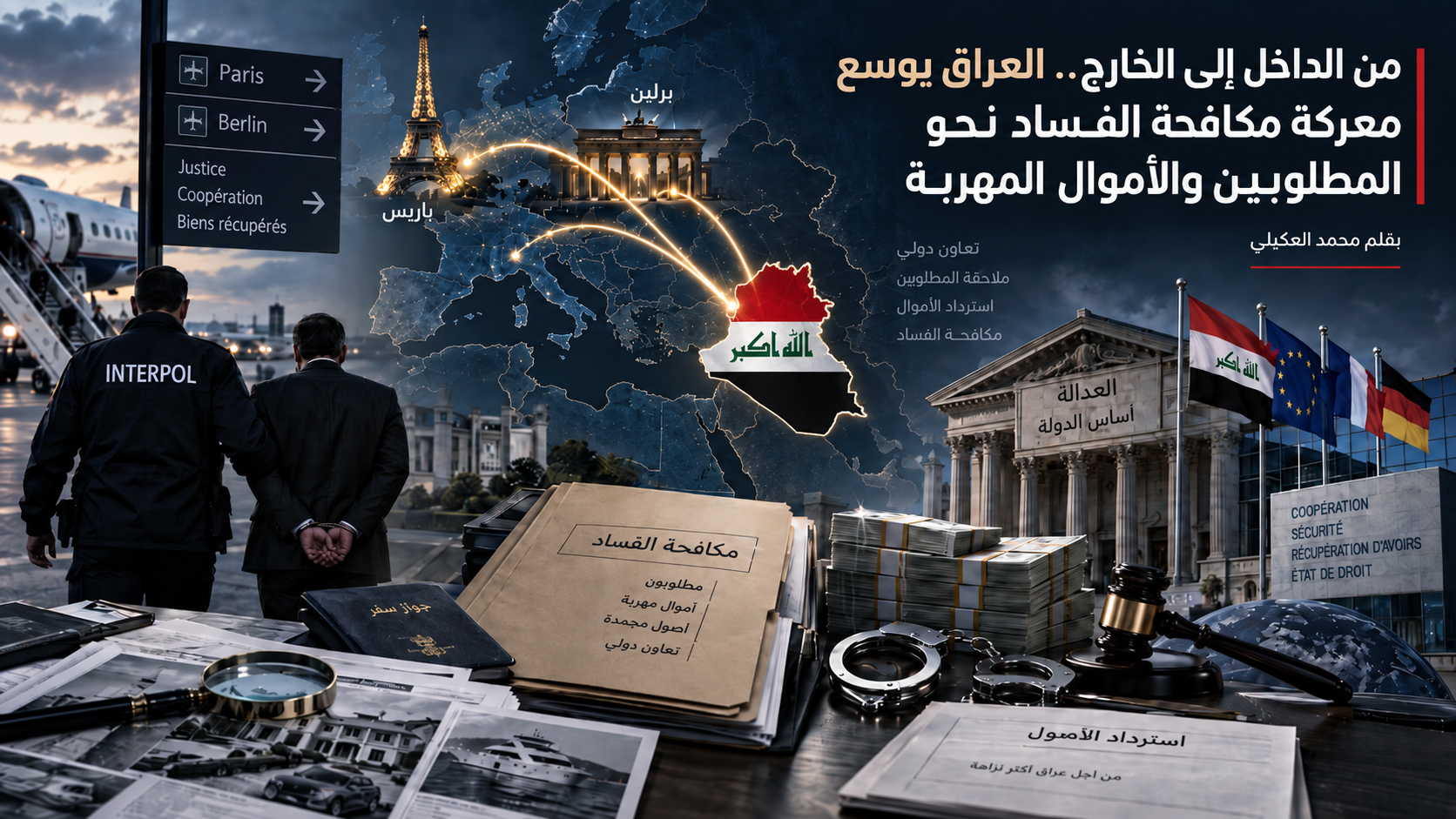
From Home to Abroad: Iraq Expands Its Anti-Corruption Drive to Fugitives and Smuggled Assets

Mohammed Al-Aqili
Writer at CROSS LINES
The article examines the anti-corruption component of Prime Minister Ali Al-Zaidi’s European tour and whether it could open a new avenue for international cooperation in pursuing individuals wanted on corruption charges and recovering stolen Iraqi funds.
Iraq’s anti-corruption campaign is no longer confined to domestic investigations or the pursuit of suspects inside the country. The Iraqi government has begun expanding its efforts abroad, drawing on international relations, legal agreements, and channels of security and judicial cooperation to pursue wanted individuals and recover funds and assets transferred out of Iraq as a result of corruption-related crimes.
This approach became particularly evident during Prime Minister Ali Faleh Al-Zaidi’s European tour of France and Germany. The visit was not limited to political, economic, and investment matters, but also included efforts related to combating corruption, recovering assets, and pursuing wanted individuals beyond Iraq’s borders.
In this context, Mohammed Ali Al-Lami, Chairman of the Federal Commission of Integrity and a member of the government delegation accompanying the prime minister, held meetings in Paris with officials from the French Anti-Corruption Agency, the French asset recovery agency, and representatives of the French Ministry of Justice. He also met with the President of the International Criminal Police Organization, INTERPOL.
Pursuit Beyond Borders
The significance of these meetings lies not so much in the institutions involved as in the nature of the issues discussed. Chief among them were tracking individuals wanted in corruption cases, locating funds and assets held outside Iraq, and accelerating the exchange of information and documents required to complete legal procedures for prosecution and recovery.
Against this backdrop, Iraq’s recent moves appear to represent an attempt to take the anti-corruption campaign to a new level—one that goes beyond issuing arrest warrants or court rulings inside Iraq and instead seeks to pursue both suspects and assets linked to corruption cases wherever they may be, with the ultimate goal of recovering them in accordance with international laws and agreements.
INTERPOL Joins the Pursuit
One of the most prominent aspects of Iraq’s efforts involves expanding cooperation with INTERPOL, which provides member states with tools to help track wanted individuals, exchange information, and identify their whereabouts.
The Iraqi side discussed with the President of INTERPOL mechanisms for strengthening coordination regarding individuals wanted in corruption cases, accelerating the exchange of relevant data, and activating direct points of contact to reduce the time required by traditional correspondence between institutions.
This step is particularly important given that some wanted individuals may move between several countries, hold foreign residency permits or citizenship, or attempt to exploit differences between national legal systems to obstruct extradition proceedings.
Tracking Smuggled Funds and Assets
The second major track of Iraq’s efforts concerns funds and assets transferred abroad—a process that may prove even more complicated than recovering the wanted individuals themselves.
Proceeds from corruption may move through multiple bank accounts or be converted into real estate, companies, investments, and other assets. They may also pass through several countries before reaching their final destination, making their detection dependent on specialized financial investigations and cooperation among banking, judicial, and regulatory authorities.
During the talks in France, the two sides discussed strengthening cooperation in tracing, freezing, seizing, confiscating, and ultimately recovering funds and assets.
Why France?
France’s involvement gives this effort a practical dimension because it has specialized institutions dedicated to combating corruption and recovering assets, as well as a legal and judicial framework from which Iraq could draw expertise in preparing cases that meet international requirements.
A Domestic Campaign With an International Reach
The international effort comes as the Iraqi government moves to expand its domestic anti-corruption campaign, making international pursuit a natural extension of those efforts.
As investigations, arrests, and the uncovering of corruption cases increase inside Iraq, so does the possibility that some individuals implicated in those cases may attempt to leave the country or transfer their assets abroad. This requires Iraqi institutions to develop a parallel capacity to act beyond the country’s borders.
Difficult Tests Ahead
This new approach, however, will face several challenges.
The first is the ability of Iraqi institutions to prepare strong and comprehensive legal files that can be submitted to foreign governments without shortcomings that could lead to the rejection of extradition or asset-recovery requests.
The second concerns the speed of information exchange among Iraqi institutions themselves. Any delay in gathering documents or inconsistencies in the information provided could affect proceedings abroad.
The third challenge is the need to distinguish criminal prosecution from political disputes, particularly because some wanted individuals may seek to portray the cases against them in their countries of residence as politically motivated.
After the European Tour
The real significance of Al-Zaidi’s European tour will not be measured by the number of meetings held, but by whether those meetings lead to permanent and direct mechanisms of cooperation between Iraq and the relevant international institutions.
Establishing effective channels with INTERPOL and French institutions responsible for combating corruption and recovering assets could provide Baghdad with additional tools in cases that, for years, have encountered difficulties once they crossed international borders.
The Real Battle Is in the Results
The success of the campaign will ultimately depend on tangible outcomes: securing the return of wanted individuals, freezing funds, recovering assets, enforcing judicial rulings, and closing the channels used to transfer illicit funds abroad.
If the government succeeds in delivering concrete results in these areas, Iraq’s anti-corruption campaign will have effectively entered a new phase—one based on pursuing those accused of corruption both inside and outside the country, and on establishing that leaving Iraq or transferring funds to another country does not mean the case is over
This approach became particularly evident during Prime Minister Ali Faleh Al-Zaidi’s European tour of France and Germany. The visit was not limited to political, economic, and investment matters, but also included efforts related to combating corruption, recovering assets, and pursuing wanted individuals beyond Iraq’s borders.
In this context, Mohammed Ali Al-Lami, Chairman of the Federal Commission of Integrity and a member of the government delegation accompanying the prime minister, held meetings in Paris with officials from the French Anti-Corruption Agency, the French asset recovery agency, and representatives of the French Ministry of Justice. He also met with the President of the International Criminal Police Organization, INTERPOL.
Pursuit Beyond Borders
The significance of these meetings lies not so much in the institutions involved as in the nature of the issues discussed. Chief among them were tracking individuals wanted in corruption cases, locating funds and assets held outside Iraq, and accelerating the exchange of information and documents required to complete legal procedures for prosecution and recovery.
Against this backdrop, Iraq’s recent moves appear to represent an attempt to take the anti-corruption campaign to a new level—one that goes beyond issuing arrest warrants or court rulings inside Iraq and instead seeks to pursue both suspects and assets linked to corruption cases wherever they may be, with the ultimate goal of recovering them in accordance with international laws and agreements.
INTERPOL Joins the Pursuit
One of the most prominent aspects of Iraq’s efforts involves expanding cooperation with INTERPOL, which provides member states with tools to help track wanted individuals, exchange information, and identify their whereabouts.
The Iraqi side discussed with the President of INTERPOL mechanisms for strengthening coordination regarding individuals wanted in corruption cases, accelerating the exchange of relevant data, and activating direct points of contact to reduce the time required by traditional correspondence between institutions.
This step is particularly important given that some wanted individuals may move between several countries, hold foreign residency permits or citizenship, or attempt to exploit differences between national legal systems to obstruct extradition proceedings.
Tracking Smuggled Funds and Assets
The second major track of Iraq’s efforts concerns funds and assets transferred abroad—a process that may prove even more complicated than recovering the wanted individuals themselves.
Proceeds from corruption may move through multiple bank accounts or be converted into real estate, companies, investments, and other assets. They may also pass through several countries before reaching their final destination, making their detection dependent on specialized financial investigations and cooperation among banking, judicial, and regulatory authorities.
During the talks in France, the two sides discussed strengthening cooperation in tracing, freezing, seizing, confiscating, and ultimately recovering funds and assets.
Why France?
France’s involvement gives this effort a practical dimension because it has specialized institutions dedicated to combating corruption and recovering assets, as well as a legal and judicial framework from which Iraq could draw expertise in preparing cases that meet international requirements.
A Domestic Campaign With an International Reach
The international effort comes as the Iraqi government moves to expand its domestic anti-corruption campaign, making international pursuit a natural extension of those efforts.
As investigations, arrests, and the uncovering of corruption cases increase inside Iraq, so does the possibility that some individuals implicated in those cases may attempt to leave the country or transfer their assets abroad. This requires Iraqi institutions to develop a parallel capacity to act beyond the country’s borders.
Difficult Tests Ahead
This new approach, however, will face several challenges.
The first is the ability of Iraqi institutions to prepare strong and comprehensive legal files that can be submitted to foreign governments without shortcomings that could lead to the rejection of extradition or asset-recovery requests.
The second concerns the speed of information exchange among Iraqi institutions themselves. Any delay in gathering documents or inconsistencies in the information provided could affect proceedings abroad.
The third challenge is the need to distinguish criminal prosecution from political disputes, particularly because some wanted individuals may seek to portray the cases against them in their countries of residence as politically motivated.
After the European Tour
The real significance of Al-Zaidi’s European tour will not be measured by the number of meetings held, but by whether those meetings lead to permanent and direct mechanisms of cooperation between Iraq and the relevant international institutions.
Establishing effective channels with INTERPOL and French institutions responsible for combating corruption and recovering assets could provide Baghdad with additional tools in cases that, for years, have encountered difficulties once they crossed international borders.
The Real Battle Is in the Results
The success of the campaign will ultimately depend on tangible outcomes: securing the return of wanted individuals, freezing funds, recovering assets, enforcing judicial rulings, and closing the channels used to transfer illicit funds abroad.
If the government succeeds in delivering concrete results in these areas, Iraq’s anti-corruption campaign will have effectively entered a new phase—one based on pursuing those accused of corruption both inside and outside the country, and on establishing that leaving Iraq or transferring funds to another country does not mean the case is over
🔗 Share Article
For Context
Related reads from the same topic or latest developments