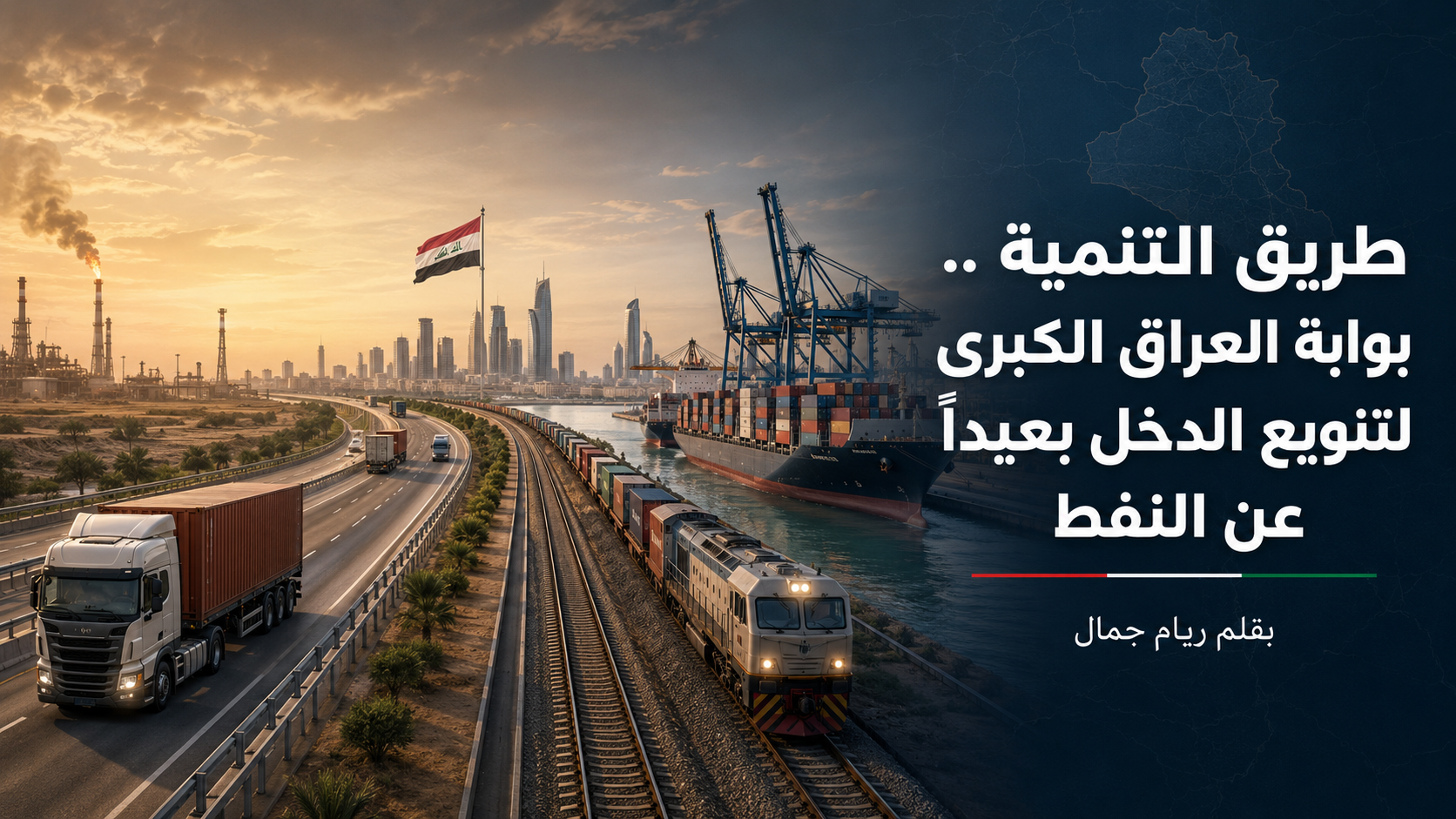
The Development Road: Iraq’s Great Gateway to Diversifying Revenue Beyond Oil

Riyam Jamal
Writer at CROSS LINES
This article focuses on the Development Road as Iraq’s strategic bet to transition from a rentier economy dependent on oil to a diversified economy built on trade and logistics. It also highlights the project’s growing geopolitical importance as a secure overland alternative to maritime shipping routes amid escalating regional tensions.
At a time when geopolitical challenges are intensifying and global supply chains are facing unprecedented tests, the Development Road project is emerging as Iraq’s most ambitious economic undertaking in decades and Baghdad’s strategic bet on moving from an oil-dependent economy toward one driven by trade, logistics, and investment.
Iraq, which relies heavily on oil revenues to finance its national budget, faces the persistent challenge of fluctuating oil prices and regional crises that directly affect exports and energy markets. The Development Road reflects a different vision: one that seeks to capitalize on Iraq’s geographic location and transform the country into a commercial hub linking the Arabian Gulf with Türkiye and Europe through a modern network of railways and highways extending from the Grand Faw Port to the Turkish border.
Stretching approximately 1,200 kilometers, the project represents far more than a corridor for transporting goods. It includes the development of industrial cities, economic zones, and logistics centers intended to strengthen local industries, attract foreign investment, and create thousands of jobs. It is also expected to increase non-oil revenues through transit fees and related services.
Regional Developments Enhance the Project’s Importance
The Development Road has gained even greater significance in recent months amid escalating military tensions between the United States and Iran, which have raised concerns over the security of navigation through the Strait of Hormuz, one of the world’s most important passages for oil and commercial shipping.
These developments have once again underscored the importance of establishing alternative land corridors that reduce dependence on maritime routes exposed to security risks.
Although the Development Road project predates these events by several years, current regional conditions have given it an additional strategic dimension. It is increasingly being viewed not merely as a domestic infrastructure project, but as part of a broader regional system designed to enhance the resilience of international trade.
Experts believe that any prolonged disruption to maritime navigation could prompt global companies to show greater interest in overland trade corridors, providing Iraq with an opportunity to strengthen its position as a regional transit hub.
International Investment and Signals of Confidence
At the same time, Baghdad is seeking to capitalize on this momentum to attract foreign capital. During the current month of July, major understandings and investment agreements were signed with American and international companies in the energy and infrastructure sectors during Prime Minister Ali Al-Zaidi’s visit to Washington.
These agreements formed part of the government’s efforts to develop transportation and energy networks and open new opportunities for investment. Economic discussions also focused on diversifying export routes and reducing dependence on traditional maritime corridors affected by regional tensions.
Economists argue that successfully attracting such investments would strengthen confidence in the Iraqi economy and provide additional momentum for strategic projects, foremost among them the Development Road, which requires international partnerships, technical expertise, and long-term financing.
From an Oil Economy to an Economy Built on Geography
Iraq occupies a strategic geographic position linking the Gulf with Türkiye and European markets, giving it a competitive advantage no less important than its natural resources.
From this perspective, the government is seeking to transform the country’s location into a sustainable source of income so that state revenues are no longer held hostage to fluctuations in global oil prices.
The project’s future revenues will not be limited to transit fees. They are also expected to include returns from industrial zones, logistics services, transportation, storage, and associated investments, helping to create a more diversified economy capable of absorbing external shocks.
Challenges That Cannot Be Ignored
Despite the optimism surrounding the project, its success remains dependent on several factors, most notably maintaining political and security stability, sustaining cooperation with neighboring countries, securing the necessary financing, and accelerating the implementation of infrastructure and legislation that facilitates the work of investors.
Regional competition among various trade corridors also places pressure on Iraq to complete the project according to clear timelines in order to benefit from the ongoing transformation of global trade routes.
A Historic Opportunity
In a world where economic balances are shifting rapidly, geography appears more valuable today than ever before.
Should Iraq succeed in capitalizing on its strategic location and completing the Development Road in accordance with the announced vision, it will not merely establish a route connecting the country’s south to its north. It may also open a new path toward an economy that is less dependent on oil and more closely integrated with trade, investment, and production.
As instability continues across the region, projects that provide safe and efficient alternatives for international trade are becoming increasingly important. This makes the Development Road far more than a transportation project; it is a project capable of reshaping Iraq’s economic role for decades to come.
Iraq, which relies heavily on oil revenues to finance its national budget, faces the persistent challenge of fluctuating oil prices and regional crises that directly affect exports and energy markets. The Development Road reflects a different vision: one that seeks to capitalize on Iraq’s geographic location and transform the country into a commercial hub linking the Arabian Gulf with Türkiye and Europe through a modern network of railways and highways extending from the Grand Faw Port to the Turkish border.
Stretching approximately 1,200 kilometers, the project represents far more than a corridor for transporting goods. It includes the development of industrial cities, economic zones, and logistics centers intended to strengthen local industries, attract foreign investment, and create thousands of jobs. It is also expected to increase non-oil revenues through transit fees and related services.
Regional Developments Enhance the Project’s Importance
The Development Road has gained even greater significance in recent months amid escalating military tensions between the United States and Iran, which have raised concerns over the security of navigation through the Strait of Hormuz, one of the world’s most important passages for oil and commercial shipping.
These developments have once again underscored the importance of establishing alternative land corridors that reduce dependence on maritime routes exposed to security risks.
Although the Development Road project predates these events by several years, current regional conditions have given it an additional strategic dimension. It is increasingly being viewed not merely as a domestic infrastructure project, but as part of a broader regional system designed to enhance the resilience of international trade.
Experts believe that any prolonged disruption to maritime navigation could prompt global companies to show greater interest in overland trade corridors, providing Iraq with an opportunity to strengthen its position as a regional transit hub.
International Investment and Signals of Confidence
At the same time, Baghdad is seeking to capitalize on this momentum to attract foreign capital. During the current month of July, major understandings and investment agreements were signed with American and international companies in the energy and infrastructure sectors during Prime Minister Ali Al-Zaidi’s visit to Washington.
These agreements formed part of the government’s efforts to develop transportation and energy networks and open new opportunities for investment. Economic discussions also focused on diversifying export routes and reducing dependence on traditional maritime corridors affected by regional tensions.
Economists argue that successfully attracting such investments would strengthen confidence in the Iraqi economy and provide additional momentum for strategic projects, foremost among them the Development Road, which requires international partnerships, technical expertise, and long-term financing.
From an Oil Economy to an Economy Built on Geography
Iraq occupies a strategic geographic position linking the Gulf with Türkiye and European markets, giving it a competitive advantage no less important than its natural resources.
From this perspective, the government is seeking to transform the country’s location into a sustainable source of income so that state revenues are no longer held hostage to fluctuations in global oil prices.
The project’s future revenues will not be limited to transit fees. They are also expected to include returns from industrial zones, logistics services, transportation, storage, and associated investments, helping to create a more diversified economy capable of absorbing external shocks.
Challenges That Cannot Be Ignored
Despite the optimism surrounding the project, its success remains dependent on several factors, most notably maintaining political and security stability, sustaining cooperation with neighboring countries, securing the necessary financing, and accelerating the implementation of infrastructure and legislation that facilitates the work of investors.
Regional competition among various trade corridors also places pressure on Iraq to complete the project according to clear timelines in order to benefit from the ongoing transformation of global trade routes.
A Historic Opportunity
In a world where economic balances are shifting rapidly, geography appears more valuable today than ever before.
Should Iraq succeed in capitalizing on its strategic location and completing the Development Road in accordance with the announced vision, it will not merely establish a route connecting the country’s south to its north. It may also open a new path toward an economy that is less dependent on oil and more closely integrated with trade, investment, and production.
As instability continues across the region, projects that provide safe and efficient alternatives for international trade are becoming increasingly important. This makes the Development Road far more than a transportation project; it is a project capable of reshaping Iraq’s economic role for decades to come.
🔗 Share Article
For Context
Related reads from the same topic or latest developments