Contemporary Thought Between Truth and Contradiction
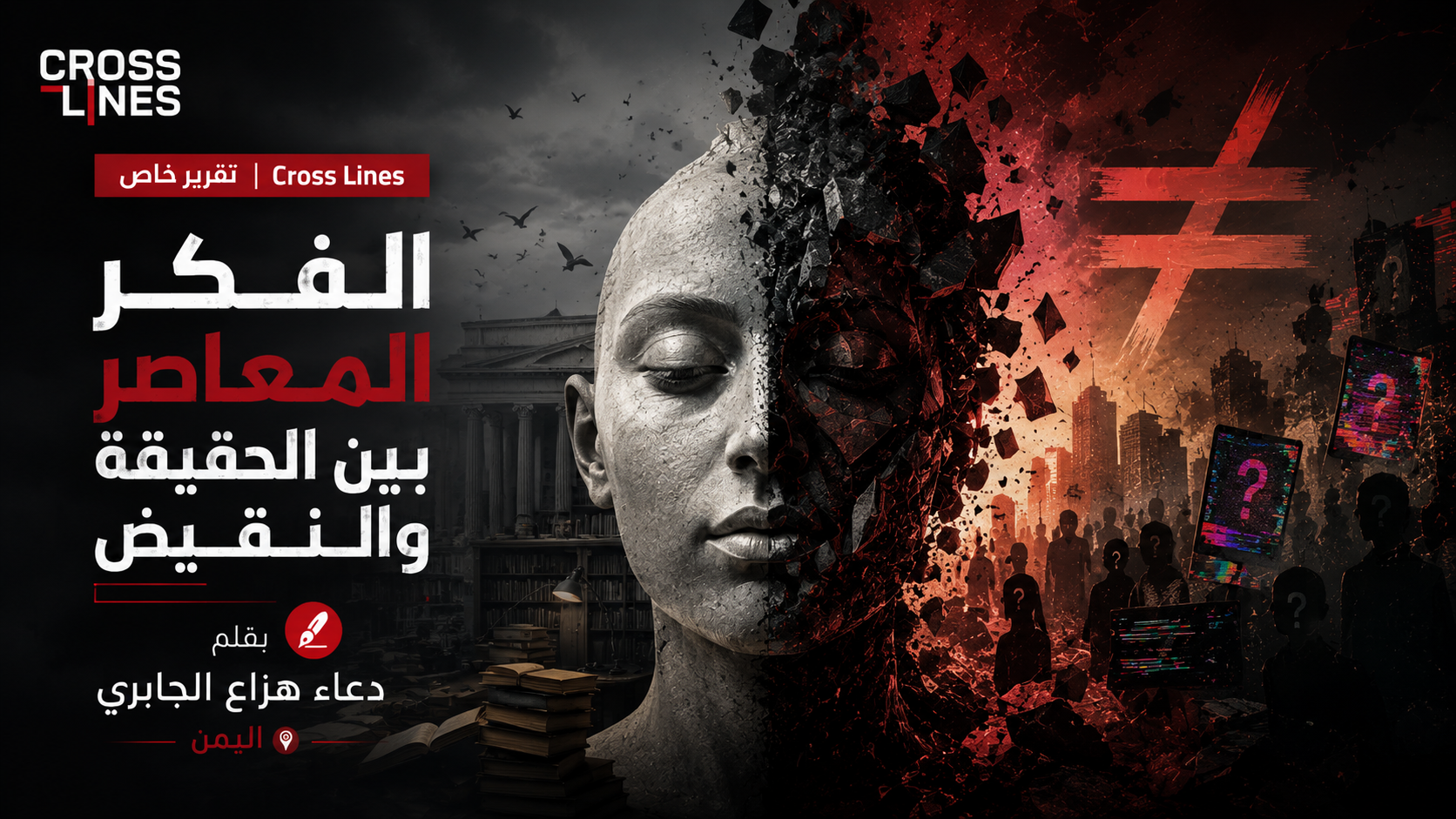

Doaa Hazza Al-Jabri
Writer at CROSS LINES
**Contemporary Thought Between Truth and Contradiction** Humanity has never known an age so overflowing with information as ours, and yet it has never known an age so confused in its search for truth as the one we live in today.
**Contemporary Thought Between Truth and Contradiction**
Humanity has never known an age so overflowing with information as ours, and yet it has never known an age so confused in its search for truth as the one we live in today. This is the great paradox at which contemporary thought stands. The more windows we open onto the world, the denser the fog that obscures our vision becomes; and the more the means of knowledge multiply, the more the forms of illusion multiply as well.
Contemporary man now lives amid a vast sea of conflicting ideas, to the point where truth itself has become a subject of debate rather than a reality to be sought. Between one opinion and another, between a discourse and its opposite, between an image and its reality, the mind stands bewildered before a world that no longer merely hides the truth, but has become capable of producing multiple versions of it.
In earlier times, humanity’s journey toward knowledge was difficult and long, yet people knew the direction in which they were heading. Today, knowledge has become available at the touch of a finger, but the destination itself has become a matter of doubt. The contemporary question is no longer: How do we reach the truth? Rather, it is: How do we distinguish it from among thousands of manufactured truths?
Contemporary thought has therefore shifted from the pursuit of certainty to the management of doubt. Instead of building its convictions upon deep reflection, the mind finds itself besieged by an endless flow of information, opinions, and interpretations. Man has come to consume ideas as he consumes news: with a speed that does not allow understanding, and with an abundance that leaves no room for contemplation.
Thus, the most dangerous challenge facing thought today is that contradiction no longer stands outside truth; it now wears its garments. Falsehood speaks the language of logic, deception borrows the tools of knowledge, and illusion adopts the vocabulary of science. The battle is no longer, as it once was, between truth and ignorance, but between a possible truth and an opposite that has mastered the art of resembling it.
Our age does not suffer from a scarcity of knowledge, but from its excess. And excess, when man loses the ability to sift through it, becomes a new form of darkness. Not everything that is said is knowledge, not everything that is published is truth, and not everything applauded by the public deserves belief.
In the midst of this scene, contemporary man appears like a traveler carrying a small lamp through a city of artificial lights. He sees everything, yet he does not know which things are truly worthy of his gaze. Voices have multiplied, while listening has diminished. Opinions have multiplied, while understanding has become rare. Slogans have multiplied, while meaning has retreated.
This proves that contemporary thought is living through another crisis no less dangerous than the others: the reduction of the human being to a position. The individual has come to be defined by what he supports or opposes more than by his humanity. Ideas, in many cases, have become closed camps rather than spaces for dialogue. The opposite has become an enemy instead of an opportunity to test and refine the truth.
Yet truth, in its essence, does not fear contradiction. On the contrary, it often reveals itself through it. Living thought does not grow in an environment of absolute certainty, nor can it survive in the chaos of absolute doubt. It is born in the delicate space between question and answer, between belief and inquiry, between what we know and what we think we know.
From here emerges the philosophical task of contemporary man: to recover the virtue of calm thinking amid the noise of the world; to learn to listen before judging, to contemplate before believing, and to search before taking sides. Truth is not a ready-made commodity to be consumed, but an ongoing journey of revision and discovery.
The real tragedy is not that we may fail to reach the truth, but that we may stop searching for it. When man loses his passion for questioning, he becomes captive to any passing answer. And when he is satisfied with what is handed to him, he willingly gives up his intellectual freedom.
It is precisely here that contemporary thought stands today at a decisive crossroads: between a truth that demands effort, patience, and humility, and a contradiction that promises ease and quick certainty. Between these two paths, the features of the human being in this age are determined: will he be a being in search of meaning, or merely a consumer of ideas?
Despite all the noise surrounding it, truth remains there—quiet, silent, far from clamor—waiting only for those who possess the courage to question, the nobility of doubt, and the sincerity of the seeker who understands that the greatest thing about truth is not possessing it, but the continual pursuit of it.
🔗 Share Article
For Context
Related reads from the same topic or latest developments