PoliticsAvailable in English
Europe Is Finally Getting Tough on China. Now Comes the Hard Part.
Editorial
Cross Lines editing
Source
Foreign Policy
Foreign Policy

Foreign Policy
Original Source
Europe is finally adopting a tougher stance toward China, as France and Germany move to use the bloc's market power as geopolitical leverage. Yet the EU still needs institutional reforms to turn that economic weight into lasting political influence.
Europe Is Finally Getting Tough on China
!Foreign Policy
Foreign Policy Get analysis and alerts more quickly in the mobile app.
Install
Back to Foreign Policy Magazine home page
* Latest
* Regions
+ Asia & the Pacific
+ China
+ Middle East & Africa
+ Americas
+ Europe
* Newsletters
Editors’ Picks
Evening roundup with our editors’ favorite stories of the day
!World Brief Icon
World Brief
Your guide to the most important world stories of the day
!China Brief Icon
China Brief
The latest news, analysis, and data from the country each week
Situation Report
Weekly update on what’s driving U.S. national security policy
FP Weekend
A curation of our best book reviews, deep dives, and other reads
!Africa Brief Icon
Africa Brief
Essential analysis of the stories shaping geopolitics on the continent
!South Asia Brief Icon
South Asia Brief
Weekly update on developments in India and its neighbors
The Reading List
Curated guides on geopolitics and current affairs
FP Bookshelf
A monthly guide to FP’s book reviews, excerpts, and reading recommendations
!Latin America Brief Icon
Latin America Brief
One-stop digest of politics, economics, and culture
!Southeast Asia Brief Icon
Southeast Asia Brief
A weekly dispatch with news from the region’s 11 countries
The New Geopolitics
A five-part masterclass in IR theory with Harvard Professor Stephen M. Walt
View All Newsletters
* FP Live
* Latest
* Trending:
* U.S. midterms
* India's protests
Search this website
* Preferences
* My FP Feed
* Saved Articles
* Newsletters
* Magazine Archive
* Subscription Settings
* FAQs
* Log Out
Sign In
Sign In
Team access Team access
Subscribe Subscribe Team access Team access
Argument: Europe Is Finally Getting Tough on China. Now Comes the Hard Part.
*
*
* Facebook
* Bluesky
* X
* LinkedIn
* WhatsApp
* Reddit
Save
1. Create an FP account to save articles to read later.
Sign Up
ALREADY AN FP SUBSCRIBER? LOGIN
PDF
1. **Downloadable PDFs** are a benefit of an FP subscription.
Subscribe Now
ALREADY AN FP SUBSCRIBER? LOGIN
Gift
*
*
* WhatsApp
1. Gifting articles is a subscriber benefit.
Subscribe Now
ALREADY AN FP SUBSCRIBER? LOGIN
2. This article is an Insider exclusive.
Contact us at [email protected] to learn about upgrade options, unlocking the ability to gift this article.
Argument
An expert’s point of view on a current event.
Europe Is Finally Getting Tough on China. Now Comes the Hard Part.
France and Germany are increasingly willing to flex market share for geopolitical leverage. But they still need reforms to maintain it.
By **Grégoire Roos**, director of the Europe, Russia, and Eurasia programs at Chatham House.
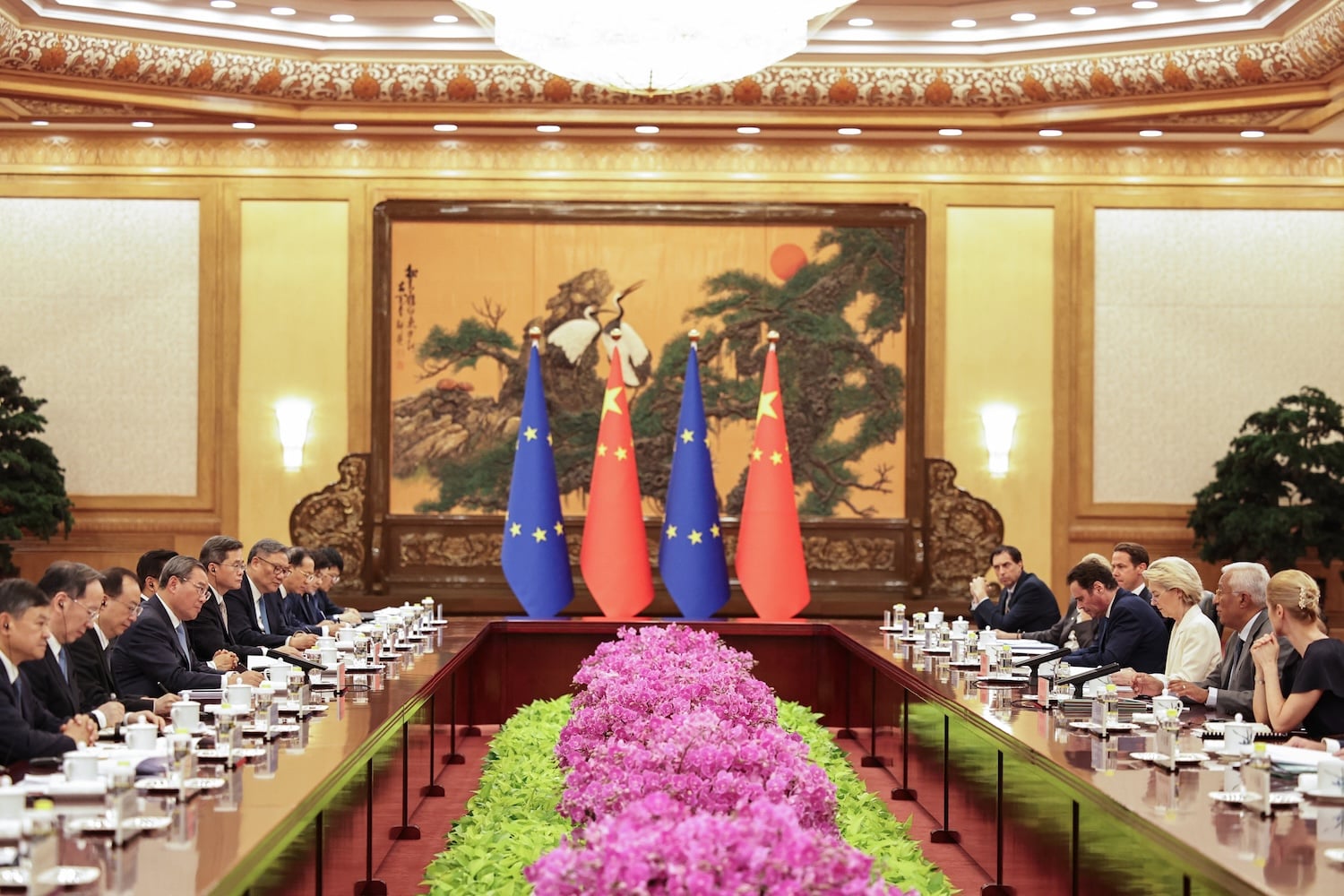
!Two long tables face each other in an ornately decorated room, with officials and aides tightly packed side-by-side as they sit. Chinese officials sit at the left table, and EU officials sit at the right. The Chinese and EU flags hang from poles at the back of the room.
*Two long tables face each other in an ornately decorated room, with officials and aides tightly packed side-by-side as they sit. Chinese officials sit at the left table, and EU officials sit at the right. The Chinese and EU flags hang from poles at the back of the room.*
European Council President António Costa speaks during the 25th European Union-China summit in Beijing on July 24, 2025. Andres Martinez Casares/AFP via Getty Images
1. Get audio access with any FP subscription.
Subscribe Now
ALREADY AN FP SUBSCRIBER? LOGIN
October 19, 2026, 11:13 AM
More than two centuries ago, Franco-Swiss Enlightenment writer Madame de Staël lamented that the German states had neglected “the great national power that had to be forged amid Europe’s colossi.” She was writing about how the politically fragmented German states had failed to combine their economic strength into a national power capable of challenging Napoleon Bonaparte. But the remark could easily apply to all of Europe today. The continent is neither small nor poor, but it has often struggled to translate its economic might into political leverage.
The joint French-German letter and nonpaper sent to European Commission President Ursula von der Leyen in early October is one encouraging sign that this may be changing. French President Emmanuel Macron and German Chancellor Friedrich Merz want the European Union to act much faster against persistent market distortions. In service of this goal, they are proposing a new mechanism that could ultimately restrict access to the European single market. Under their proposal, economic measures put forward by the commission could take effect unless a qualified majority of governments opposed them.
The French-German letter doesn’t name the source of the market distortions that these measures are intended to check. But the unspoken target is obvious: China.
---
For much of the past two decades, France and Germany approached China from significantly different economic positions. Paris was concerned about a lack of reciprocity, threats to industrial sovereignty, and the risks created by strategic dependencies. German Chancellor Angela Merkel’s China policy was shaped by that firm belief that expanding economic relationships with Beijing remained, on balance, favorable to the German economy. As a result, China became a major source of growth for the German industry—especially cars, machinery, and chemicals—while German companies helped develop the Chinese industrial infrastructure by investing heavily in local production.
But Berlin might have wanted to be more cautious, as the geoeconomic dynamics of the past decade have made its calculations much harder to sustain. German exports to China fell by 9.7 percent in 2025, while imports rose by 8.8 percent. The bilateral German deficit reached 89.3 billion euros. During the first five months of 2026, exports fell another 14.5 percent from the same period a year earlier; imports continued to rise. Unsurprisingly, German motor-vehicle exports have been hit particularly hard.
Those numbers capture more than a growing trade imbalance and point to an uncomfortable truth for Europe—and in particular Germany, the continent’s industrial powerhouse. China has moved steadily from customer to competitor in industries that are crucial to the German economy.
This explains why the Franco-German paper feels somewhat different from previous exercises in European “de-risking.” At last, Berlin accepts a proposition that Paris has pressed for years: Interdependence does create leverage, and Europe would be foolish not to use its own. This is particularly true at a time when large parts of Eur
!Foreign Policy
Foreign Policy Get analysis and alerts more quickly in the mobile app.
Install
Back to Foreign Policy Magazine home page
* Latest
* Regions
+ Asia & the Pacific
+ China
+ Middle East & Africa
+ Americas
+ Europe
* Newsletters
Editors’ Picks
Evening roundup with our editors’ favorite stories of the day
!World Brief Icon
World Brief
Your guide to the most important world stories of the day
!China Brief Icon
China Brief
The latest news, analysis, and data from the country each week
Situation Report
Weekly update on what’s driving U.S. national security policy
FP Weekend
A curation of our best book reviews, deep dives, and other reads
!Africa Brief Icon
Africa Brief
Essential analysis of the stories shaping geopolitics on the continent
!South Asia Brief Icon
South Asia Brief
Weekly update on developments in India and its neighbors
The Reading List
Curated guides on geopolitics and current affairs
FP Bookshelf
A monthly guide to FP’s book reviews, excerpts, and reading recommendations
!Latin America Brief Icon
Latin America Brief
One-stop digest of politics, economics, and culture
!Southeast Asia Brief Icon
Southeast Asia Brief
A weekly dispatch with news from the region’s 11 countries
The New Geopolitics
A five-part masterclass in IR theory with Harvard Professor Stephen M. Walt
View All Newsletters
* FP Live
* Latest
* Trending:
* U.S. midterms
* India's protests
Search this website
* Preferences
* My FP Feed
* Saved Articles
* Newsletters
* Magazine Archive
* Subscription Settings
* FAQs
* Log Out
Sign In
Sign In
Team access Team access
Subscribe Subscribe Team access Team access
Argument: Europe Is Finally Getting Tough on China. Now Comes the Hard Part.
*
*
* Bluesky
* X
Save
1. Create an FP account to save articles to read later.
Sign Up
ALREADY AN FP SUBSCRIBER? LOGIN
1. **Downloadable PDFs** are a benefit of an FP subscription.
Subscribe Now
ALREADY AN FP SUBSCRIBER? LOGIN
Gift
*
*
1. Gifting articles is a subscriber benefit.
Subscribe Now
ALREADY AN FP SUBSCRIBER? LOGIN
2. This article is an Insider exclusive.
Contact us at [email protected] to learn about upgrade options, unlocking the ability to gift this article.
Argument
An expert’s point of view on a current event.
Europe Is Finally Getting Tough on China. Now Comes the Hard Part.
France and Germany are increasingly willing to flex market share for geopolitical leverage. But they still need reforms to maintain it.
By **Grégoire Roos**, director of the Europe, Russia, and Eurasia programs at Chatham House.
!Two long tables face each other in an ornately decorated room, with officials and aides tightly packed side-by-side as they sit. Chinese officials sit at the left table, and EU officials sit at the right. The Chinese and EU flags hang from poles at the back of the room.
*Two long tables face each other in an ornately decorated room, with officials and aides tightly packed side-by-side as they sit. Chinese officials sit at the left table, and EU officials sit at the right. The Chinese and EU flags hang from poles at the back of the room.*
European Council President António Costa speaks during the 25th European Union-China summit in Beijing on July 24, 2025. Andres Martinez Casares/AFP via Getty Images
1. Get audio access with any FP subscription.
Subscribe Now
ALREADY AN FP SUBSCRIBER? LOGIN
October 19, 2026, 11:13 AM
More than two centuries ago, Franco-Swiss Enlightenment writer Madame de Staël lamented that the German states had neglected “the great national power that had to be forged amid Europe’s colossi.” She was writing about how the politically fragmented German states had failed to combine their economic strength into a national power capable of challenging Napoleon Bonaparte. But the remark could easily apply to all of Europe today. The continent is neither small nor poor, but it has often struggled to translate its economic might into political leverage.
The joint French-German letter and nonpaper sent to European Commission President Ursula von der Leyen in early October is one encouraging sign that this may be changing. French President Emmanuel Macron and German Chancellor Friedrich Merz want the European Union to act much faster against persistent market distortions. In service of this goal, they are proposing a new mechanism that could ultimately restrict access to the European single market. Under their proposal, economic measures put forward by the commission could take effect unless a qualified majority of governments opposed them.
More than two centuries ago, Franco-Swiss Enlightenment writer Madame de Staël lamented that the German states had neglected “the great national power that had to be forged amid Europe’s colossi.” She was writing about how the politically fragmented German states had failed to combine their economic strength into a national power capable of challenging Napoleon Bonaparte. But the remark could easily apply to all of Europe today. The continent is neither small nor poor, but it has often struggled to translate its economic might into political leverage.
The joint French-German letter and nonpaper sent to European Commission President Ursula von der Leyen in early October is one encouraging sign that this may be changing. French President Emmanuel Macron and German Chancellor Friedrich Merz want the European Union to act much faster against persistent market distortions. In service of this goal, they are proposing a new mechanism that could ultimately restrict access to the European single market. Under their proposal, economic measures put forward by the commission could take effect unless a qualified majority of governments opposed them.
The French-German letter doesn’t name the source of the market distortions that these measures are intended to check. But the unspoken target is obvious: China.
---
For much of the past two decades, France and Germany approached China from significantly different economic positions. Paris was concerned about a lack of reciprocity, threats to industrial sovereignty, and the risks created by strategic dependencies. German Chancellor Angela Merkel’s China policy was shaped by that firm belief that expanding economic relationships with Beijing remained, on balance, favorable to the German economy. As a result, China became a major source of growth for the German industry—especially cars, machinery, and chemicals—while German companies helped develop the Chinese industrial infrastructure by investing heavily in local production.
But Berlin might have wanted to be more cautious, as the geoeconomic dynamics of the past decade have made its calculations much harder to sustain. German exports to China fell by 9.7 percent in 2025, while imports rose by 8.8 percent. The bilateral German deficit reached 89.3 billion euros. During the first five months of 2026, exports fell another 14.5 percent from the same period a year earlier; imports continued to rise. Unsurprisingly, German motor-vehicle exports have been hit particularly hard.
Those numbers capture more than a growing trade imbalance and point to an uncomfortable truth for Europe—and in particular Germany, the continent’s industrial powerhouse. China has moved steadily from customer to competitor in industries that are crucial to the German economy.
This explains why the Franco-German paper feels somewhat different from previous exercises in European “de-risking.” At last, Berlin accepts a proposition that Paris has pressed for years: Interdependence does create leverage, and Europe would be foolish not to use its own. This is particularly true at a time when large parts of Eur
Share Article
Tags:#الصين#الاتحاد الأوروبي#ألمانيا#فرنسا#التجارة الخارجية#الجيواقتصاد
Source: Foreign Policy
For Context
Related reads from the same topic or latest developments