What an Extradition Trial Reveals About Moscow’s Influence in Africa
Foreign Policy

Foreign Policy
Original Source
New details from an extradition trial in South Africa have exposed a network of pro-Russian actors across Africa following a failed coup attempt in Benin. The case reveals how Moscow leverages social media influencers and anti-colonial sentiment to expand its influence across the continent.
What Benin's Failed Coup Reveals About Russia's Network in Africa
By using this website, you agree to our use of cookies. This use includes personalization of content and ads, and traffic analytics. Review our Privacy Policy for more information.
!Foreign Policy
Foreign Policy
Get analysis and alerts more quickly in the mobile app.
Install
Back to Foreign Policy Magazine home page
* Latest
* Regions
+ Asia & the Pacific
+ China
+ Middle East & Africa
+ Americas
+ Europe
* Newsletters
Editors’ Picks
Evening roundup with our editors’ favorite stories of the day
!World Brief Icon
World Brief
Your guide to the most important world stories of the day
!China Brief Icon
China Brief
The latest news, analysis, and data from the country each week
Situation Report
Weekly update on what’s driving U.S. national security policy
FP Weekend
A curation of our best book reviews, deep dives, and other reads
!Africa Brief Icon
Africa Brief
Essential analysis of the stories shaping geopolitics on the continent
!South Asia Brief Icon
South Asia Brief
Weekly update on developments in India and its neighbors
The Reading List
Curated guides on geopolitics and current affairs
FP Bookshelf
A monthly guide to FP’s book reviews, excerpts, and reading recommendations
!Latin America Brief Icon
Latin America Brief
One-stop digest of politics, economics, and culture
!Southeast Asia Brief Icon
Southeast Asia Brief
A weekly dispatch with news from the region’s 11 countries
The New Geopolitics
A five-part masterclass in IR theory with Harvard Professor Stephen M. Walt
View All Newsletters
* FP Live
* Latest
* Trending:
* Iran war
* Brazil's election kicks off
Search this website
* Preferences
* My FP Feed
* Saved Articles
* Newsletters
* Magazine Archive
* Subscription Settings
* FAQs
* Log Out
Sign In
Sign In
Campus and team access Campus and team access
Subscribe SubscribeCampus and team access Campus and team access
Africa Brief:
What an Extradition Trial Reveals About Moscow’s Influence in Africa
*
*
* Facebook
* Bluesky
* X
* LinkedIn
* WhatsApp
* Reddit
Save
1. Create an FP account to save articles to read later.
Sign Up
ALREADY AN FP SUBSCRIBER? LOGIN
PDF
1. **Downloadable PDFs** are a benefit of an FP subscription.
Subscribe Now
ALREADY AN FP SUBSCRIBER? LOGIN
Gift
*
*
* WhatsApp
1. Gifting articles is a subscriber benefit.
Subscribe Now
ALREADY AN FP SUBSCRIBER? LOGIN
2. This article is an Insider exclusive.
Contact us at [email protected] to learn about upgrade options, unlocking the ability to gift this article.
Africa Brief
Lagos-based Nosmot Gbadamosi reports from across Africa on what’s driving policy, economics, and culture in the world’s fastest-growing and youngest continent. Sign up for the latest news, expert analysis, and data insights. Delivered Wednesday.
What an Extradition Trial Reveals About Moscow’s Influence in Africa
New details have emerged about a network of pro-Russian actors in the Sahel and beyond.
!Gbadamosi-Nosmot-foreign-policy-columnist10
*Gbadamosi-Nosmot-foreign-policy-columnist10*
*Nosmot Gbadamosi*
By **Nosmot Gbadamosi**, a multimedia journalist and the writer of *Foreign Policy*’s weekly Africa Brief.
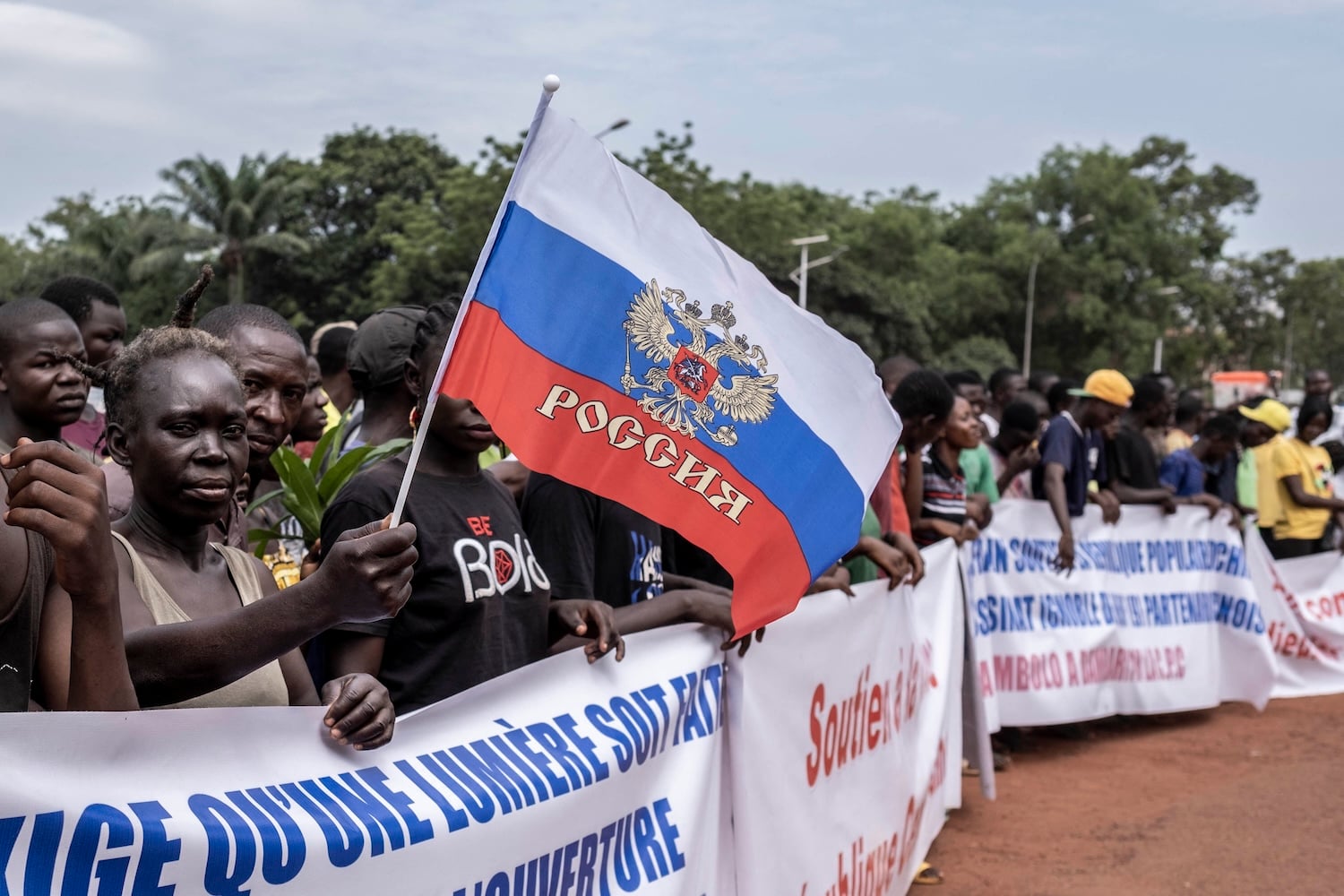
!People in a crowd hold up banners; one waves a Russian flag with the Russian state symbol on it.
*People in a crowd hold up banners; one waves a Russian flag with the Russian state symbol on it.*
A demonstrator holds a flag with the emblem of Russia during a march in support of the Russian presence in the country, seen in Bangui, Central African Republic, on March 22, 2023. Barbara Debout/AFP via Getty Images
*
*
August 26, 2026, 3:50 PM
Welcome to *Foreign Policy*’s Africa Brief*.*
The highlights this week: Benin’s failed coup highlights a network of **pro-Russian actors** across the continent, the dispute over **Zambia’s fraught election** continues, and the **Tanzanian government** suspends an independent newspaper.
Welcome to *Foreign Policy*’s Africa Brief*.*
The highlights this week: Benin’s failed coup highlights a network of **pro-Russian actors** across the continent, the dispute over **Zambia’s fraught election** continues, and the **Tanzanian government** suspends an independent newspaper.
*Africa Brief will take a break for the next two weeks. Our regular programming will return on Wednesday, Sept. 16.*
Sign up to receive Africa Brief in your inbox every Wednesday.
---
Moscow’s Expanding Network
A coup thwarted in Benin last year has highlighted a network of pro-Russian actors in Africa, according to new details that have emerged from an ongoing extradition trial in South Africa.
The December mutiny, which was led by Lt. Col. Pascal Tigri and included the temporary seizure of the national broadcaster, collapsed within hours following military intervention from neighboring Nigeria. However, subsequent legal proceedings have shed light on how local pro-Russian influencers and movements work to achieve shared aims across African borders.
In its bid to prosecute those involved in the failed coup, Benin filed extradition requests for individuals in a number of African countries. This included Tigri, who fled to Togo—though his exact whereabouts remain unknown—and pro-Russian social media influencer Kemi Seba, who escaped to South Africa.
In April, South African police arrested Seba (whose real name is Stellio Gilles Robert Capo Chichi), who is wanted by Benin for “inciting” the coup. South African prosecutors allege that Russia funded and orchestrated an illegal escape plan for the 45-year-old Seba.
According to South African police, Seba was arrested with more than $18,000. Pretoria’s intelligence has suggested that the cash originated from Russia and was to be paid to Francois van der Merwe, a leader within the Afrikaner white nationalist group Bittereinders, to facilitate cross-border transport of Seba and his 18-year-old son from South Africa into Zimbabwe and on to Europe to carry out terror attacks, according to court documents revealed earlier this month. Seba and his legal team reject the accusations.
All three individuals—Seba, his son, and Merwe—were arrested together. Merwe had previously attended a September gathering of neofascists in St. Petersburg, Russia.
Despite growing up in France, Seba, who has about 1.5 million Facebook followers, has been a highly vocal critic of French neocolonialism in Francophone Africa on social media. He was stripped of his French nationality in July 2024 after he had previously been arrested for allegedly inciting anti-French and antisemitic sentiment. A month later, Niger appointed Seba as a special advisor to Nigerien President Abdourahamane Tchiani and gave him a diplomatic passport.
In December, on the day of the Benin coup attempt, Seba posted a video that he later deleted, which hailed the mutiny as a “day of liberation” and praised the fall of “a clan of predators preying on the economy and freedoms.” He has also widely praised Russia on social media.
Russia has fostered close ties with Benin’s neighboring junta-led nations of Niger, Burkina Faso, and Mali. Analysts have suggested that Seba’s pro-coup posts were part of a highly coordinated network of African diaspora influencers that worked to amplify the putschists’ messaging to create a false impression of popular support for the coup.
This appears to be a trend not just in the Sahel, but also across Africa. In 2022, the U.S. State Department accused Russia’s defunct paramilitary Wagner Group of using Seba and other influencers to spread pro-Kremlin narratives. In some cases, fake journalists wrote hundreds of pro-Russian articles in more than a dozen African countries, from Senegal to the Democratic Republic of the Congo.
While it may be tempting to dismiss Benin’s coup plot and other destabilizing events in Africa as simply Russian orchestrated, Moscow seeds its influence by tapping into systemic problems with democratic backsliding. Ben
By using this website, you agree to our use of cookies. This use includes personalization of content and ads, and traffic analytics. Review our Privacy Policy for more information.
!Foreign Policy
Foreign Policy
Get analysis and alerts more quickly in the mobile app.
Install
Back to Foreign Policy Magazine home page
* Latest
* Regions
+ Asia & the Pacific
+ China
+ Middle East & Africa
+ Americas
+ Europe
* Newsletters
Editors’ Picks
Evening roundup with our editors’ favorite stories of the day
!World Brief Icon
World Brief
Your guide to the most important world stories of the day
!China Brief Icon
China Brief
The latest news, analysis, and data from the country each week
Situation Report
Weekly update on what’s driving U.S. national security policy
FP Weekend
A curation of our best book reviews, deep dives, and other reads
!Africa Brief Icon
Africa Brief
Essential analysis of the stories shaping geopolitics on the continent
!South Asia Brief Icon
South Asia Brief
Weekly update on developments in India and its neighbors
The Reading List
Curated guides on geopolitics and current affairs
FP Bookshelf
A monthly guide to FP’s book reviews, excerpts, and reading recommendations
!Latin America Brief Icon
Latin America Brief
One-stop digest of politics, economics, and culture
!Southeast Asia Brief Icon
Southeast Asia Brief
A weekly dispatch with news from the region’s 11 countries
The New Geopolitics
A five-part masterclass in IR theory with Harvard Professor Stephen M. Walt
View All Newsletters
* FP Live
* Latest
* Trending:
* Iran war
* Brazil's election kicks off
Search this website
* Preferences
* My FP Feed
* Saved Articles
* Newsletters
* Magazine Archive
* Subscription Settings
* FAQs
* Log Out
Sign In
Sign In
Campus and team access Campus and team access
Subscribe SubscribeCampus and team access Campus and team access
Africa Brief:
What an Extradition Trial Reveals About Moscow’s Influence in Africa
*
*
* Bluesky
* X
Save
1. Create an FP account to save articles to read later.
Sign Up
ALREADY AN FP SUBSCRIBER? LOGIN
1. **Downloadable PDFs** are a benefit of an FP subscription.
Subscribe Now
ALREADY AN FP SUBSCRIBER? LOGIN
Gift
*
*
1. Gifting articles is a subscriber benefit.
Subscribe Now
ALREADY AN FP SUBSCRIBER? LOGIN
2. This article is an Insider exclusive.
Contact us at [email protected] to learn about upgrade options, unlocking the ability to gift this article.
Africa Brief
Lagos-based Nosmot Gbadamosi reports from across Africa on what’s driving policy, economics, and culture in the world’s fastest-growing and youngest continent. Sign up for the latest news, expert analysis, and data insights. Delivered Wednesday.
What an Extradition Trial Reveals About Moscow’s Influence in Africa
New details have emerged about a network of pro-Russian actors in the Sahel and beyond.
!Gbadamosi-Nosmot-foreign-policy-columnist10
*Gbadamosi-Nosmot-foreign-policy-columnist10*
*Nosmot Gbadamosi*
By **Nosmot Gbadamosi**, a multimedia journalist and the writer of *Foreign Policy*’s weekly Africa Brief.
!People in a crowd hold up banners; one waves a Russian flag with the Russian state symbol on it.
*People in a crowd hold up banners; one waves a Russian flag with the Russian state symbol on it.*
A demonstrator holds a flag with the emblem of Russia during a march in support of the Russian presence in the country, seen in Bangui, Central African Republic, on March 22, 2023. Barbara Debout/AFP via Getty Images
*
*
August 26, 2026, 3:50 PM
Welcome to *Foreign Policy*’s Africa Brief*.*
The highlights this week: Benin’s failed coup highlights a network of **pro-Russian actors** across the continent, the dispute over **Zambia’s fraught election** continues, and the **Tanzanian government** suspends an independent newspaper.
Welcome to *Foreign Policy*’s Africa Brief*.*
The highlights this week: Benin’s failed coup highlights a network of **pro-Russian actors** across the continent, the dispute over **Zambia’s fraught election** continues, and the **Tanzanian government** suspends an independent newspaper.
*Africa Brief will take a break for the next two weeks. Our regular programming will return on Wednesday, Sept. 16.*
Sign up to receive Africa Brief in your inbox every Wednesday.
---
Moscow’s Expanding Network
A coup thwarted in Benin last year has highlighted a network of pro-Russian actors in Africa, according to new details that have emerged from an ongoing extradition trial in South Africa.
The December mutiny, which was led by Lt. Col. Pascal Tigri and included the temporary seizure of the national broadcaster, collapsed within hours following military intervention from neighboring Nigeria. However, subsequent legal proceedings have shed light on how local pro-Russian influencers and movements work to achieve shared aims across African borders.
In its bid to prosecute those involved in the failed coup, Benin filed extradition requests for individuals in a number of African countries. This included Tigri, who fled to Togo—though his exact whereabouts remain unknown—and pro-Russian social media influencer Kemi Seba, who escaped to South Africa.
In April, South African police arrested Seba (whose real name is Stellio Gilles Robert Capo Chichi), who is wanted by Benin for “inciting” the coup. South African prosecutors allege that Russia funded and orchestrated an illegal escape plan for the 45-year-old Seba.
According to South African police, Seba was arrested with more than $18,000. Pretoria’s intelligence has suggested that the cash originated from Russia and was to be paid to Francois van der Merwe, a leader within the Afrikaner white nationalist group Bittereinders, to facilitate cross-border transport of Seba and his 18-year-old son from South Africa into Zimbabwe and on to Europe to carry out terror attacks, according to court documents revealed earlier this month. Seba and his legal team reject the accusations.
All three individuals—Seba, his son, and Merwe—were arrested together. Merwe had previously attended a September gathering of neofascists in St. Petersburg, Russia.
Despite growing up in France, Seba, who has about 1.5 million Facebook followers, has been a highly vocal critic of French neocolonialism in Francophone Africa on social media. He was stripped of his French nationality in July 2024 after he had previously been arrested for allegedly inciting anti-French and antisemitic sentiment. A month later, Niger appointed Seba as a special advisor to Nigerien President Abdourahamane Tchiani and gave him a diplomatic passport.
In December, on the day of the Benin coup attempt, Seba posted a video that he later deleted, which hailed the mutiny as a “day of liberation” and praised the fall of “a clan of predators preying on the economy and freedoms.” He has also widely praised Russia on social media.
Russia has fostered close ties with Benin’s neighboring junta-led nations of Niger, Burkina Faso, and Mali. Analysts have suggested that Seba’s pro-coup posts were part of a highly coordinated network of African diaspora influencers that worked to amplify the putschists’ messaging to create a false impression of popular support for the coup.
This appears to be a trend not just in the Sahel, but also across Africa. In 2022, the U.S. State Department accused Russia’s defunct paramilitary Wagner Group of using Seba and other influencers to spread pro-Kremlin narratives. In some cases, fake journalists wrote hundreds of pro-Russian articles in more than a dozen African countries, from Senegal to the Democratic Republic of the Congo.
While it may be tempting to dismiss Benin’s coup plot and other destabilizing events in Africa as simply Russian orchestrated, Moscow seeds its influence by tapping into systemic problems with democratic backsliding. Ben
🔗 Share Article
Tags:#روسيا#أفريقيا#النفوذ الروسي#بنين#الانقلابات#وسائل التواصل
Source: Foreign Policy
For Context
Related reads from the same topic or latest developments


