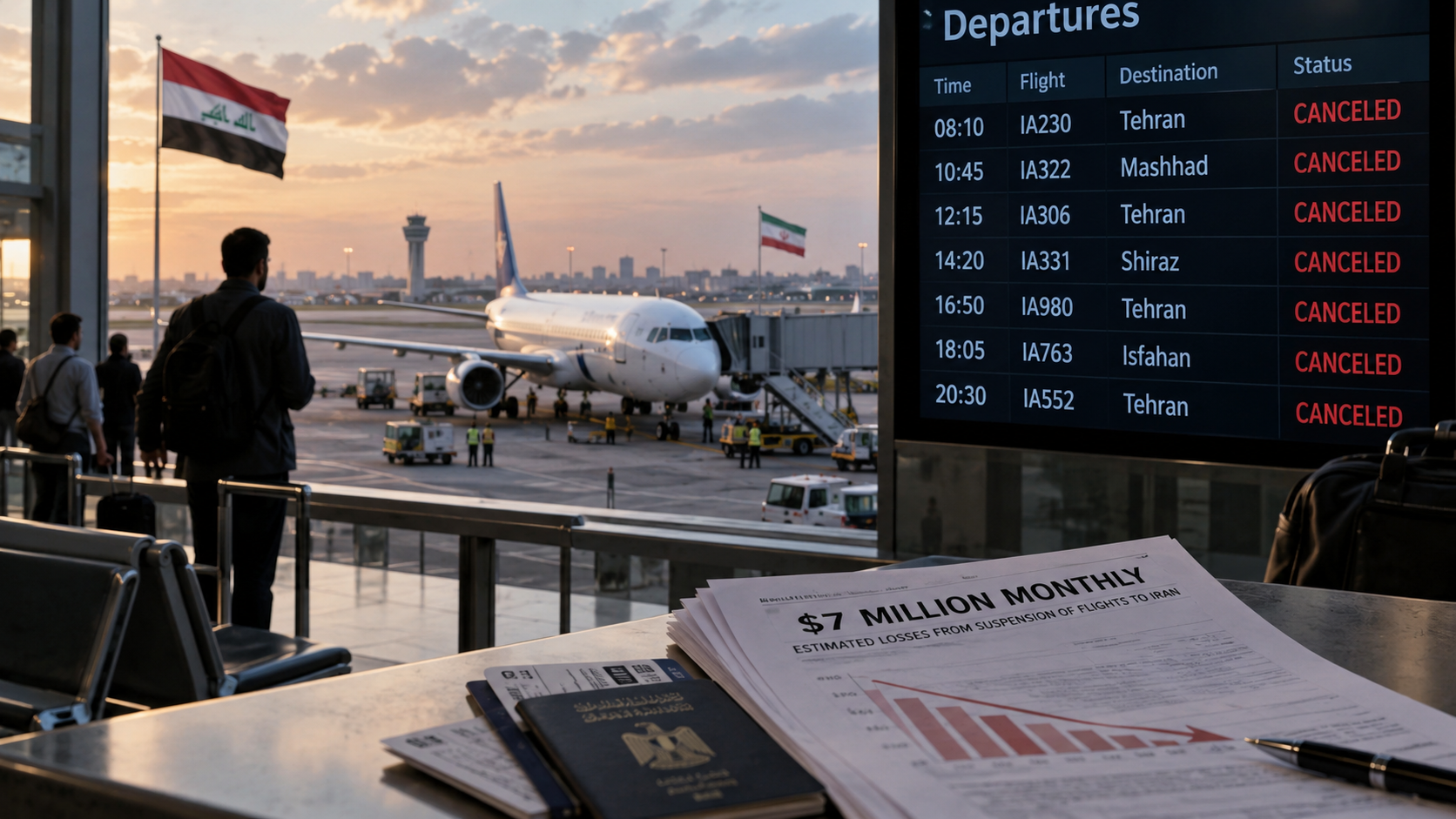
Suspension of Flights With Iran Costs Iraq $7 Million Monthly

Riyam Jamal
Writer at CROSS LINES
This article examines the repercussions of the paralysis in air travel between Iraq and Iran, which has cost the country millions of dollars in financial losses, in addition to creating a humanitarian and economic crisis through the disruption of medical tourism and the studies of Iraqi students.
Iraq’s airport runways did not need a direct closure order to lose their usual activity. It was enough for the threat of sanctions compliance to emerge for Iranian aircraft engines to stop landing. The broader political and financial dispute between Washington and Tehran has turned into a silent economic and humanitarian crisis inside Iraq, disrupting vital sectors on which millions of citizens and visitors depend.
Paralysis of Medical Tourism and Educational Services
Iran is a major destination for tens of thousands of Iraqis every year seeking affordable medical treatment. In addition, more than 50,000 Iraqi students are pursuing undergraduate and postgraduate studies at Iranian universities.
The suspension of direct flights has put critically ill patients at risk, as traveling for several hours by land through congested border crossings is difficult or, in some cases, impractical. Iraqi students, meanwhile, face the risk of missing examinations and academic terms due to the current logistical difficulties and the rising cost of temporary overland transportation.
Declining Liquidity in Local Markets and Service Sectors
Air traffic connecting Karbala and Najaf with Tehran has a direct impact on Iraq’s daily economic cycle.
Hospitality and retail: Estimates from the hotel sector in Najaf and Karbala indicate that occupancy rates have fallen to exceptionally low levels, negatively affecting domestic transportation, traditional markets, restaurants, and other businesses dependent on visitors.
Supply chains and rapid trade: The suspension of air cargo carried aboard passenger aircraft has slowed the exchange of light goods and disrupted urgent commercial activity between businesspeople in the two countries.
September 8 and the Strategy of Comprehensive Pressure
The situation began when the U.S. Treasury Department announced tightened measures targeting 36 entities linked to Iran’s aviation sector, declaring that all remaining active Iranian companies would be covered by the restrictions.
Washington went further by suspending three key licenses and issuing a stern warning to foreign companies against providing logistical or ground services to these airlines.
The U.S. Office of Foreign Assets Control (OFAC) issued a temporary license allowing existing transactions to be wound down until September 23. As the deadline approached, ground-handling companies at Iraqi airports found themselves facing two difficult choices: either continue servicing aircraft arriving from Iran or risk exposure to U.S. sanctions.
As expected, ground-handling companies declined to service Iranian airlines, effectively severing air links without the need for an official decision to close Iraqi airports.
Financial Losses and Operational Disruption Across Airports and Tourism
The suspension affected between 15 and 20 flights per day, but its consequences extended far beyond quieter runways.
During peak seasons, the number of flights can reach approximately 50 per day, equivalent to around 1,500 flights per month.
Experts and economists estimate that Iraqi airports are losing approximately $75,000 to $100,000 per day in revenues from landing fees, lighting services, air navigation services, airport facilities, ground handling, and aircraft refueling.
Local tourism companies, hotels, and taxi drivers have also entered a severe downturn as the number of Iranian visitors traveling to the holy shrines in Najaf and Karbala has declined.
Meanwhile, Iraqi airport authorities could lose between $2.25 million and $3 million per month in non-oil revenues.
Direct and Indirect Losses
According to specialists, the overall daily economic loss is estimated at approximately $250,000.
Total monthly losses could therefore reach approximately $7.5 million.
Estimated Impact Over Time
Around three months of suspended flights could cost the affected sectors approximately $22.5 million.
If the suspension continues for six months, losses could rise to approximately $45 million.
Difficult Overland Travel and Rising Costs
The situation has forced Iraqis to seek alternative routes.
Thousands of Iraqi students studying at Iranian universities, patients seeking medical treatment, and traders have found themselves compelled to replace short flights with exhausting overland journeys.
This has significantly increased travel times and created additional hardship for elderly passengers and patients. Transportation costs have also risen as travelers are forced to rely on alternatives that can be more expensive than the low-cost airfares previously offered by Iranian carriers.
Government and Parliamentary Action
In response to the escalating crisis, the media office of the Iraqi prime minister announced that direct talks had been opened with the U.S. side to seek exemptions for specific airports on humanitarian grounds, including medical treatment, education, and religious visits.
Meanwhile, the Iraqi Council of Representatives objected to the mechanism being implemented, describing it as “hasty and ill-considered,” while raising the possibility of holding an extraordinary parliamentary session to press for genuine protection of Iraq’s vital interests.
The aviation crisis once again demonstrates how Iraq continually finds itself at the center of a complex geopolitical equation, where its financial obligations and international standards intersect with the realities imposed by its geography and social ties.
At the same time, however, the crisis highlights the cautious room for maneuver that Baghdad is attempting to establish. Through preventive diplomacy and direct dialogue with Washington, Iraq is seeking to shield its domestic economy and the basic needs of its citizens from the consequences of regional conflicts.
The Iraqi state’s ability to manage these delicate balances and secure humanitarian and economic exemptions amid stringent international sanctions will represent more than a response to a temporary aviation crisis. It will be a genuine test of the maturity of Iraq’s foreign policy and its ability to protect the foundations of its sovereignty and vital national interests in an unstable regional environment.
Paralysis of Medical Tourism and Educational Services
Iran is a major destination for tens of thousands of Iraqis every year seeking affordable medical treatment. In addition, more than 50,000 Iraqi students are pursuing undergraduate and postgraduate studies at Iranian universities.
The suspension of direct flights has put critically ill patients at risk, as traveling for several hours by land through congested border crossings is difficult or, in some cases, impractical. Iraqi students, meanwhile, face the risk of missing examinations and academic terms due to the current logistical difficulties and the rising cost of temporary overland transportation.
Declining Liquidity in Local Markets and Service Sectors
Air traffic connecting Karbala and Najaf with Tehran has a direct impact on Iraq’s daily economic cycle.
Hospitality and retail: Estimates from the hotel sector in Najaf and Karbala indicate that occupancy rates have fallen to exceptionally low levels, negatively affecting domestic transportation, traditional markets, restaurants, and other businesses dependent on visitors.
Supply chains and rapid trade: The suspension of air cargo carried aboard passenger aircraft has slowed the exchange of light goods and disrupted urgent commercial activity between businesspeople in the two countries.
September 8 and the Strategy of Comprehensive Pressure
The situation began when the U.S. Treasury Department announced tightened measures targeting 36 entities linked to Iran’s aviation sector, declaring that all remaining active Iranian companies would be covered by the restrictions.
Washington went further by suspending three key licenses and issuing a stern warning to foreign companies against providing logistical or ground services to these airlines.
The U.S. Office of Foreign Assets Control (OFAC) issued a temporary license allowing existing transactions to be wound down until September 23. As the deadline approached, ground-handling companies at Iraqi airports found themselves facing two difficult choices: either continue servicing aircraft arriving from Iran or risk exposure to U.S. sanctions.
As expected, ground-handling companies declined to service Iranian airlines, effectively severing air links without the need for an official decision to close Iraqi airports.
Financial Losses and Operational Disruption Across Airports and Tourism
The suspension affected between 15 and 20 flights per day, but its consequences extended far beyond quieter runways.
During peak seasons, the number of flights can reach approximately 50 per day, equivalent to around 1,500 flights per month.
Experts and economists estimate that Iraqi airports are losing approximately $75,000 to $100,000 per day in revenues from landing fees, lighting services, air navigation services, airport facilities, ground handling, and aircraft refueling.
Local tourism companies, hotels, and taxi drivers have also entered a severe downturn as the number of Iranian visitors traveling to the holy shrines in Najaf and Karbala has declined.
Meanwhile, Iraqi airport authorities could lose between $2.25 million and $3 million per month in non-oil revenues.
Direct and Indirect Losses
According to specialists, the overall daily economic loss is estimated at approximately $250,000.
Total monthly losses could therefore reach approximately $7.5 million.
Estimated Impact Over Time
Around three months of suspended flights could cost the affected sectors approximately $22.5 million.
If the suspension continues for six months, losses could rise to approximately $45 million.
Difficult Overland Travel and Rising Costs
The situation has forced Iraqis to seek alternative routes.
Thousands of Iraqi students studying at Iranian universities, patients seeking medical treatment, and traders have found themselves compelled to replace short flights with exhausting overland journeys.
This has significantly increased travel times and created additional hardship for elderly passengers and patients. Transportation costs have also risen as travelers are forced to rely on alternatives that can be more expensive than the low-cost airfares previously offered by Iranian carriers.
Government and Parliamentary Action
In response to the escalating crisis, the media office of the Iraqi prime minister announced that direct talks had been opened with the U.S. side to seek exemptions for specific airports on humanitarian grounds, including medical treatment, education, and religious visits.
Meanwhile, the Iraqi Council of Representatives objected to the mechanism being implemented, describing it as “hasty and ill-considered,” while raising the possibility of holding an extraordinary parliamentary session to press for genuine protection of Iraq’s vital interests.
The aviation crisis once again demonstrates how Iraq continually finds itself at the center of a complex geopolitical equation, where its financial obligations and international standards intersect with the realities imposed by its geography and social ties.
At the same time, however, the crisis highlights the cautious room for maneuver that Baghdad is attempting to establish. Through preventive diplomacy and direct dialogue with Washington, Iraq is seeking to shield its domestic economy and the basic needs of its citizens from the consequences of regional conflicts.
The Iraqi state’s ability to manage these delicate balances and secure humanitarian and economic exemptions amid stringent international sanctions will represent more than a response to a temporary aviation crisis. It will be a genuine test of the maturity of Iraq’s foreign policy and its ability to protect the foundations of its sovereignty and vital national interests in an unstable regional environment.
🔗 Share Article
For Context
Related reads from the same topic or latest developments