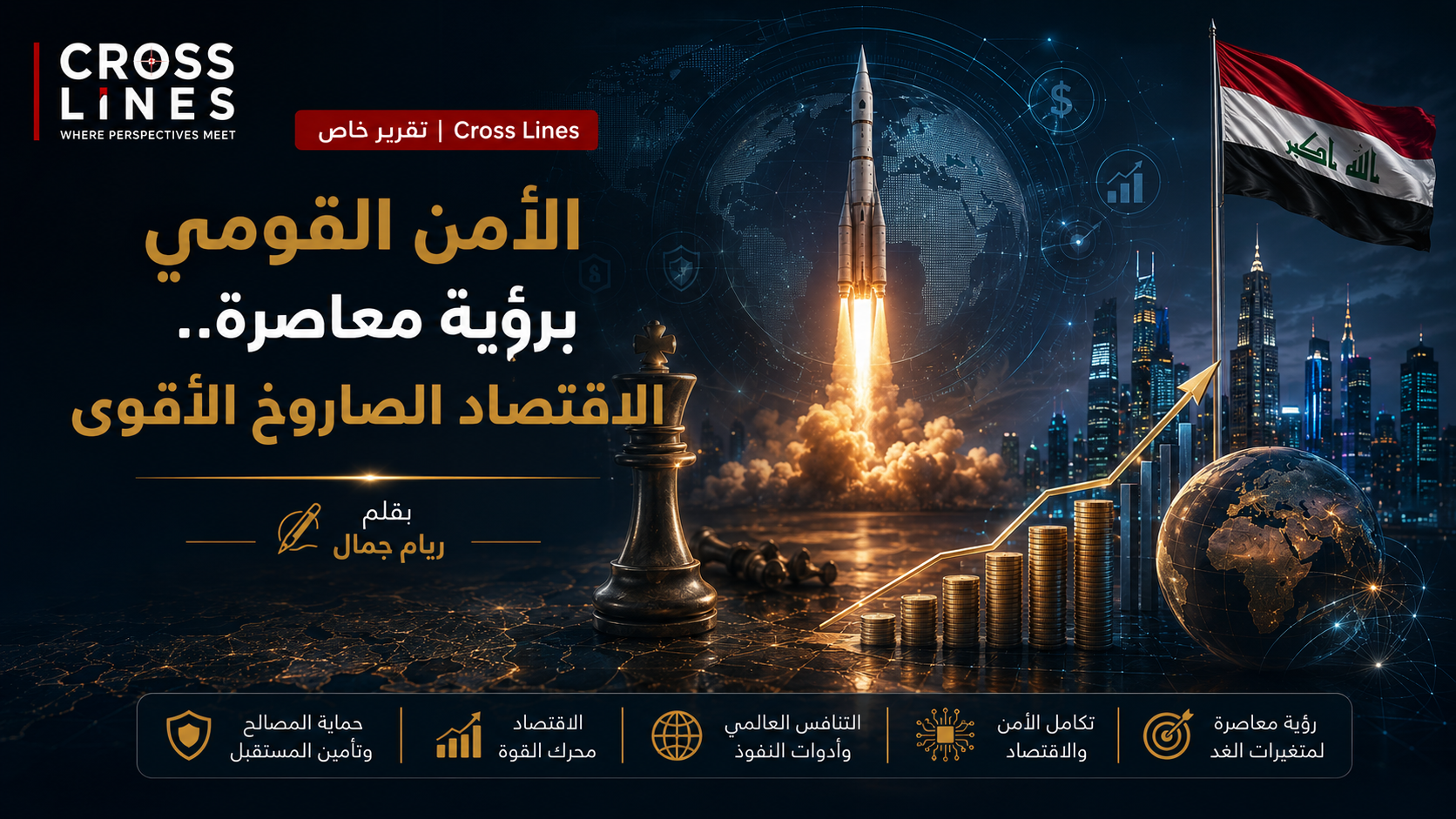
National Security from a Contemporary Perspective: The Economy as the Strongest Missile

Riyam Jamal
Writer at CROSS LINES
Amid rising geopolitical tensions, wars are no longer fought with weapons alone. Economic tools have become an effective means of imposing influence and achieving political gains.
Amid rising geopolitical tensions, wars are no longer fought with weapons alone. Economic tools have become an effective means of imposing influence and achieving political gains. This article discusses how international conflicts have changed the rules of the global economy.
Modern wars are no longer measured by the number of tanks and aircraft, but by the scale of economic sanctions, tariffs, control over energy, supply chains, and technology. Today, a state can inflict economic losses on its rivals without firing a single bullet, simply by disrupting trade or restricting access to global markets.
In June 2026, international reports confirmed that geopolitical tensions had become one of the most influential factors affecting the global economy, after their impact was reflected in energy prices, inflation, investment, and the movement of international trade.
The Economy: From a Tool for Growth to an Instrument of Influence
Over the past decade, the nature of international relations has witnessed a clear transformation. The economy is no longer merely a means of achieving development; it has become a tool for managing conflicts and securing political gains.
Today, states use multiple instruments, including financial sanctions, tariffs, restrictions on technology exports, control over energy supplies, and influence over global maritime routes. These tools no longer affect governments alone; their impact now reaches the lives of millions of people around the world.
In recent weeks, international economic institutions have warned that continued tensions in the Middle East could lead to slower global growth, higher inflation, and rising energy prices, especially if trade movement through vital maritime corridors is disrupted. The World Trade Organization has also pointed to signs of a slowdown in global goods trade as a result of geopolitical disturbances.
Is Iraq Quickly Affected?
Although Iraq is not a direct party to most global economic conflicts, it is quickly affected by them. This is because its economy relies heavily on oil, while local markets depend on imports to meet a large part of their needs.
For this reason, any disruption in energy prices, shipping costs, or global trade movement is quickly reflected in prices, investment, and public revenues. At the same time, however, current transformations may offer Iraq an opportunity if it succeeds in investing in its geographic location, diversifying its economy, and improving the investment environment instead of relying almost entirely on oil revenues.
Sanctions Have Become More Dangerous Than Wars
In many cases, economic sanctions may continue for many years, affecting growth, investment, currency value, and living standards, while military operations may end within a shorter period. Therefore, economic pressure tools have become an essential part of modern conflicts, and their effects extend to countries that are not directly involved in the dispute.
The world is currently witnessing a clear shift in the nature of conflict between states. Military power alone no longer determines the balance of influence; the economy has become one of the most important tools of impact and pressure.
Has the Concept of National Security Changed?
National security is no longer measured only by military capability. It now includes energy security, food security, technological security, and the security of supply chains.
Recent crises have shown that disrupting a maritime strait, imposing restrictions on technology exports, or rising energy prices can create economic consequences that extend across entire continents within days. This reality is pushing governments to reconsider their economic policies as part of their broader security strategies.
A Future Outlook
Current indicators suggest that the world is moving toward a stage in which the economy will become a central element of international competition. The importance of diversifying energy sources, securing supply chains, developing local industries, and reducing dependence on a single resource or partner will continue to grow.
For Iraq, the question is no longer: how can it benefit from rising oil prices? Rather, the question has become: how can it build an economy capable of withstanding changes in the rules of the global game?
The past years have proven that modern conflicts are not managed on battlefields alone, but also in banks, ports, energy markets, trade networks, and shipping routes. In a world where politics and economics are deeply intertwined, the countries most capable of adapting are the ones most capable of protecting their interests.
As for Iraq, which stands at an economic crossroads, its ability to invest in its geographic location, diversify its economy, and strengthen the investment environment may determine whether it remains vulnerable to global crises or becomes a more active player in the new economic order.
Modern wars are no longer measured by the number of tanks and aircraft, but by the scale of economic sanctions, tariffs, control over energy, supply chains, and technology. Today, a state can inflict economic losses on its rivals without firing a single bullet, simply by disrupting trade or restricting access to global markets.
In June 2026, international reports confirmed that geopolitical tensions had become one of the most influential factors affecting the global economy, after their impact was reflected in energy prices, inflation, investment, and the movement of international trade.
The Economy: From a Tool for Growth to an Instrument of Influence
Over the past decade, the nature of international relations has witnessed a clear transformation. The economy is no longer merely a means of achieving development; it has become a tool for managing conflicts and securing political gains.
Today, states use multiple instruments, including financial sanctions, tariffs, restrictions on technology exports, control over energy supplies, and influence over global maritime routes. These tools no longer affect governments alone; their impact now reaches the lives of millions of people around the world.
In recent weeks, international economic institutions have warned that continued tensions in the Middle East could lead to slower global growth, higher inflation, and rising energy prices, especially if trade movement through vital maritime corridors is disrupted. The World Trade Organization has also pointed to signs of a slowdown in global goods trade as a result of geopolitical disturbances.
Is Iraq Quickly Affected?
Although Iraq is not a direct party to most global economic conflicts, it is quickly affected by them. This is because its economy relies heavily on oil, while local markets depend on imports to meet a large part of their needs.
For this reason, any disruption in energy prices, shipping costs, or global trade movement is quickly reflected in prices, investment, and public revenues. At the same time, however, current transformations may offer Iraq an opportunity if it succeeds in investing in its geographic location, diversifying its economy, and improving the investment environment instead of relying almost entirely on oil revenues.
Sanctions Have Become More Dangerous Than Wars
In many cases, economic sanctions may continue for many years, affecting growth, investment, currency value, and living standards, while military operations may end within a shorter period. Therefore, economic pressure tools have become an essential part of modern conflicts, and their effects extend to countries that are not directly involved in the dispute.
The world is currently witnessing a clear shift in the nature of conflict between states. Military power alone no longer determines the balance of influence; the economy has become one of the most important tools of impact and pressure.
Has the Concept of National Security Changed?
National security is no longer measured only by military capability. It now includes energy security, food security, technological security, and the security of supply chains.
Recent crises have shown that disrupting a maritime strait, imposing restrictions on technology exports, or rising energy prices can create economic consequences that extend across entire continents within days. This reality is pushing governments to reconsider their economic policies as part of their broader security strategies.
A Future Outlook
Current indicators suggest that the world is moving toward a stage in which the economy will become a central element of international competition. The importance of diversifying energy sources, securing supply chains, developing local industries, and reducing dependence on a single resource or partner will continue to grow.
For Iraq, the question is no longer: how can it benefit from rising oil prices? Rather, the question has become: how can it build an economy capable of withstanding changes in the rules of the global game?
The past years have proven that modern conflicts are not managed on battlefields alone, but also in banks, ports, energy markets, trade networks, and shipping routes. In a world where politics and economics are deeply intertwined, the countries most capable of adapting are the ones most capable of protecting their interests.
As for Iraq, which stands at an economic crossroads, its ability to invest in its geographic location, diversify its economy, and strengthen the investment environment may determine whether it remains vulnerable to global crises or becomes a more active player in the new economic order.
🔗 Share Article
For Context
Related reads from the same topic or latest developments