Between Western Restraint and China’s Momentum: Artificial Intelligence and the Battle for Global Leadership

Doaa Hazza Al-Jabri
Writer at CROSS LINES
As China accelerates its efforts to consolidate its position as a global superpower in artificial intelligence, a debate is gaining ground in Western circles that would have seemed unlikely only a few years ago: Should the development of artificial intellig...
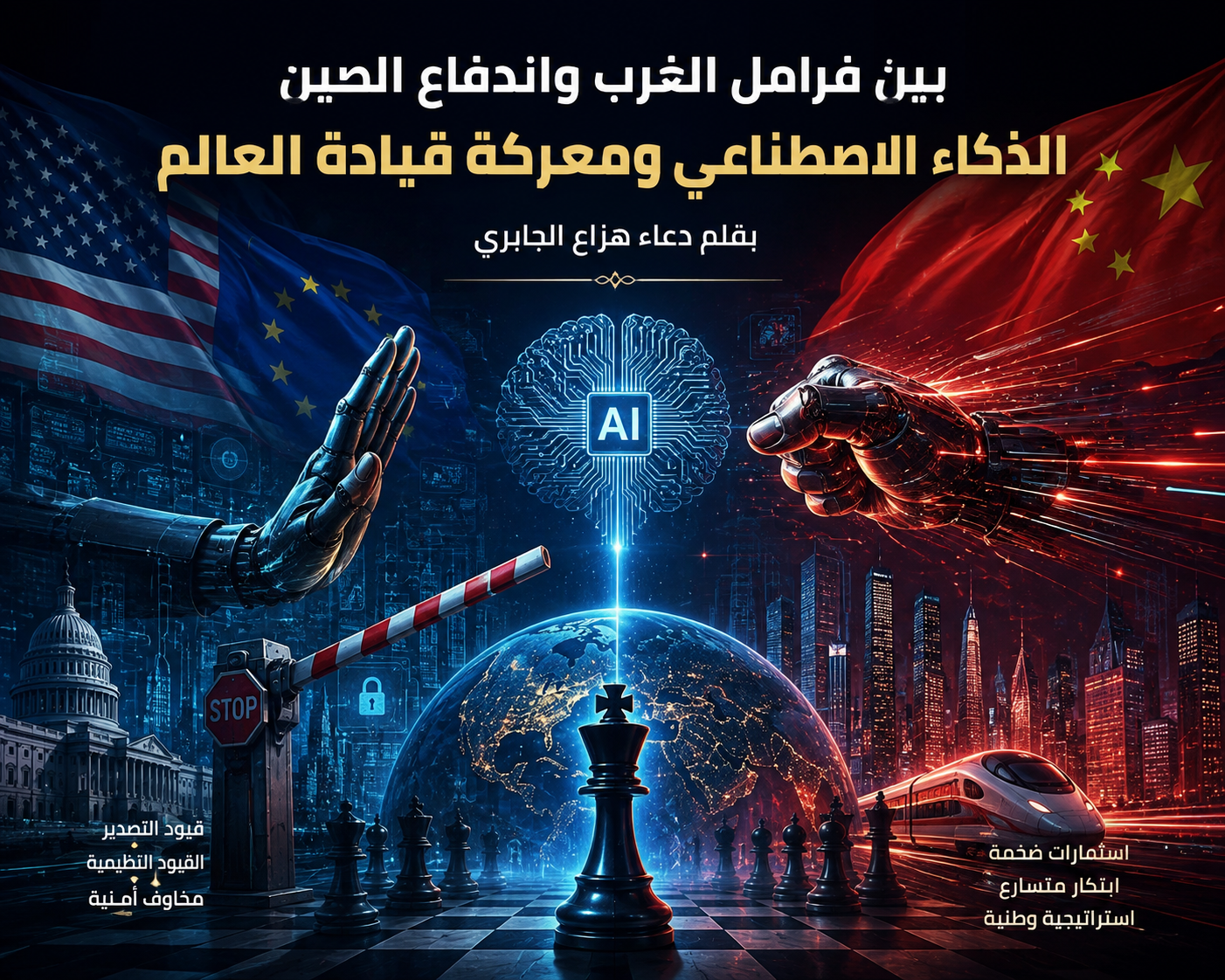
As China accelerates its efforts to consolidate its position as a global superpower in artificial intelligence, a debate is gaining ground in Western circles that would have seemed unlikely only a few years ago: Should the development of artificial intelligence be slowed to prevent it from escaping human control, or would such restraint simply give China more room to expand its technological and strategic advantage?
On the surface, this appears to be a technical question. In reality, however, it reveals one of the most complex struggles of the twenty-first century. This is not merely a battle over software and algorithms, but over the future of global leadership and who will write the next chapter in the history of human civilization.
The question is no longer simply: Who possesses artificial intelligence? It has become: Who has the right to slow it down?
When the West considers placing limits on the advance of intelligent machines, the debate is not only about producing a smarter model or a faster processor. It resembles a philosophical trial of the human mind as it confronts perhaps the most consequential invention it has created since the discovery of fire.
The paradox is that the West, which led the digital revolution for decades, is now discussing the possibility of slowing artificial intelligence in the name of ethics and safety, while China continues to advance rapidly in investment, research, and practical application.
China appears to understand that whoever reaches the summit of artificial intelligence first will not merely possess the most advanced technology. It will gain access to the keys of the global economy, the tools of political influence, and the ability to reshape the balance of power for decades to come.
This raises a deeper question: Is the fear truly about artificial intelligence itself, or about the possibility that global leadership may shift to whoever masters it first?
Technology has never been neutral. Whoever controls the direction of scientific progress will later draw the maps of the economy, reshape political power, and define the new language of influence.
Artificial intelligence is therefore no longer merely a program designed to assist human beings. It is becoming the currency of future power and a tool capable of reorganizing the international order without a single shot being fired.
Within this increasingly integrated global technological system, China views artificial intelligence as the infrastructure of the future.
The West, meanwhile, faces an existential dilemma: How can it preserve its scientific superiority without unleashing a force that may eventually exceed humanity’s ability to control it?
This is not simply a confrontation between East and West. It is a contest between two philosophies.
One believes that boldness is the path to leadership. The other insists that ethics must come before speed.
For this reason, artificial intelligence is not merely a technological issue. It is fundamentally a civilizational one.
It is a question that will determine the meaning of power, the limits of freedom, and the value of human beings in an age when machines may become more capable of reasoning, while remaining entirely incapable of possessing a conscience.
The central question therefore remains: Can humanity slow down its own invention without slowing the course of history?
Or will history, as it so often has, favor those who dare to cross the threshold first, leaving the hesitant to explain later why they lost?
In the artificial intelligence race, the winner will not necessarily be the one that builds the smartest machine, but the one that succeeds in making that machine an extension of its civilizational vision.
As for nations that merely watch the race from the sidelines, they will not own the future of technology. They will live in a future designed by others.
On the surface, this appears to be a technical question. In reality, however, it reveals one of the most complex struggles of the twenty-first century. This is not merely a battle over software and algorithms, but over the future of global leadership and who will write the next chapter in the history of human civilization.
The question is no longer simply: Who possesses artificial intelligence? It has become: Who has the right to slow it down?
When the West considers placing limits on the advance of intelligent machines, the debate is not only about producing a smarter model or a faster processor. It resembles a philosophical trial of the human mind as it confronts perhaps the most consequential invention it has created since the discovery of fire.
The paradox is that the West, which led the digital revolution for decades, is now discussing the possibility of slowing artificial intelligence in the name of ethics and safety, while China continues to advance rapidly in investment, research, and practical application.
China appears to understand that whoever reaches the summit of artificial intelligence first will not merely possess the most advanced technology. It will gain access to the keys of the global economy, the tools of political influence, and the ability to reshape the balance of power for decades to come.
This raises a deeper question: Is the fear truly about artificial intelligence itself, or about the possibility that global leadership may shift to whoever masters it first?
Technology has never been neutral. Whoever controls the direction of scientific progress will later draw the maps of the economy, reshape political power, and define the new language of influence.
Artificial intelligence is therefore no longer merely a program designed to assist human beings. It is becoming the currency of future power and a tool capable of reorganizing the international order without a single shot being fired.
Within this increasingly integrated global technological system, China views artificial intelligence as the infrastructure of the future.
The West, meanwhile, faces an existential dilemma: How can it preserve its scientific superiority without unleashing a force that may eventually exceed humanity’s ability to control it?
This is not simply a confrontation between East and West. It is a contest between two philosophies.
One believes that boldness is the path to leadership. The other insists that ethics must come before speed.
For this reason, artificial intelligence is not merely a technological issue. It is fundamentally a civilizational one.
It is a question that will determine the meaning of power, the limits of freedom, and the value of human beings in an age when machines may become more capable of reasoning, while remaining entirely incapable of possessing a conscience.
The central question therefore remains: Can humanity slow down its own invention without slowing the course of history?
Or will history, as it so often has, favor those who dare to cross the threshold first, leaving the hesitant to explain later why they lost?
In the artificial intelligence race, the winner will not necessarily be the one that builds the smartest machine, but the one that succeeds in making that machine an extension of its civilizational vision.
As for nations that merely watch the race from the sidelines, they will not own the future of technology. They will live in a future designed by others.
🔗 Share Article
For Context
Related reads from the same topic or latest developments