Views🌐 Available in EnglishCorrespondent ReportAugust 2, 2026
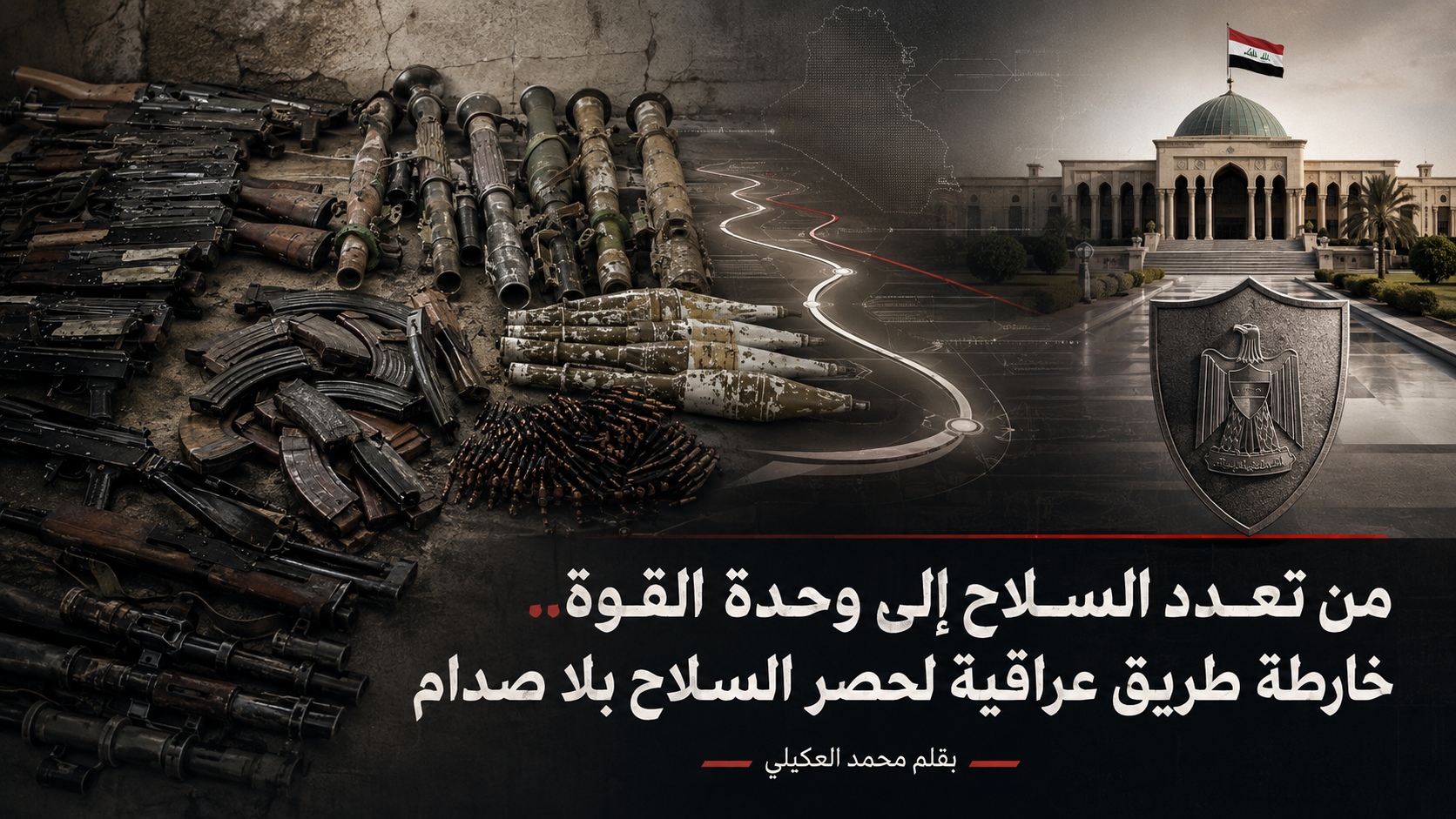
From Multiple Armed Groups to Unified State Authority: An Iraqi Roadmap for Consolidating Arms Without Conflict
Correspondent Report
Mohammed Al-Akili
Baghdad
CROSS LINES
Mohammed Al-Aqili
Writer at CROSS LINES
This article outlines a peaceful roadmap for implementing Iraq's policy of restricting the possession of weapons to the state, avoiding armed confrontation with factions that have yet to come under state authority, while advocating for a fair and inclusive approach to their integration.
Iraq's policy of consolidating all arms under state control remains in a cautious implementation phase. While several political forces with armed wings have welcomed the initiative and surrendered part of their weapons to the Iraqi government, other factions continue to reject integration under the state's authority. They justify their position by pointing to the continued presence of the International Coalition forces in Iraq—a reservation that some consider understandable and one the government may choose to address through negotiation, particularly after setting September 30 as the date for the coalition's final withdrawal, rather than pursuing confrontations that would benefit no one.
restricting the possession of weapons to the state | Mohammed Al-Akili
In this context, several peaceful approaches could be pursued to encourage reluctant factions to integrate into Iraq's official security framework. It is important to recognize that these groups are fundamentally Iraqi organizations whose members participated in the country's military campaign against ISIS between 2014 and 2018. Many already operate brigades within the Popular Mobilization Forces (PMF), which function under the authority of the Commander-in-Chief of the Armed Forces as an official state institution.
From this perspective, practical pathways exist to encourage their participation in the state's arms-consolidation policy. Their fighters and military experience could be incorporated into Iraq's security institutions, transforming them from a potential source of concern into an asset for counterterrorism, border protection, and emergency response—provided they operate fully under the law, the national chain of command, and the exclusive authority of the Iraqi state over security decisions and the use of force.
Mistakes the State Must Avoid
It would be a mistake to treat the issue of state monopoly over arms as merely collecting weapons and closing military headquarters. In Iraq, weapons have become intertwined with political identities, social structures, wartime experiences, security concerns, networks of influence, and both domestic and regional relationships.
Attempting to resolve this issue through sudden directives or sweeping security operations could lead some parties to perceive the process as a threat to their status and identity. What should be an institutional reform could instead evolve into a crisis of trust—or even a confrontation that serves no one's interests.
A more effective approach would emphasize that the state is not asking these fighters to abandon their national role, but rather to continue serving it from within official institutions and under legitimate command. Instead of portraying armed factions as inevitable adversaries, disciplined members should be viewed as valuable military and human resources that can be reorganized into a stronger component of Iraq's national defense system.
Such an approach does not imply tolerating parallel chains of command or granting permanent exceptional status to any group. Rather, it means creating a legal framework that preserves dignity, rights, and past sacrifices while requiring an unambiguous commitment to unified command, centralized financing, and the state's exclusive authority over arms.
The Safest Path Toward a State Monopoly on Arms
The most sustainable path toward consolidating weapons under state authority lies neither in waging war against the factions nor in accepting the indefinite existence of independent armed groups. Instead, it requires a comprehensive national settlement capable of transforming fragmented military power into a unified national force.
Such a settlement should begin with binding dialogue, followed by a comprehensive inventory of weapons and personnel, the surrender of heavy weaponry, the individual integration of qualified fighters into official security institutions, support for those transitioning into civilian life, the separation of political activity from armed leadership, and the dismantling of parallel systems of financing and decision-making.
The objective of integration is not to purchase silence or postpone the problem. It is to absorb the experience, capabilities, and sacrifices of these fighters into the institutions of the Iraqi state while bringing all competing military structures to an end.
A wise state does not turn its own citizens into enemies. At the same time, it cannot accept a partner in sovereignty. By combining firm enforcement with fair guarantees, Iraq can transform fragmented armed groups from forces that risk confrontation into a unified national force operating under a single flag, a single command, and one sovereign national decision.
🔗 Share Article
For Context
Related reads from the same topic or latest developments