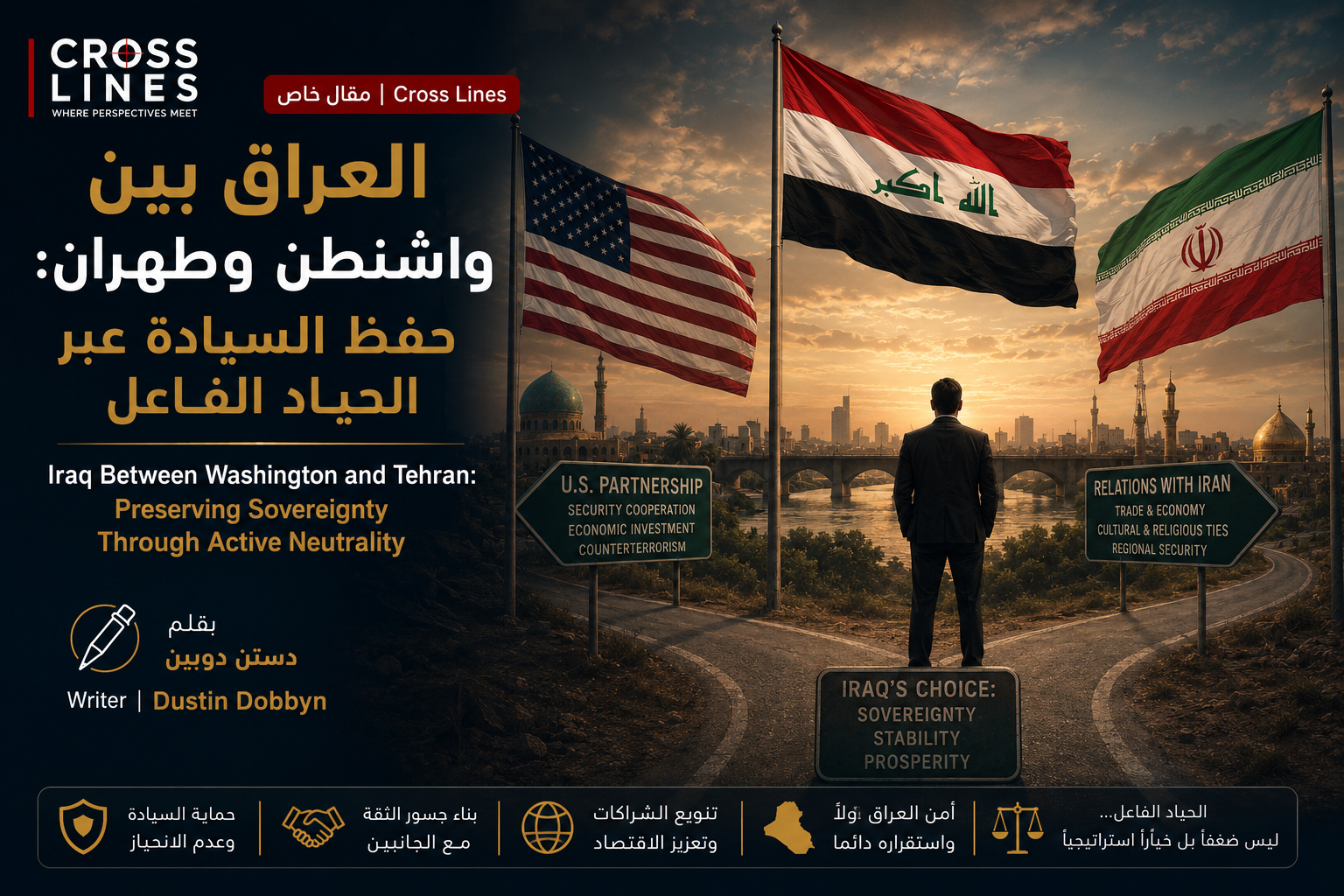
Iraq Between Washington and Tehran: Preserving Sovereignty Through Active Neutrality

Dustin Dobbyn
Writer at CROSS LINES
Iraq Between Washington and Tehran: Preserving Sovereignty Through Active Neutrality As geopolitical tensions continue to rise across the Middle East and ceasefires repeatedly fail to hold, Iraq finds itself caught between two competing powers.
Iraq Between Washington and Tehran: Preserving Sovereignty Through Active Neutrality
As geopolitical tensions continue to rise across the Middle East and ceasefires repeatedly fail to hold, Iraq finds itself caught between two competing powers. The decisions made by Baghdad in the coming months could determine whether Iraq remains a stabilizing force in the region or once again becomes the center of a broader proxy conflict.
Many people outside the region, particularly in the United States, may view the current tensions as a dispute between two countries thousands of miles away. For those living in the Middle East, however, the reality is much different. Every escalation brings uncertainty, raising concerns about security, economic stability, and the possibility that neighboring countries could be drawn into a conflict they never sought.
Iraq occupies one of the world’s most strategically important geopolitical positions. The ongoing rivalry between the United States and Iran places Baghdad in an exceptionally difficult situation. Iraq maintains deep political, economic, religious, and security ties with Iran while also relying on a long-standing strategic partnership with the United States. If Iraq leans too heavily toward either side, it risks becoming a battlefield for another proxy war—a position the country has endured far too many times throughout its modern history.
For that reason, Iraq’s best course of action is to preserve its sovereignty above all else. The Iraqi government should continue making it clear that military operations conducted within its borders must occur only with the authorization of the Iraqi state. By reinforcing its constitutional commitment to national sovereignty, Iraq can demonstrate that its territory will not be used as a launching point for conflicts between outside powers.
At the same time, Iraq should continue maintaining constructive relationships with both Washington and Tehran. Its cooperation with the United States has been instrumental in the campaign against ISIS and in strengthening Iraq’s security forces. Likewise, Iraq’s religious, cultural, and economic ties with Iran remain significant and have helped maintain diplomatic channels during periods of heightened regional tension. Preserving both relationships serves Iraq’s national interests far better than choosing one side over the other.
The central takeaway is simple: Iraq benefits far more from balanced diplomacy than from exclusive alignment with either country. Maintaining open communication with both the United States and Iran allows Iraq to protect its national interests while reducing the likelihood of becoming the next battleground in a regional confrontation. The country’s future depends on reconstruction, economic growth, and political stability—not another prolonged conflict fought within its borders.
Strengthening Iraq from within should remain the government’s highest priority. Continued investment in the Iraqi Armed Forces, federal police, border security, intelligence capabilities, and judicial institutions will help reduce foreign influence while reinforcing the government’s ability to protect its own people. A stronger Iraqi state is better positioned to defend its sovereignty and make independent decisions free from outside pressure.
Iraq also has a unique opportunity to continue serving as a regional mediator rather than a participant in great-power competition. In recent years, Baghdad has demonstrated that diplomacy can be an effective tool for reducing tensions between neighboring states. By expanding regional cooperation, strengthening its economy, and building resilient national institutions, Iraq can further establish itself as a force for stability throughout the Middle East.
Ultimately, Iraq’s most effective strategy is one of active neutrality. This does not mean remaining passive in the face of regional challenges. Rather, it means protecting Iraq’s territorial integrity, maintaining productive relationships with both the United States and Iran, and ensuring that every decision is guided first and foremost by the interests of the Iraqi people. In an increasingly unstable region, preserving sovereignty, promoting diplomacy, and strengthening national institutions offer Iraq its best path toward lasting peace and long-term stability.
As geopolitical tensions continue to rise across the Middle East and ceasefires repeatedly fail to hold, Iraq finds itself caught between two competing powers. The decisions made by Baghdad in the coming months could determine whether Iraq remains a stabilizing force in the region or once again becomes the center of a broader proxy conflict.
Many people outside the region, particularly in the United States, may view the current tensions as a dispute between two countries thousands of miles away. For those living in the Middle East, however, the reality is much different. Every escalation brings uncertainty, raising concerns about security, economic stability, and the possibility that neighboring countries could be drawn into a conflict they never sought.
Iraq occupies one of the world’s most strategically important geopolitical positions. The ongoing rivalry between the United States and Iran places Baghdad in an exceptionally difficult situation. Iraq maintains deep political, economic, religious, and security ties with Iran while also relying on a long-standing strategic partnership with the United States. If Iraq leans too heavily toward either side, it risks becoming a battlefield for another proxy war—a position the country has endured far too many times throughout its modern history.
For that reason, Iraq’s best course of action is to preserve its sovereignty above all else. The Iraqi government should continue making it clear that military operations conducted within its borders must occur only with the authorization of the Iraqi state. By reinforcing its constitutional commitment to national sovereignty, Iraq can demonstrate that its territory will not be used as a launching point for conflicts between outside powers.
At the same time, Iraq should continue maintaining constructive relationships with both Washington and Tehran. Its cooperation with the United States has been instrumental in the campaign against ISIS and in strengthening Iraq’s security forces. Likewise, Iraq’s religious, cultural, and economic ties with Iran remain significant and have helped maintain diplomatic channels during periods of heightened regional tension. Preserving both relationships serves Iraq’s national interests far better than choosing one side over the other.
The central takeaway is simple: Iraq benefits far more from balanced diplomacy than from exclusive alignment with either country. Maintaining open communication with both the United States and Iran allows Iraq to protect its national interests while reducing the likelihood of becoming the next battleground in a regional confrontation. The country’s future depends on reconstruction, economic growth, and political stability—not another prolonged conflict fought within its borders.
Strengthening Iraq from within should remain the government’s highest priority. Continued investment in the Iraqi Armed Forces, federal police, border security, intelligence capabilities, and judicial institutions will help reduce foreign influence while reinforcing the government’s ability to protect its own people. A stronger Iraqi state is better positioned to defend its sovereignty and make independent decisions free from outside pressure.
Iraq also has a unique opportunity to continue serving as a regional mediator rather than a participant in great-power competition. In recent years, Baghdad has demonstrated that diplomacy can be an effective tool for reducing tensions between neighboring states. By expanding regional cooperation, strengthening its economy, and building resilient national institutions, Iraq can further establish itself as a force for stability throughout the Middle East.
Ultimately, Iraq’s most effective strategy is one of active neutrality. This does not mean remaining passive in the face of regional challenges. Rather, it means protecting Iraq’s territorial integrity, maintaining productive relationships with both the United States and Iran, and ensuring that every decision is guided first and foremost by the interests of the Iraqi people. In an increasingly unstable region, preserving sovereignty, promoting diplomacy, and strengthening national institutions offer Iraq its best path toward lasting peace and long-term stability.
🔗 Share Article
For Context
Related reads from the same topic or latest developments