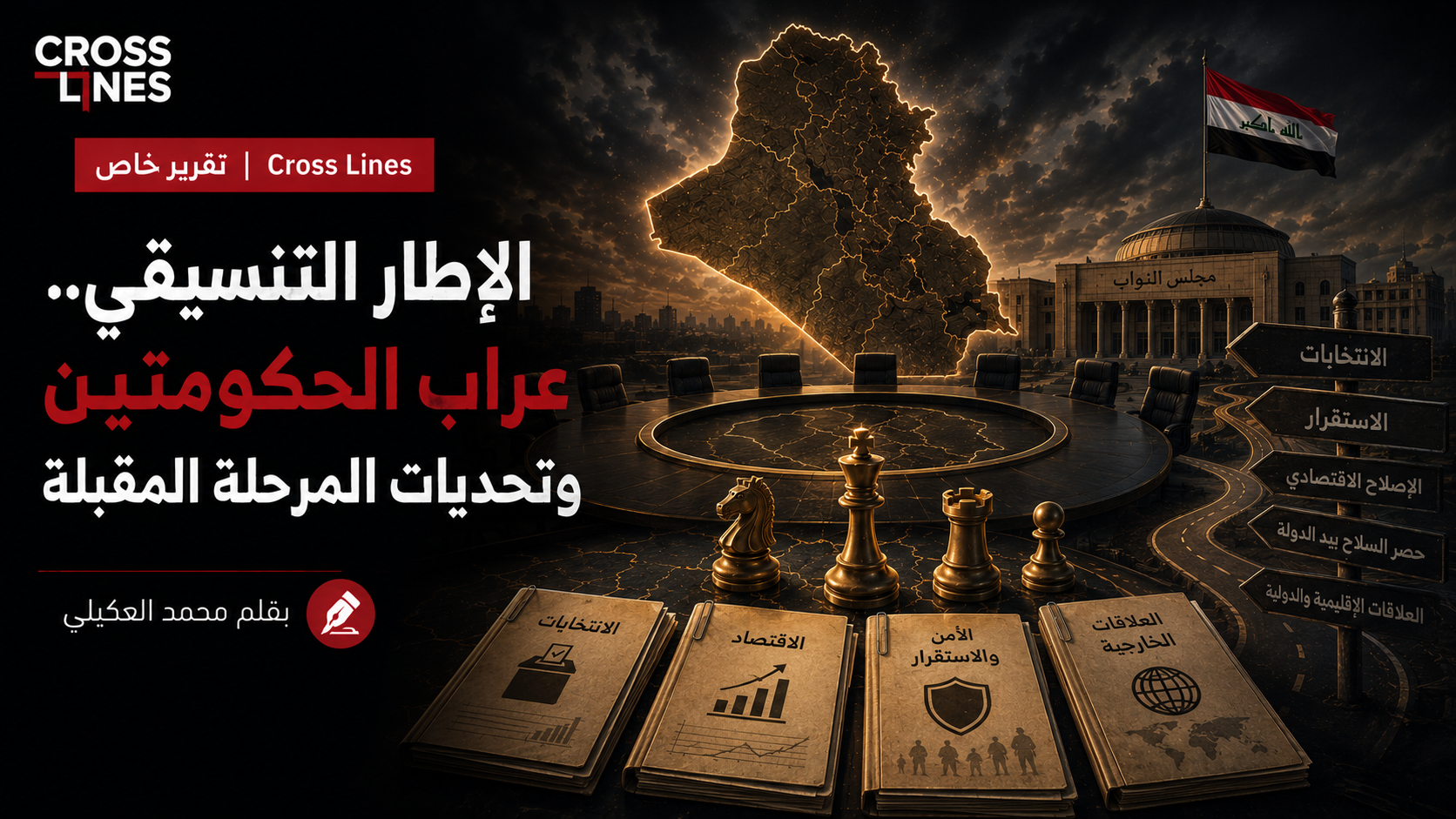
The Coordination Framework: The Godfather of Two Governments and the Challenges of the Next Phase

Mohammed Al-Aqili
Writer at CROSS LINES
**The Coordination Framework: The Godfather of Two Governments and the Challenges of the Next Phase** After the Coordination Framework succeeded in forming two consecutive governments following the withdrawal of the Sadrist Movement from the Iraqi political...
**The Coordination Framework: The Godfather of Two Governments and the Challenges of the Next Phase**
After the Coordination Framework succeeded in forming two consecutive governments following the withdrawal of the Sadrist Movement from the Iraqi political scene, this Shiite bloc assumed a major responsibility: proving its ability to restore public confidence in the political process. This is what it sought to do during the government of Mohammed Shia’ Al-Sudani. Today, however, it faces a new challenge: the government of Prime Minister Ali Al-Zaidi, whose administrative requirements differ greatly from those of Al-Sudani’s government.
Since the formation of Prime Minister Mohammed Shia’ Al-Sudani’s government in late 2022, the Iraqi political scene has entered a new phase in the management of power, led by the Coordination Framework as the largest parliamentary bloc and the political umbrella sponsoring the government. This phase was characterized by “political realism” and a focus on the services file in order to calm the street and attempt to contain accumulated structural crises.
As we enter 2026, the Coordination Framework stands before decisive obligations that require a shift from the mentality of “managing daily crises” toward the horizon of “building a stable state,” particularly in the files of sovereignty, security, the economy, and international relations.
**First: A Reading of the Coordination Framework’s Method of Managing Power**
The Coordination Framework’s approach to governance through Al-Sudani’s government was marked by two main mechanisms:
**A. Service diplomacy and quick achievements:**
The Framework understood that restoring the trust of the Iraqi street passes through the gateway of reconstruction. Therefore, the government focused on projects to relieve traffic congestion, develop infrastructure, and reactivate stalled projects. This direction gave the political system an “oxygen dose” and created a general sense of field stability.
**B. Cautious internal balance:**
The Framework sought to preserve the “State Administration Coalition,” which includes Kurdish and Sunni forces alongside Shiite forces, through mutual concessions, avoiding zero-sum confrontations, and attempting to absorb the absence of the Sadrist Movement from the parliamentary scene without provoking it politically.
Despite these relative successes, this phase was marked by a “duality of decision-making” in some sovereign files, where the official commitments of the government overlapped with the ideological orientations of some factions within the Framework, especially during periods of regional crises.
**Second: The Necessary Steps to Advance Iraq Politically, Security-wise, and Economically**
In order for this temporary stability to transform into a genuine and sustainable renaissance, the Coordination Framework must take courageous and structural decisions.
**1. The Political and Security Track**
**A. Extending sovereignty and monopolizing legitimate violence through comprehensive institutionalization:**
This requires absolute and unconditional support for ending all manifestations of weapons “outside the framework of the state,” and placing the decision of war and peace entirely in the hands of the Commander-in-Chief of the Armed Forces.
**B. Resolving the identity of the factions:**
The Framework, as the political sponsor, must oblige all armed wings to fully relinquish their military arsenals outside the framework of the state, and transform the Popular Mobilization Forces into a professional military institution fully subject to official regulations, away from partisan influence.
**C. Reforming the electoral system and achieving reconciliation:**
A competitive and attractive political environment must be built to ensure the return of boycotting forces, such as the Sadrist Movement and opposition groups, to civil competition, in order to protect the system from sudden street shocks.
**2. The Economic Track: From Rentierism to Sustainable Development**
**A. Activating major strategic projects:**
Ambition must not be limited to paving roads. Rather, it should include adopting mega-projects such as the “Development Road” and the development of the “Grand Faw Port,” turning Iraq into an international trade corridor linking East and West.
**B. Drying up the sources of corruption and restructuring public finance:**
This requires striking at the shadow economies affiliated with some political forces, fully controlling border crossings, and continuing the automation of the banking system to integrate it into the global financial system, in line with World Bank recommendations.
**C. Buying weapons and supporting reconstruction:**
Investment budgets should be allocated to purchase medium weapons from tribes and individuals, while redirecting these funds toward youth employment projects to reduce unemployment, which is one of the causes of security instability.
**Third: Building Balanced and Long-Term Relations with the World and the Great Powers**
Iraq’s geopolitical position requires the Coordination Framework to adopt a foreign-policy doctrine based on “positive balance and shared interests,” rather than the politics of axes.
**A. Relations with the United States: Partnership, not dependency or hostility**
The relationship with Washington must move beyond the purely military framework of the international coalition toward the full activation of the Strategic Framework Agreement in the fields of technology, education, energy, and investment. Iraq needs American technology to develop its oil and gas fields and desalinate water.
**B. Relations with emerging great powers: China and Russia**
Iraq should open up to Beijing through oil-for-infrastructure agreements and benefit from Russian capabilities in the energy sector, provided this is done with pragmatism that does not provoke the Western financial system, which controls Iraq’s oil revenues.
**C. Zeroing out regional crises**
Iraq should continue playing the role of “mediator and reconciler” in the Middle East, as it has done in bringing regional powers closer together. This would turn Baghdad into a meeting point for international interests rather than an arena for settling scores.
The success of the Coordination Framework in governing Iraq is not measured by its ability to remain in power, but by the extent of its courage in building a state of institutions. In 2026, Iraq possesses a historic opportunity thanks to financial abundance and relative security stability. Transforming this stability into a lasting renaissance requires prioritizing the interest of the “state” over the interest of the “component or party,” and creating a foreign policy that respects Iraq’s sovereignty, makes it a reliable partner for the world, and turns it into a gateway for geopolitical development in the region. This is what some political forces have already begun working to achieve, particularly after moving practically toward the process of restricting weapons to the hands of the state.
After the Coordination Framework succeeded in forming two consecutive governments following the withdrawal of the Sadrist Movement from the Iraqi political scene, this Shiite bloc assumed a major responsibility: proving its ability to restore public confidence in the political process. This is what it sought to do during the government of Mohammed Shia’ Al-Sudani. Today, however, it faces a new challenge: the government of Prime Minister Ali Al-Zaidi, whose administrative requirements differ greatly from those of Al-Sudani’s government.
Since the formation of Prime Minister Mohammed Shia’ Al-Sudani’s government in late 2022, the Iraqi political scene has entered a new phase in the management of power, led by the Coordination Framework as the largest parliamentary bloc and the political umbrella sponsoring the government. This phase was characterized by “political realism” and a focus on the services file in order to calm the street and attempt to contain accumulated structural crises.
As we enter 2026, the Coordination Framework stands before decisive obligations that require a shift from the mentality of “managing daily crises” toward the horizon of “building a stable state,” particularly in the files of sovereignty, security, the economy, and international relations.
**First: A Reading of the Coordination Framework’s Method of Managing Power**
The Coordination Framework’s approach to governance through Al-Sudani’s government was marked by two main mechanisms:
**A. Service diplomacy and quick achievements:**
The Framework understood that restoring the trust of the Iraqi street passes through the gateway of reconstruction. Therefore, the government focused on projects to relieve traffic congestion, develop infrastructure, and reactivate stalled projects. This direction gave the political system an “oxygen dose” and created a general sense of field stability.
**B. Cautious internal balance:**
The Framework sought to preserve the “State Administration Coalition,” which includes Kurdish and Sunni forces alongside Shiite forces, through mutual concessions, avoiding zero-sum confrontations, and attempting to absorb the absence of the Sadrist Movement from the parliamentary scene without provoking it politically.
Despite these relative successes, this phase was marked by a “duality of decision-making” in some sovereign files, where the official commitments of the government overlapped with the ideological orientations of some factions within the Framework, especially during periods of regional crises.
**Second: The Necessary Steps to Advance Iraq Politically, Security-wise, and Economically**
In order for this temporary stability to transform into a genuine and sustainable renaissance, the Coordination Framework must take courageous and structural decisions.
**1. The Political and Security Track**
**A. Extending sovereignty and monopolizing legitimate violence through comprehensive institutionalization:**
This requires absolute and unconditional support for ending all manifestations of weapons “outside the framework of the state,” and placing the decision of war and peace entirely in the hands of the Commander-in-Chief of the Armed Forces.
**B. Resolving the identity of the factions:**
The Framework, as the political sponsor, must oblige all armed wings to fully relinquish their military arsenals outside the framework of the state, and transform the Popular Mobilization Forces into a professional military institution fully subject to official regulations, away from partisan influence.
**C. Reforming the electoral system and achieving reconciliation:**
A competitive and attractive political environment must be built to ensure the return of boycotting forces, such as the Sadrist Movement and opposition groups, to civil competition, in order to protect the system from sudden street shocks.
**2. The Economic Track: From Rentierism to Sustainable Development**
**A. Activating major strategic projects:**
Ambition must not be limited to paving roads. Rather, it should include adopting mega-projects such as the “Development Road” and the development of the “Grand Faw Port,” turning Iraq into an international trade corridor linking East and West.
**B. Drying up the sources of corruption and restructuring public finance:**
This requires striking at the shadow economies affiliated with some political forces, fully controlling border crossings, and continuing the automation of the banking system to integrate it into the global financial system, in line with World Bank recommendations.
**C. Buying weapons and supporting reconstruction:**
Investment budgets should be allocated to purchase medium weapons from tribes and individuals, while redirecting these funds toward youth employment projects to reduce unemployment, which is one of the causes of security instability.
**Third: Building Balanced and Long-Term Relations with the World and the Great Powers**
Iraq’s geopolitical position requires the Coordination Framework to adopt a foreign-policy doctrine based on “positive balance and shared interests,” rather than the politics of axes.
**A. Relations with the United States: Partnership, not dependency or hostility**
The relationship with Washington must move beyond the purely military framework of the international coalition toward the full activation of the Strategic Framework Agreement in the fields of technology, education, energy, and investment. Iraq needs American technology to develop its oil and gas fields and desalinate water.
**B. Relations with emerging great powers: China and Russia**
Iraq should open up to Beijing through oil-for-infrastructure agreements and benefit from Russian capabilities in the energy sector, provided this is done with pragmatism that does not provoke the Western financial system, which controls Iraq’s oil revenues.
**C. Zeroing out regional crises**
Iraq should continue playing the role of “mediator and reconciler” in the Middle East, as it has done in bringing regional powers closer together. This would turn Baghdad into a meeting point for international interests rather than an arena for settling scores.
The success of the Coordination Framework in governing Iraq is not measured by its ability to remain in power, but by the extent of its courage in building a state of institutions. In 2026, Iraq possesses a historic opportunity thanks to financial abundance and relative security stability. Transforming this stability into a lasting renaissance requires prioritizing the interest of the “state” over the interest of the “component or party,” and creating a foreign policy that respects Iraq’s sovereignty, makes it a reliable partner for the world, and turns it into a gateway for geopolitical development in the region. This is what some political forces have already begun working to achieve, particularly after moving practically toward the process of restricting weapons to the hands of the state.
🔗 Share Article
For Context
Related reads from the same topic or latest developments