ViewsAvailable in English
Nine Ministries Vacant Amid Political Disputes: Can Al-Zaidi Resolve the “Incomplete Cabinet” Deadlock?
Editorial
Cross Lines editing
Source
CROSS LINES

Mohammed Al-Aqili
Writer at CROSS LINES
The report examines the challenges facing Iraqi Prime Minister Ali Al-Zaidi as he seeks to complete his ministerial cabinet.
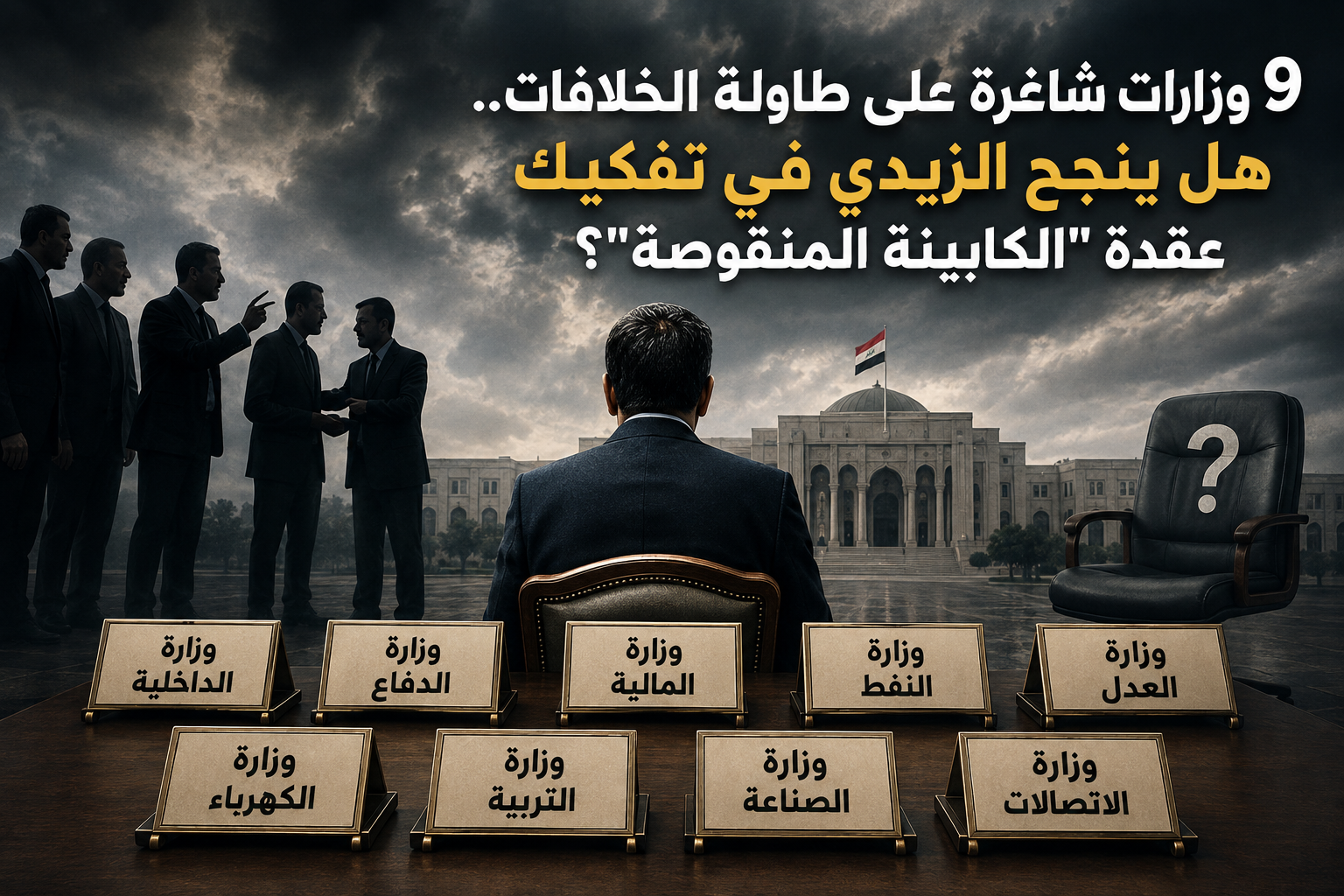
Iraq’s political scene continues to cautiously await the outcome of the prolonged vacancies in nine ministerial portfolios within Prime Minister Ali Al-Zaidi’s cabinet. The vacancies represent one of the first and most complex challenges Al-Zaidi has faced since taking the constitutional oath before Parliament.
The nine ministries have become an arena for continuing disputes among political blocs that have so far failed to reach a consensus, despite the clear distribution of political weight and entitlements resulting from the latest parliamentary elections.
A Battle of Wills: Internal Divisions and External Reservations
Observers of Iraqi politics attribute the delay in completing the government formation to a complex network of competing interests and disagreements, centered on the following factors:
Internal disputes: Competition has intensified within individual political blocs over which party or faction is entitled to representation in the remaining ministerial portfolios.
Inter-bloc bargaining: Political blocs continue to impose conditions and engage in negotiations over the exchange of positions and the consolidation of influence.
External reservations: There are reportedly undisclosed objections from regional or international actors regarding some of the names being considered for ministerial positions.
These overlapping pressures have placed the government in a difficult position. The vacant ministries are currently being administered on an acting basis, negatively affecting institutional performance and contributing to administrative shortcomings at a time when decisive executive action is required.
Parallel Minefields: Weapons and Corruption
As Al-Zaidi seeks to resolve the issue of the remaining ministers, he also finds himself surrounded by highly complex issues that directly intersect with the political negotiations, most notably:
Restricting weapons to state control: Efforts to reinforce the authority of official state institutions collide with the interests of political forces that possess armed wings and wield significant influence in Parliament, complicating efforts to reach broader political understandings.
Combating corruption: Any serious attempt to confront major corruption networks and reopen significant corruption cases is immediately liable to be interpreted as “political targeting,” potentially undermining the fragile consensus the prime minister needs to secure approval for the remainder of his cabinet.
This overlap means that virtually any major reform initiative carries considerable political risk and could cost Al-Zaidi the political backing necessary to complete his government without further complications.
The Demands of the Current Stage and the Government’s Future
Amid these overlapping pressures, the prime minister faces an exceptional responsibility: resisting the pressures of political quota-sharing while making greater efforts to select competent and credible figures to lead the vacant ministries.
The sensitivity of the current political stage leaves little room for half-measures. Al-Zaidi’s success or failure in breaking this deadlock will have significant consequences—positive or negative—for his political future and his government’s ability to restore public confidence.
The nine ministries have become an arena for continuing disputes among political blocs that have so far failed to reach a consensus, despite the clear distribution of political weight and entitlements resulting from the latest parliamentary elections.
A Battle of Wills: Internal Divisions and External Reservations
Observers of Iraqi politics attribute the delay in completing the government formation to a complex network of competing interests and disagreements, centered on the following factors:
Internal disputes: Competition has intensified within individual political blocs over which party or faction is entitled to representation in the remaining ministerial portfolios.
Inter-bloc bargaining: Political blocs continue to impose conditions and engage in negotiations over the exchange of positions and the consolidation of influence.
External reservations: There are reportedly undisclosed objections from regional or international actors regarding some of the names being considered for ministerial positions.
These overlapping pressures have placed the government in a difficult position. The vacant ministries are currently being administered on an acting basis, negatively affecting institutional performance and contributing to administrative shortcomings at a time when decisive executive action is required.
Parallel Minefields: Weapons and Corruption
As Al-Zaidi seeks to resolve the issue of the remaining ministers, he also finds himself surrounded by highly complex issues that directly intersect with the political negotiations, most notably:
Restricting weapons to state control: Efforts to reinforce the authority of official state institutions collide with the interests of political forces that possess armed wings and wield significant influence in Parliament, complicating efforts to reach broader political understandings.
Combating corruption: Any serious attempt to confront major corruption networks and reopen significant corruption cases is immediately liable to be interpreted as “political targeting,” potentially undermining the fragile consensus the prime minister needs to secure approval for the remainder of his cabinet.
This overlap means that virtually any major reform initiative carries considerable political risk and could cost Al-Zaidi the political backing necessary to complete his government without further complications.
The Demands of the Current Stage and the Government’s Future
Amid these overlapping pressures, the prime minister faces an exceptional responsibility: resisting the pressures of political quota-sharing while making greater efforts to select competent and credible figures to lead the vacant ministries.
The sensitivity of the current political stage leaves little room for half-measures. Al-Zaidi’s success or failure in breaking this deadlock will have significant consequences—positive or negative—for his political future and his government’s ability to restore public confidence.
Share Article
For Context
Related reads from the same topic or latest developments