The Strait of Hormuz Exposes the Fragility of Iraq’s Economy… and the Economic Solutions Are Painful
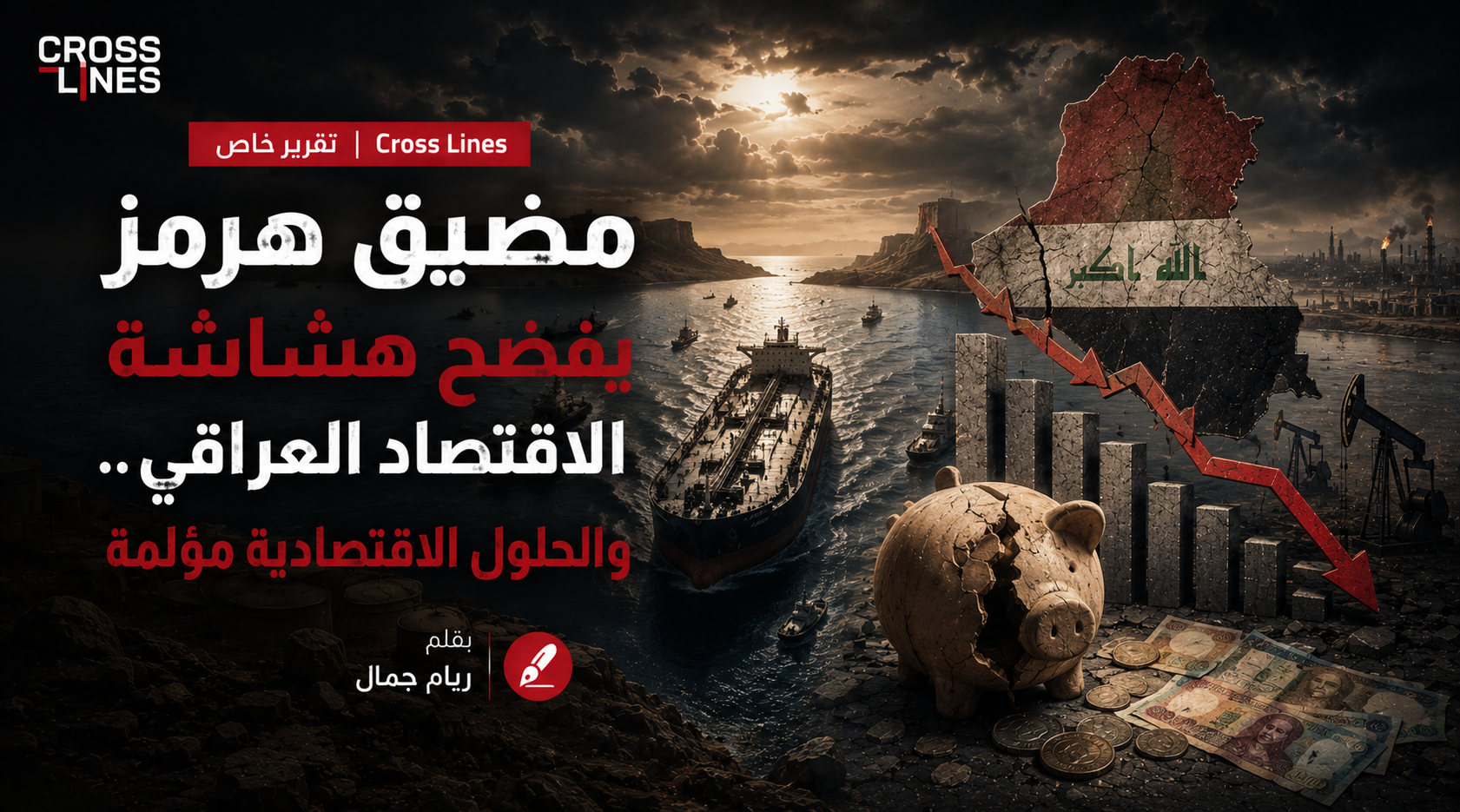

Riyam Jamal
Writer at CROSS LINES
In this article, we trace the inevitable sequence of events that brought Iraq to this critical point on the economic map, and how the crisis shifted from a geopolitical threat into a compulsory opportunity for reform.
In this article, we trace the inevitable sequence of events that brought Iraq to this critical point on the economic map, and how the crisis shifted from a geopolitical threat into a compulsory opportunity for reform.
The closure of the Strait of Hormuz and the halt of navigation through it were not merely a passing crisis for Iraq. Rather, they were a shockwave that struck the country’s financial core, exposing a structural fragility that had accumulated over two decades.
Today, Iraq finds itself facing its most difficult financial challenge, as the main artery of its oil exports — and almost its only source of revenue — is threatened with a complete shutdown. This places the government before fateful choices that may force it to redraw the country’s economic map.
The Roots: 2003–2026… Two Decades of the Rentier Trap
The story begins at the roots. Since 2003, Iraq’s economic features have been shaped around an almost absolute rentier model, with oil revenues covering more than 90% of the state budget. This total dependence ignored a dangerous fact: that this oil passes through a single waterway that is highly sensitive and politically tense — the Strait of Hormuz.
Professor of political economy Hussein al-Falluji described this phase in a press statement as one in which one mistake accumulated after another, saying:
“We are now in the final chapter, facing the inevitable result of mistakes accumulated over the past twenty years, and everyone has begun to sense the danger.”
The Closure of the Strait and the Paralysis of the Oil Artery
With the recent escalation of regional tensions, the worst-case scenario turned into a tangible reality with the closure of the Strait of Hormuz. Navigation was halted, and Iraq suddenly found itself cut off by sea from its international markets.
Iraqi economic expert Abdul Rahman al-Mashhadani translated the scale of this shock into stark figures, explaining that the disruption of navigation at Basra’s ports effectively means the suspension of around 3.3 million barrels per day of crude oil exports.
What made matters worse was the numerical blockage of alternative outlets. The crisis came at a late and financially accumulated moment, while the export line through Türkiye’s Ceyhan port remains suspended. Even if it were restarted, al-Mashhadani confirms that its export capacity would not exceed 230,000 barrels per day — less than 7% of Iraq’s usual total exports. This is a level completely incapable of covering the sudden shortfall.
The Urgent Response: Searching for Alternative Land Routes
Faced with this financial paralysis, decision-makers in Baghdad must not remain trapped in the corridor of economic death. They must move quickly to accelerate plans for land-based exports and diversify supply routes through several strategic pathways, most notably:
The Strategic Development Road: Accelerating the connection of the Grand Faw Port to a railway and road network passing through Türkiye and reaching Europe, in order to transform Iraq into a global trade corridor that guarantees non-oil revenue flows.
The Basra–Haditha Pipeline Project: Providing land-based flexibility that would allow crude oil to be transported toward Mediterranean ports in Türkiye and Syria.
The Basra–Aqaba Pipeline Project: Securing an additional land outlet for exporting oil through the ports of the Hashemite Kingdom of Jordan.
Reviving Old Pipelines: Reopening the files of historic, suspended pipelines to examine the possibility of repairing and operating them on an emergency basis.
The Puzzle of the Future: Settling Iraq’s Economic Identity Remains Postponed
Although land-based projects represent geographic solutions to the crisis, international pressure — particularly from the International Monetary Fund — has begun pushing toward addressing the root of the problem: the very structure of Iraq’s economy.
Here, Professor of political economy Hussein al-Falluji again stresses that Iraq today stands before only two choices: either wait for a comprehensive collapse, or immediately begin a phase of painful remedies.
Al-Falluji believes that the first step in this painful surgery begins with redefining the country’s economic identity and answering the question of its economic model with full clarity:
Will the state remain the main and sole player and operator of economic activity, or will it take a step back, limiting itself to regulation and oversight while allowing sufficient space for the private sector?
The Strait of Hormuz Did Not Create the Crisis
The Strait of Hormuz crisis did not create Iraq’s problem; it merely exposed it in the clearest possible way. Without resolving the identity of Iraq’s economy and finding radical solutions that free the country from the cloak of the rentier state, emergency plans will remain nothing more than temporary painkillers. Meanwhile, the fate of millions of Iraqis will remain tied to the security of a waterway located beyond their borders.
The closure of the Strait of Hormuz and the halt of navigation through it were not merely a passing crisis for Iraq. Rather, they were a shockwave that struck the country’s financial core, exposing a structural fragility that had accumulated over two decades.
Today, Iraq finds itself facing its most difficult financial challenge, as the main artery of its oil exports — and almost its only source of revenue — is threatened with a complete shutdown. This places the government before fateful choices that may force it to redraw the country’s economic map.
The Roots: 2003–2026… Two Decades of the Rentier Trap
The story begins at the roots. Since 2003, Iraq’s economic features have been shaped around an almost absolute rentier model, with oil revenues covering more than 90% of the state budget. This total dependence ignored a dangerous fact: that this oil passes through a single waterway that is highly sensitive and politically tense — the Strait of Hormuz.
Professor of political economy Hussein al-Falluji described this phase in a press statement as one in which one mistake accumulated after another, saying:
“We are now in the final chapter, facing the inevitable result of mistakes accumulated over the past twenty years, and everyone has begun to sense the danger.”
The Closure of the Strait and the Paralysis of the Oil Artery
With the recent escalation of regional tensions, the worst-case scenario turned into a tangible reality with the closure of the Strait of Hormuz. Navigation was halted, and Iraq suddenly found itself cut off by sea from its international markets.
Iraqi economic expert Abdul Rahman al-Mashhadani translated the scale of this shock into stark figures, explaining that the disruption of navigation at Basra’s ports effectively means the suspension of around 3.3 million barrels per day of crude oil exports.
What made matters worse was the numerical blockage of alternative outlets. The crisis came at a late and financially accumulated moment, while the export line through Türkiye’s Ceyhan port remains suspended. Even if it were restarted, al-Mashhadani confirms that its export capacity would not exceed 230,000 barrels per day — less than 7% of Iraq’s usual total exports. This is a level completely incapable of covering the sudden shortfall.
The Urgent Response: Searching for Alternative Land Routes
Faced with this financial paralysis, decision-makers in Baghdad must not remain trapped in the corridor of economic death. They must move quickly to accelerate plans for land-based exports and diversify supply routes through several strategic pathways, most notably:
The Strategic Development Road: Accelerating the connection of the Grand Faw Port to a railway and road network passing through Türkiye and reaching Europe, in order to transform Iraq into a global trade corridor that guarantees non-oil revenue flows.
The Basra–Haditha Pipeline Project: Providing land-based flexibility that would allow crude oil to be transported toward Mediterranean ports in Türkiye and Syria.
The Basra–Aqaba Pipeline Project: Securing an additional land outlet for exporting oil through the ports of the Hashemite Kingdom of Jordan.
Reviving Old Pipelines: Reopening the files of historic, suspended pipelines to examine the possibility of repairing and operating them on an emergency basis.
The Puzzle of the Future: Settling Iraq’s Economic Identity Remains Postponed
Although land-based projects represent geographic solutions to the crisis, international pressure — particularly from the International Monetary Fund — has begun pushing toward addressing the root of the problem: the very structure of Iraq’s economy.
Here, Professor of political economy Hussein al-Falluji again stresses that Iraq today stands before only two choices: either wait for a comprehensive collapse, or immediately begin a phase of painful remedies.
Al-Falluji believes that the first step in this painful surgery begins with redefining the country’s economic identity and answering the question of its economic model with full clarity:
Will the state remain the main and sole player and operator of economic activity, or will it take a step back, limiting itself to regulation and oversight while allowing sufficient space for the private sector?
The Strait of Hormuz Did Not Create the Crisis
The Strait of Hormuz crisis did not create Iraq’s problem; it merely exposed it in the clearest possible way. Without resolving the identity of Iraq’s economy and finding radical solutions that free the country from the cloak of the rentier state, emergency plans will remain nothing more than temporary painkillers. Meanwhile, the fate of millions of Iraqis will remain tied to the security of a waterway located beyond their borders.
🔗 Share Article
For Context
Related reads from the same topic or latest developments