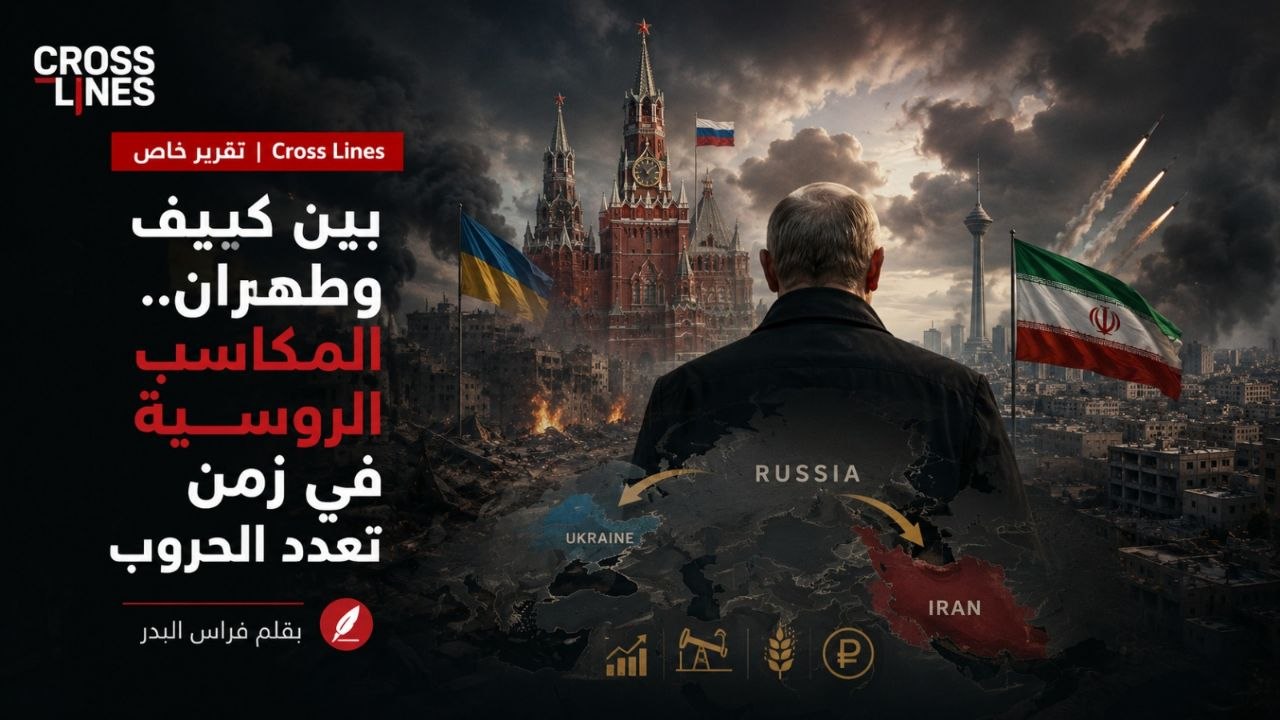
Between Kyiv and Tehran: Russian gains in a time of multiple wars

Firas Majid Al-Badr
Writer at CROSS LINES
The ongoing Russian-Ukrainian war, which began in April 2022, and the conflict in the Middle East, along with their repercussions on the global balance of power, suggest, based on analyses, reports, and data, that Russia is the primary beneficiary of both w...
The ongoing Russian-Ukrainian war, which began in April 2022, and the conflict in the Middle East, along with their repercussions on the global balance of power, suggest, based on analyses, reports, and data, that Russia is the primary beneficiary of both wars—economically, militarily, and in terms of influence—to a significant degree for the coming decades.
All the tensions in the Middle East serve Moscow's interests, and Russia is the main beneficiary of the ongoing conflicts. This is due to the consolidation of its economic power, its military support, and the setbacks suffered by its global rivals, namely the United States, NATO, and the Europeans. Numerous indicators suggest that Moscow may be among the most prominent beneficiaries of the Middle East war's repercussions. Amidst Russia's growing gains, America's focus on Ukraine has diminished, and it has suffered military losses in the Iran-Iraq War. This situation casts a shadow on how to counter Russia's strategic objectives, according to international assessments.
It is estimated that the Iran-Iraq War has a significant impact on the ongoing conflict in Ukraine and Russia, with numerous repercussions, most notably a decrease in US support for Kyiv. The US has been providing military support and funding to Ukraine since the beginning of the war with Russia, in addition to supplying it with strategic weapons. This support has largely ceased compared to pre-war levels, as Washington's military resources have been diverted during the conflict in the Middle East.
According to the Global Conflict Tracking website, estimated US aid to Ukraine exceeded $180 billion, with the European Union providing approximately $190 billion. Washington also provided over $69 billion in direct military aid, including weapons, ammunition, and air defense systems, along with intelligence and economic support to bolster Kyiv's capabilities in its war against Russia.
These supplies covered approximately 40 percent of Ukraine's total defense needs, as revealed by CNN, in addition to billions of dollars to support the stability of the Ukrainian economy. This forced Kyiv to deplete its stockpile of interceptor missiles and reduce the effectiveness of its air defenses after Washington restricted its options for supplying Ukraine with offensive weapons and missiles and failed to provide Kyiv with the necessary military supplies.
The second, and more important, step was the closure of navigation in the Strait of Hormuz, through which about 20 percent of the world's oil and liquefied natural gas trade passes. This closure, resulting from the war's repercussions and the reduction in production by major energy producers in the Gulf region, led to disruptions in supply chains and significant increases in global energy prices. This gave Moscow an advantage by allowing it to increase its oil exports to key Asian markets such as India and China, unaffected by the Hormuz closure. This further bolstered its economy and increased its oil revenues as a result of the war in the Middle East, enabling it to finance its military operations in Ukraine.
The US has been diverting its attention from Ukraine and focusing on the Iranian talks and diplomatic negotiations, as well as the relentless efforts to reopen the Strait of Hormuz and solidify key points to prevent Tehran from acquiring a nuclear bomb and to secure the surrender and destruction of its nuclear remnants. These issues are preoccupying Washington, diverting its attention from supporting Ukraine and the potential consequences of war with Russia.
The trilateral talks between Washington, Moscow, and Kyiv, once in Florida and once in Abu Dhabi, have stalled. This has given Moscow the advantage in shaping its strategic objectives and acquiring territory and provinces with minimal effort, before it teeters on the brink of a global war led by America, along with European countries, NATO, and all its allies. However, the Iranian war has thwarted these plans, creating a new map of alliances and regional influence.
According to the Moscow News Agency, Russian forces now control approximately 20 percent of Ukraine's total territory, including Crimea and the Donbas regions seized before 2022, as well as parts of Donetsk, Luhansk, Zaporizhzhia, and Kherson. This control is part of Russia's efforts to achieve geopolitical, economic, and military gains, as well as to capitalize on the diversion of Moscow's energy exports to Asian countries, resulting in significant trade benefits amid rising global commodity prices.
We must also consider the military aspect and what transpired on the ground. Moscow also benefited from the experience gained with both old and new weapons in ground operations, particularly through the use of inexpensive drones in close cooperation with Iran. This cooperation remains unconfirmed or undenied. These drones have reportedly inflicted significant financial losses on Ukrainian air defenses.
Meanwhile, the Moscow Times, citing Bloomberg military data, reported that Russian aircraft production has more than doubled, largely driven by increased drone manufacturing, even as growth in the broader defense sector continues to slow. The data highlights how drone production has become one of the fastest-growing sectors in Russia's wartime economy. Russian aviation production, which includes military aircraft and drones, surged by 117% year-on-year in April, a remarkable acceleration compared to the average annual growth rate of 68% recorded in 2025.
This experience with multiple missile systems and air and attack systems contrasts sharply with that of the United States, which has depleted its arsenal of weapons, systems, missiles, and defenses in the war with Iran and in supporting and bolstering Israel with its systems. The interceptor capabilities expended by Iranian missiles are shifting the global strategic balance of power in a new order favoring Russia, which is now closer than ever to achieving its objectives in Ukraine: controlling territory, forcing Kyiv to negotiate, preventing Ukraine's NATO membership, breaking sanctions, and draining the West.
Despite these gains, Moscow still faces significant challenges, including the continuation of Western sanctions and the depletion of its human resources.
All the tensions in the Middle East serve Moscow's interests, and Russia is the main beneficiary of the ongoing conflicts. This is due to the consolidation of its economic power, its military support, and the setbacks suffered by its global rivals, namely the United States, NATO, and the Europeans. Numerous indicators suggest that Moscow may be among the most prominent beneficiaries of the Middle East war's repercussions. Amidst Russia's growing gains, America's focus on Ukraine has diminished, and it has suffered military losses in the Iran-Iraq War. This situation casts a shadow on how to counter Russia's strategic objectives, according to international assessments.
It is estimated that the Iran-Iraq War has a significant impact on the ongoing conflict in Ukraine and Russia, with numerous repercussions, most notably a decrease in US support for Kyiv. The US has been providing military support and funding to Ukraine since the beginning of the war with Russia, in addition to supplying it with strategic weapons. This support has largely ceased compared to pre-war levels, as Washington's military resources have been diverted during the conflict in the Middle East.
According to the Global Conflict Tracking website, estimated US aid to Ukraine exceeded $180 billion, with the European Union providing approximately $190 billion. Washington also provided over $69 billion in direct military aid, including weapons, ammunition, and air defense systems, along with intelligence and economic support to bolster Kyiv's capabilities in its war against Russia.
These supplies covered approximately 40 percent of Ukraine's total defense needs, as revealed by CNN, in addition to billions of dollars to support the stability of the Ukrainian economy. This forced Kyiv to deplete its stockpile of interceptor missiles and reduce the effectiveness of its air defenses after Washington restricted its options for supplying Ukraine with offensive weapons and missiles and failed to provide Kyiv with the necessary military supplies.
The second, and more important, step was the closure of navigation in the Strait of Hormuz, through which about 20 percent of the world's oil and liquefied natural gas trade passes. This closure, resulting from the war's repercussions and the reduction in production by major energy producers in the Gulf region, led to disruptions in supply chains and significant increases in global energy prices. This gave Moscow an advantage by allowing it to increase its oil exports to key Asian markets such as India and China, unaffected by the Hormuz closure. This further bolstered its economy and increased its oil revenues as a result of the war in the Middle East, enabling it to finance its military operations in Ukraine.
The US has been diverting its attention from Ukraine and focusing on the Iranian talks and diplomatic negotiations, as well as the relentless efforts to reopen the Strait of Hormuz and solidify key points to prevent Tehran from acquiring a nuclear bomb and to secure the surrender and destruction of its nuclear remnants. These issues are preoccupying Washington, diverting its attention from supporting Ukraine and the potential consequences of war with Russia.
The trilateral talks between Washington, Moscow, and Kyiv, once in Florida and once in Abu Dhabi, have stalled. This has given Moscow the advantage in shaping its strategic objectives and acquiring territory and provinces with minimal effort, before it teeters on the brink of a global war led by America, along with European countries, NATO, and all its allies. However, the Iranian war has thwarted these plans, creating a new map of alliances and regional influence.
According to the Moscow News Agency, Russian forces now control approximately 20 percent of Ukraine's total territory, including Crimea and the Donbas regions seized before 2022, as well as parts of Donetsk, Luhansk, Zaporizhzhia, and Kherson. This control is part of Russia's efforts to achieve geopolitical, economic, and military gains, as well as to capitalize on the diversion of Moscow's energy exports to Asian countries, resulting in significant trade benefits amid rising global commodity prices.
We must also consider the military aspect and what transpired on the ground. Moscow also benefited from the experience gained with both old and new weapons in ground operations, particularly through the use of inexpensive drones in close cooperation with Iran. This cooperation remains unconfirmed or undenied. These drones have reportedly inflicted significant financial losses on Ukrainian air defenses.
Meanwhile, the Moscow Times, citing Bloomberg military data, reported that Russian aircraft production has more than doubled, largely driven by increased drone manufacturing, even as growth in the broader defense sector continues to slow. The data highlights how drone production has become one of the fastest-growing sectors in Russia's wartime economy. Russian aviation production, which includes military aircraft and drones, surged by 117% year-on-year in April, a remarkable acceleration compared to the average annual growth rate of 68% recorded in 2025.
This experience with multiple missile systems and air and attack systems contrasts sharply with that of the United States, which has depleted its arsenal of weapons, systems, missiles, and defenses in the war with Iran and in supporting and bolstering Israel with its systems. The interceptor capabilities expended by Iranian missiles are shifting the global strategic balance of power in a new order favoring Russia, which is now closer than ever to achieving its objectives in Ukraine: controlling territory, forcing Kyiv to negotiate, preventing Ukraine's NATO membership, breaking sanctions, and draining the West.
Despite these gains, Moscow still faces significant challenges, including the continuation of Western sanctions and the depletion of its human resources.
🔗 Share Article
For Context
Related reads from the same topic or latest developments