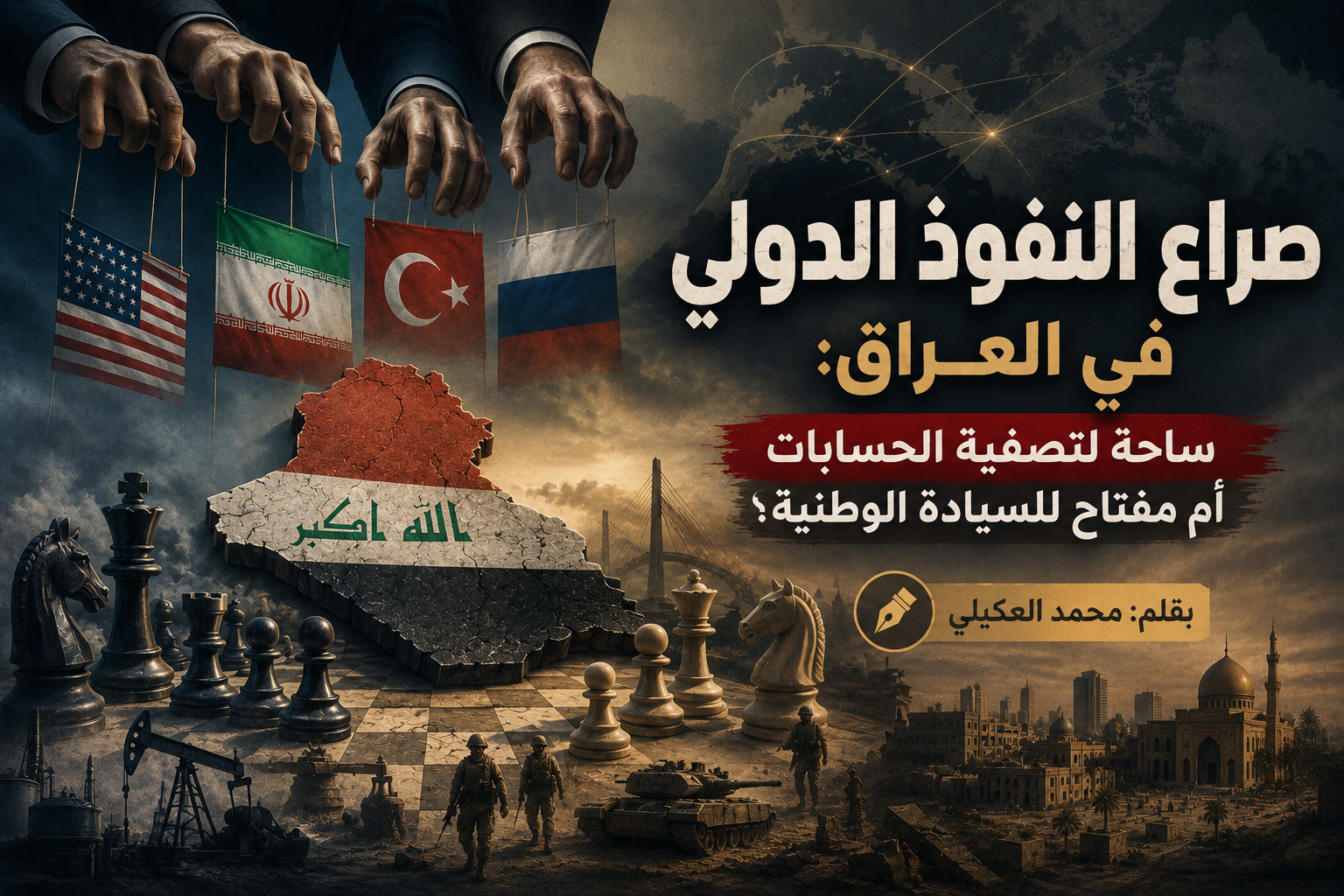
The Struggle for International Influence in Iraq: A Battlefield for Settling Scores or a Key to National Sovereignty?

Mohammed Al-Aqili
Writer at CROSS LINES
Iraq has never been merely an ordinary geographic space in the Middle East. Throughout history, and because of its strategic location and vast wealth, it has stood at the heart of regional and international balances.
Iraq has never been merely an ordinary geographic space in the Middle East. Throughout history, and because of its strategic location and vast wealth, it has stood at the heart of regional and international balances. After 2003, the country became one of the most complex arenas in the world, witnessing an intense struggle for influence among major international and regional powers. Each power has sought to shape the Iraqi scene in a way that serves its higher strategic interests, forcing Iraq to pay a heavy price in terms of its stability, sovereignty, and the wealth of its people.
The Map of Influence: Players and Agendas
The struggle for influence in Iraq is divided among several main axes, where the regional dimension overlaps with the international one.
1. The American Axis
The United States approaches Iraq from a strategic perspective that views the country as a key pillar of U.S. national security in the region, as well as a platform for monitoring and balancing regional powers. This is in addition to economic and security interests linked to counterterrorism and ensuring the flow of energy.
2. The Regional Axis: Neighboring States
For Iraq’s neighbors, particularly Iran and Turkey, the country represents a vital security and economic depth. Iran views Iraq as a strategic buffer and an essential economic outlet, while Turkey focuses on northern security concerns, especially the Kurdistan Workers’ Party, in addition to major trade ties and water-related issues.
3. Soft International Expansion: China and Russia
Major Asian and Eurasian powers enter Iraq primarily through the economic gateway. China views Iraq as a key partner in the Belt and Road Initiative and as a major importer of Iraqi oil. Russia, meanwhile, has strengthened its presence through energy investments and security coordination.
The Risks of This Struggle for the Iraqi State
Turning Iraq into an arena for settling regional and international scores carries structural risks that threaten the foundations of the state. The most prominent of these risks include:
Weakening independent national decision-making: The mutual pressure exerted by external powers weakens the ability of successive governments to make purely sovereign decisions that serve the interests of the Iraqi citizen first.
Political and social polarization: International competition is reflected internally through divisions among local political forces, some of which lean toward one axis or another. This obstructs the building of genuine national consensus and deepens political crises.
Ongoing security threats: When competition between international axes intensifies, Iraqi territory is often used as a mailbox for exchanging military or security messages. This endangers civil peace and threatens infrastructure.
Disrupting economic development: Global and domestic capital becomes hesitant to invest in an environment charged with international political tensions. This prevents Iraq from making full use of its resources to rebuild the country and create jobs for the unemployed.
Ways to End External Influence and Restore Sovereignty
Iraq’s exit from the circle of international conflict is not impossible. However, it requires a comprehensive national strategy based on two main tracks: an internal track and an external one.
First: Strengthening the Internal Front
Building strong institutions: Iraq must move beyond the quota-based system and establish a state built on citizenship and competence. Weak institutions are the loopholes through which foreign agendas enter.
Restricting arms and decision-making authority to the state: The capabilities of the official armed forces and security agencies must be strengthened, while ensuring that decisions of war and peace remain exclusively in the hands of the Iraqi government in accordance with the Constitution.
Economic independence: Iraq must reduce its absolute dependence on oil, activate productive sectors such as industry and agriculture, and achieve self-sufficiency in energy and gas in order to reduce reliance on external actors.
Second: Diplomacy of Positive Balance
Iraq as a bridge, not an arena: Iraq should adopt a diplomatic doctrine that turns the country into a meeting point for shared interests and regional stability, rather than a party to narrow alliances and axis politics.
A network of mutual interests: Agreements with major powers, including the United States, China, and neighboring states, should be built on the basis of equal partnership and mutual economic benefit. Relations should gradually shift from a security and military character toward a developmental and investment-oriented one.
Protecting borders, waters, and airspace: Iraq must activate the tools of international law and the United Nations to protect its land borders, waters, and airspace from violations, while firmly demanding its water rights from neighboring countries.
Ending the struggle for international influence in Iraq begins inside Baghdad, not in foreign capitals. When Iraq possesses a cohesive political front, a strong and diversified economy, and military institutions fully subject to state authority, external powers will no longer find an easy path to impose their will. At that point, Iraq can move from being a “regional problem” in search of a solution to becoming a “regional leader” capable of shaping stability in the region.
The Map of Influence: Players and Agendas
The struggle for influence in Iraq is divided among several main axes, where the regional dimension overlaps with the international one.
1. The American Axis
The United States approaches Iraq from a strategic perspective that views the country as a key pillar of U.S. national security in the region, as well as a platform for monitoring and balancing regional powers. This is in addition to economic and security interests linked to counterterrorism and ensuring the flow of energy.
2. The Regional Axis: Neighboring States
For Iraq’s neighbors, particularly Iran and Turkey, the country represents a vital security and economic depth. Iran views Iraq as a strategic buffer and an essential economic outlet, while Turkey focuses on northern security concerns, especially the Kurdistan Workers’ Party, in addition to major trade ties and water-related issues.
3. Soft International Expansion: China and Russia
Major Asian and Eurasian powers enter Iraq primarily through the economic gateway. China views Iraq as a key partner in the Belt and Road Initiative and as a major importer of Iraqi oil. Russia, meanwhile, has strengthened its presence through energy investments and security coordination.
The Risks of This Struggle for the Iraqi State
Turning Iraq into an arena for settling regional and international scores carries structural risks that threaten the foundations of the state. The most prominent of these risks include:
Weakening independent national decision-making: The mutual pressure exerted by external powers weakens the ability of successive governments to make purely sovereign decisions that serve the interests of the Iraqi citizen first.
Political and social polarization: International competition is reflected internally through divisions among local political forces, some of which lean toward one axis or another. This obstructs the building of genuine national consensus and deepens political crises.
Ongoing security threats: When competition between international axes intensifies, Iraqi territory is often used as a mailbox for exchanging military or security messages. This endangers civil peace and threatens infrastructure.
Disrupting economic development: Global and domestic capital becomes hesitant to invest in an environment charged with international political tensions. This prevents Iraq from making full use of its resources to rebuild the country and create jobs for the unemployed.
Ways to End External Influence and Restore Sovereignty
Iraq’s exit from the circle of international conflict is not impossible. However, it requires a comprehensive national strategy based on two main tracks: an internal track and an external one.
First: Strengthening the Internal Front
Building strong institutions: Iraq must move beyond the quota-based system and establish a state built on citizenship and competence. Weak institutions are the loopholes through which foreign agendas enter.
Restricting arms and decision-making authority to the state: The capabilities of the official armed forces and security agencies must be strengthened, while ensuring that decisions of war and peace remain exclusively in the hands of the Iraqi government in accordance with the Constitution.
Economic independence: Iraq must reduce its absolute dependence on oil, activate productive sectors such as industry and agriculture, and achieve self-sufficiency in energy and gas in order to reduce reliance on external actors.
Second: Diplomacy of Positive Balance
Iraq as a bridge, not an arena: Iraq should adopt a diplomatic doctrine that turns the country into a meeting point for shared interests and regional stability, rather than a party to narrow alliances and axis politics.
A network of mutual interests: Agreements with major powers, including the United States, China, and neighboring states, should be built on the basis of equal partnership and mutual economic benefit. Relations should gradually shift from a security and military character toward a developmental and investment-oriented one.
Protecting borders, waters, and airspace: Iraq must activate the tools of international law and the United Nations to protect its land borders, waters, and airspace from violations, while firmly demanding its water rights from neighboring countries.
Ending the struggle for international influence in Iraq begins inside Baghdad, not in foreign capitals. When Iraq possesses a cohesive political front, a strong and diversified economy, and military institutions fully subject to state authority, external powers will no longer find an easy path to impose their will. At that point, Iraq can move from being a “regional problem” in search of a solution to becoming a “regional leader” capable of shaping stability in the region.
🔗 Share Article
For Context
Related reads from the same topic or latest developments