Iraq’s Salary Crisis: Fears and Solutions

Firas Majid Al-Badr
Writer at CROSS LINES
An analytical reading of Iraq’s salary crisis, with a forward-looking assessment of the government’s possible approaches to addressing it and the most suitable ways to confront the challenge intelligently without falling into greater financial or social risks.
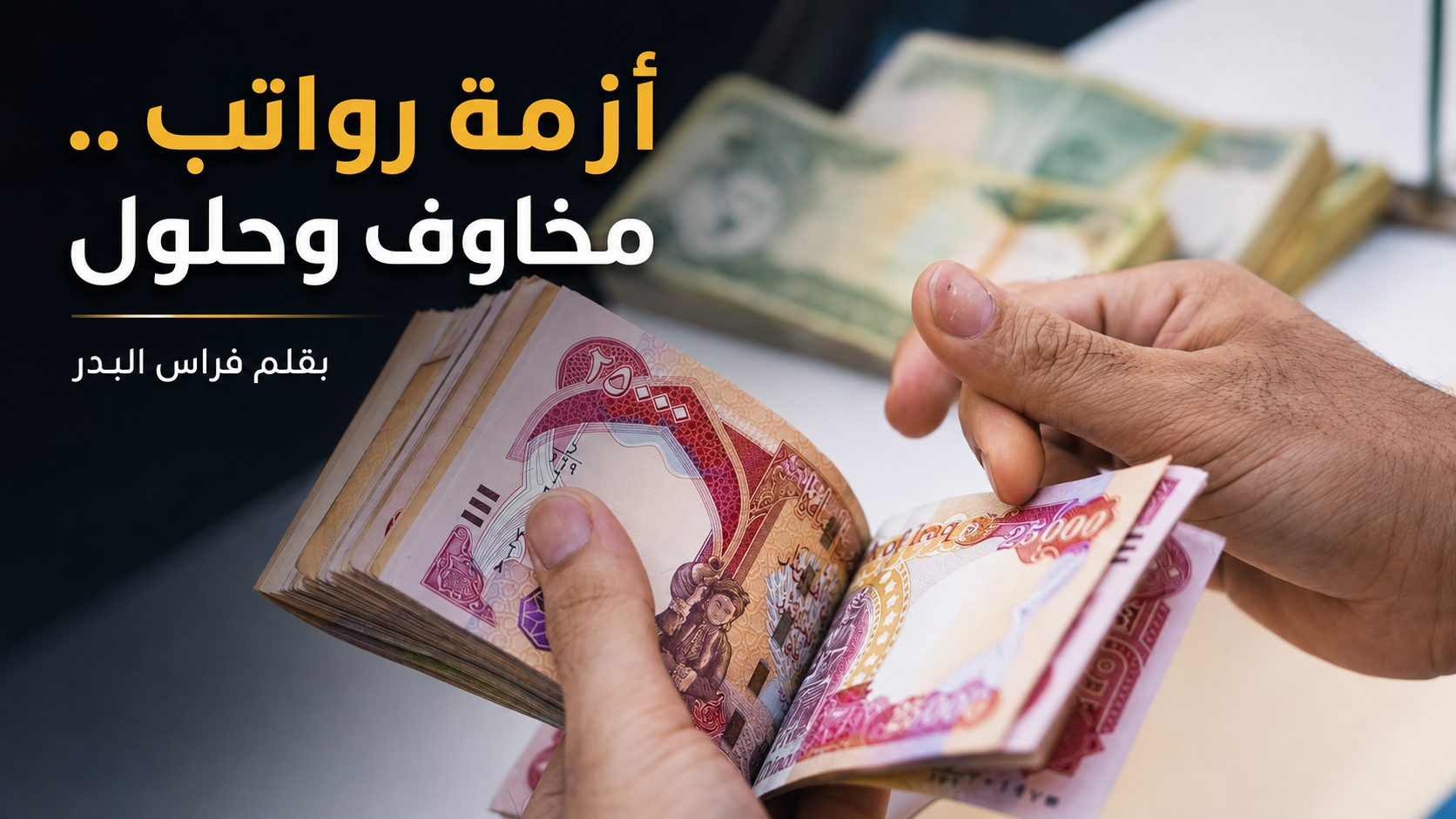
“There is no money.” This was the blunt statement made by Iraq’s Minister of Health during a press conference following delays in public-sector salary payments. It was a remarkably candid admission from a senior official after the government had largely avoided openly addressing the delays and the growing frustration among employees.
The statement was followed by an acknowledgment from the government spokesperson that Iraq is facing a financial crisis and a widening gap between state revenues and the scale of operational spending allocated to salaries.
According to the minister, the government faces increasing difficulty in financing monthly salary obligations, which amount to approximately 10.8 trillion Iraqi dinars. These payments are distributed among nearly eight million public employees, pensioners, and beneficiaries of the social welfare system.
To cover the temporary shortfall and ensure the continued payment of salaries and pensions, the government has resorted to domestic borrowing and rapid banking solutions.
The salary-delay crisis may continue for several months, with the possibility that salaries will be paid every 45 days instead of monthly.
The problem is primarily the result of Iraq’s heavy dependence on oil exports and the revenues generated from them, which are transferred through the U.S. Federal Reserve—a separate and complex issue in itself.
However, the suspension of more than 90 percent of Iraq’s oil exports through the Gulf, combined with the crisis in the Strait of Hormuz, has left the country struggling to finance monthly salaries and wages.
This situation demonstrates the failure of repeated claims that the salaries of employees and pensioners are fully secured and represent a “red line” that cannot be affected.
According to financial and banking expert Dr. Mustafa Akram Hantoush, Iraq’s monthly oil revenue has fallen from around nine trillion dinars to only two trillion dinars over the past three months.
The salary-financing deficit now exceeds three trillion and 300 billion Iraqi dinars, according to the Minister of Finance.
This alarming figure should serve as a warning and compel the state to introduce immediate and urgent plans to secure the monthly salary budget and prevent a potentially serious economic and social crisis.
At the same time, government spending and discretionary expenditures on nonessential matters continue to increase, while the wages, livelihoods, and financial entitlements of public employees are left exposed to uncertainty.
Mazhar Mohammed Saleh, the Prime Minister’s financial adviser, has said that the government is experiencing temporary financial distress rather than bankruptcy.
He attributed the crisis to fluctuations in oil prices and the state budget’s excessive dependence on oil revenues.
His comments further highlight the extent to which operational expenditures dominate public finances. Salaries, grants, and related expenses account for nearly 94 percent of the state’s actual spending.
The salary bill alone consumes approximately 81 percent of the overall state budget, while investment and development spending represents only around 6 percent.
Meanwhile, oil revenues account for nearly 90 percent of the budget, according to figures from the Ministry of Finance and the parliamentary Finance Committee.
According to statistics from the Ministries of Finance and Planning, approximately 4.5 million people are employed on permanent government payrolls.
This figure is accompanied by around 2.9 million civilian and military pensioners, in addition to approximately 2.5 million families covered by the social protection network.
Altogether, the number of Iraqis receiving direct income from the state exceeds 8.5 to nine million people, representing around 20 percent of the country’s total population.
The financial crisis erupted after years of repeated warnings and appeals to successive governments not to rely exclusively on oil to finance the budget and sustain Iraq’s economy.
Governments were repeatedly urged to diversify national income by revitalizing investment, agriculture, industry, and tourism, while developing alternative sources of public revenue.
Such measures were necessary to avoid the type of crisis the country is experiencing today as a result of the closure of the Strait of Hormuz and the broader security and military tensions in the Gulf, which have cast a shadow over the entire country and culminated in the current salary crisis.
Among the proposed solutions is adjusting the exchange rate, reducing government spending, and implementing a comprehensive package of administrative and financial reforms.
These reforms should include simplifying government procedures, lowering the state’s operational expenditure, and reviewing and unifying the public-sector salary scale.
A revised salary structure should address the wide gap between lower- and middle-ranking employees and those holding senior and special government positions.
The government must also combat “ghost employees” and individuals receiving more than one state salary by fully automating payroll systems and employment records.
Random and politically motivated public-sector recruitment should also be suspended.
Additional measures should include the automation of customs procedures and border crossings, reforming tax collection and public-service fees, and accelerating financial inclusion and digital transformation.
State-owned banks must also be restructured, while the foreign currency sales window should be brought under tighter control.
The government should activate the Public-Private Partnership Law, support small and medium-sized enterprises, and revive neglected sectors of the economy.
Most importantly, Iraq should establish a sovereign emergency fund financed by a portion of oil revenues to provide financial protection during future crises and prevent public-sector salaries from being held hostage to sudden disruptions in oil exports or regional instability.
The statement was followed by an acknowledgment from the government spokesperson that Iraq is facing a financial crisis and a widening gap between state revenues and the scale of operational spending allocated to salaries.
According to the minister, the government faces increasing difficulty in financing monthly salary obligations, which amount to approximately 10.8 trillion Iraqi dinars. These payments are distributed among nearly eight million public employees, pensioners, and beneficiaries of the social welfare system.
To cover the temporary shortfall and ensure the continued payment of salaries and pensions, the government has resorted to domestic borrowing and rapid banking solutions.
The salary-delay crisis may continue for several months, with the possibility that salaries will be paid every 45 days instead of monthly.
The problem is primarily the result of Iraq’s heavy dependence on oil exports and the revenues generated from them, which are transferred through the U.S. Federal Reserve—a separate and complex issue in itself.
However, the suspension of more than 90 percent of Iraq’s oil exports through the Gulf, combined with the crisis in the Strait of Hormuz, has left the country struggling to finance monthly salaries and wages.
This situation demonstrates the failure of repeated claims that the salaries of employees and pensioners are fully secured and represent a “red line” that cannot be affected.
According to financial and banking expert Dr. Mustafa Akram Hantoush, Iraq’s monthly oil revenue has fallen from around nine trillion dinars to only two trillion dinars over the past three months.
The salary-financing deficit now exceeds three trillion and 300 billion Iraqi dinars, according to the Minister of Finance.
This alarming figure should serve as a warning and compel the state to introduce immediate and urgent plans to secure the monthly salary budget and prevent a potentially serious economic and social crisis.
At the same time, government spending and discretionary expenditures on nonessential matters continue to increase, while the wages, livelihoods, and financial entitlements of public employees are left exposed to uncertainty.
Mazhar Mohammed Saleh, the Prime Minister’s financial adviser, has said that the government is experiencing temporary financial distress rather than bankruptcy.
He attributed the crisis to fluctuations in oil prices and the state budget’s excessive dependence on oil revenues.
His comments further highlight the extent to which operational expenditures dominate public finances. Salaries, grants, and related expenses account for nearly 94 percent of the state’s actual spending.
The salary bill alone consumes approximately 81 percent of the overall state budget, while investment and development spending represents only around 6 percent.
Meanwhile, oil revenues account for nearly 90 percent of the budget, according to figures from the Ministry of Finance and the parliamentary Finance Committee.
According to statistics from the Ministries of Finance and Planning, approximately 4.5 million people are employed on permanent government payrolls.
This figure is accompanied by around 2.9 million civilian and military pensioners, in addition to approximately 2.5 million families covered by the social protection network.
Altogether, the number of Iraqis receiving direct income from the state exceeds 8.5 to nine million people, representing around 20 percent of the country’s total population.
The financial crisis erupted after years of repeated warnings and appeals to successive governments not to rely exclusively on oil to finance the budget and sustain Iraq’s economy.
Governments were repeatedly urged to diversify national income by revitalizing investment, agriculture, industry, and tourism, while developing alternative sources of public revenue.
Such measures were necessary to avoid the type of crisis the country is experiencing today as a result of the closure of the Strait of Hormuz and the broader security and military tensions in the Gulf, which have cast a shadow over the entire country and culminated in the current salary crisis.
Among the proposed solutions is adjusting the exchange rate, reducing government spending, and implementing a comprehensive package of administrative and financial reforms.
These reforms should include simplifying government procedures, lowering the state’s operational expenditure, and reviewing and unifying the public-sector salary scale.
A revised salary structure should address the wide gap between lower- and middle-ranking employees and those holding senior and special government positions.
The government must also combat “ghost employees” and individuals receiving more than one state salary by fully automating payroll systems and employment records.
Random and politically motivated public-sector recruitment should also be suspended.
Additional measures should include the automation of customs procedures and border crossings, reforming tax collection and public-service fees, and accelerating financial inclusion and digital transformation.
State-owned banks must also be restructured, while the foreign currency sales window should be brought under tighter control.
The government should activate the Public-Private Partnership Law, support small and medium-sized enterprises, and revive neglected sectors of the economy.
Most importantly, Iraq should establish a sovereign emergency fund financed by a portion of oil revenues to provide financial protection during future crises and prevent public-sector salaries from being held hostage to sudden disruptions in oil exports or regional instability.
🔗 Share Article
For Context
Related reads from the same topic or latest developments