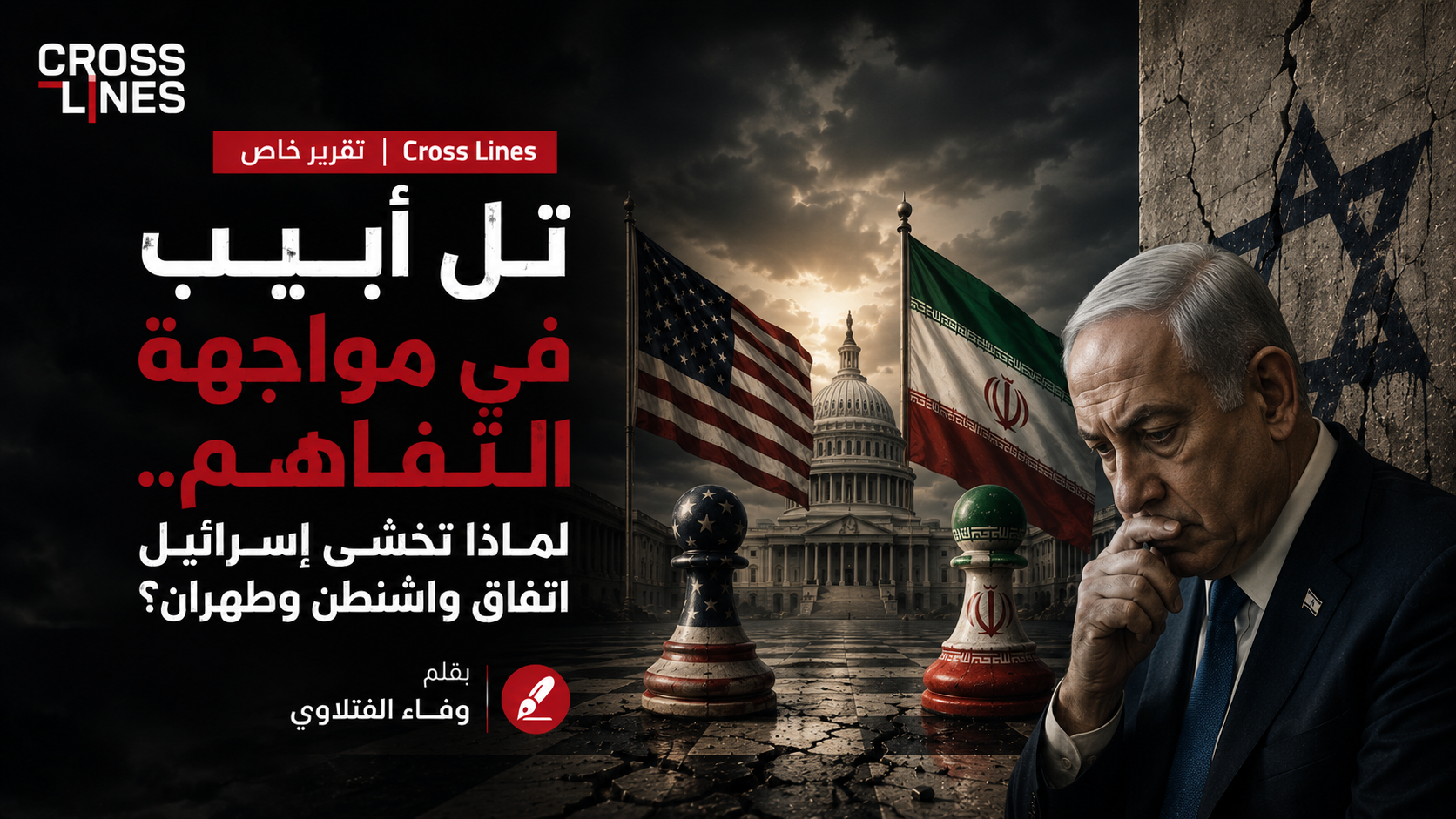
Tel Aviv Against the Deal.. Why Does Israel Fear a Washington–Tehran Agreement?

Wafaa Al-Fatlawi
Writer at CROSS LINES
This article addresses the undeclared understanding between Washington and Tehran as an attempt to manage the conflict in the region rather than end it.
This article addresses the undeclared understanding between Washington and Tehran as an attempt to manage the conflict in the region rather than end it. It is based on a limited easing of sanctions in exchange for restraining Iran’s nuclear program and containing regional tensions. The article argues that Israel fears this agreement and is working to obstruct it, viewing it as a development that would grant Iran greater room for influence and prevent Israel from advancing its project for the Middle East. Meanwhile, Washington seeks to avoid a costly confrontation, while Tehran sees the understanding as an opportunity to ease economic pressure and strengthen its regional position.
Talk of an agreement between the United States and Iran is no longer merely a passing diplomatic development. It has become a complex regional file in which military, economic, and political calculations intersect, amid growing questions over whether such an agreement represents the beginning of genuine de-escalation or merely a temporary truce ahead of a new round of conflict in the Middle East.
At the same time, Israel is seeking to obstruct any potential understanding between Washington and Tehran by continuing military escalation and maintaining strikes on Beirut and its southern suburbs, in an attempt to derail any path that could lead to regional calm and limit its security and military project, which is based on expanding the scope of confrontation under the pretext of countering Iranian influence in the region.
The latest moves between the United States and Iran came after months of mutual escalation through indirect attacks, economic pressure, and military threats. This pushed both sides to search for a formula that would prevent a full-scale explosion without reaching a complete final settlement. Washington understands that continued open confrontation threatens its interests and its bases across the Middle East, while also increasing instability in global energy markets. Tehran, meanwhile, sees the easing of sanctions and economic pressure as an urgent domestic necessity amid mounting financial challenges.
The agreement, which has not been fully announced, reportedly includes several provisions being circulated in political and media circles. Most notably, it involves a relative easing of some economic restrictions in exchange for controlling Iranian nuclear activity within specific limits, with the nuclear file to be revisited 60 days after the signing of the agreement. The understandings also include indirect security arrangements related to calming regional fronts and preventing the expansion of clashes in Lebanon, Iraq, Syria, and the Gulf. Leaks also point to understandings over the release of frozen Iranian funds, alongside keeping communication channels open to avoid any direct military confrontation.
From the American perspective, the agreement represents a means of managing the crisis rather than ending it. Washington seeks to prevent Iran from reaching the stage of possessing full nuclear capability while maintaining the balance of deterrence in the region, without becoming involved in a broad war that could be politically and militarily costly, especially amid international shifts and Washington’s preoccupation with other files such as Ukraine and China.
Iran, for its part, views the agreement as an implicit recognition of its regional weight and its ability to impose new equations. Tehran believes that its policy of resilience and reciprocal pressure pushed Washington back to the table of understandings. It is also trying to use any de-escalation to reduce the impact of sanctions and improve its domestic economic situation, without offering fundamental concessions that would affect its regional influence or military structure.
Despite the atmosphere of de-escalation, the scene remains fragile and capable of exploding at any moment, especially with Israel’s continued rejection of any understanding that grants Iran room to maneuver or eases pressure on it. Tel Aviv views any agreement with Tehran as a long-term threat. For this reason, it continues to exert political and security pressure to thwart any settlement that does not clearly reduce Iranian influence in the region.
According to political readings, the current agreement is closer to managing conflict than creating peace. Core issues remain unresolved, foremost among them the nuclear program, the weapons of factions allied with Iran, the future of regional influence, and economic sanctions. Any political shift inside the United States or sudden escalation on the ground could quickly lead to the collapse of these understandings.
In light of the current facts, the region appears to be entering a phase of cautious de-escalation rather than a stable settlement. Each side is seeking to catch its breath and rearrange its cards while awaiting new rounds of negotiation or confrontation. Therefore, the agreement between Washington and Tehran may postpone the battle, but so far it does not appear capable of ending it completely.
Talk of an agreement between the United States and Iran is no longer merely a passing diplomatic development. It has become a complex regional file in which military, economic, and political calculations intersect, amid growing questions over whether such an agreement represents the beginning of genuine de-escalation or merely a temporary truce ahead of a new round of conflict in the Middle East.
At the same time, Israel is seeking to obstruct any potential understanding between Washington and Tehran by continuing military escalation and maintaining strikes on Beirut and its southern suburbs, in an attempt to derail any path that could lead to regional calm and limit its security and military project, which is based on expanding the scope of confrontation under the pretext of countering Iranian influence in the region.
The latest moves between the United States and Iran came after months of mutual escalation through indirect attacks, economic pressure, and military threats. This pushed both sides to search for a formula that would prevent a full-scale explosion without reaching a complete final settlement. Washington understands that continued open confrontation threatens its interests and its bases across the Middle East, while also increasing instability in global energy markets. Tehran, meanwhile, sees the easing of sanctions and economic pressure as an urgent domestic necessity amid mounting financial challenges.
The agreement, which has not been fully announced, reportedly includes several provisions being circulated in political and media circles. Most notably, it involves a relative easing of some economic restrictions in exchange for controlling Iranian nuclear activity within specific limits, with the nuclear file to be revisited 60 days after the signing of the agreement. The understandings also include indirect security arrangements related to calming regional fronts and preventing the expansion of clashes in Lebanon, Iraq, Syria, and the Gulf. Leaks also point to understandings over the release of frozen Iranian funds, alongside keeping communication channels open to avoid any direct military confrontation.
From the American perspective, the agreement represents a means of managing the crisis rather than ending it. Washington seeks to prevent Iran from reaching the stage of possessing full nuclear capability while maintaining the balance of deterrence in the region, without becoming involved in a broad war that could be politically and militarily costly, especially amid international shifts and Washington’s preoccupation with other files such as Ukraine and China.
Iran, for its part, views the agreement as an implicit recognition of its regional weight and its ability to impose new equations. Tehran believes that its policy of resilience and reciprocal pressure pushed Washington back to the table of understandings. It is also trying to use any de-escalation to reduce the impact of sanctions and improve its domestic economic situation, without offering fundamental concessions that would affect its regional influence or military structure.
Despite the atmosphere of de-escalation, the scene remains fragile and capable of exploding at any moment, especially with Israel’s continued rejection of any understanding that grants Iran room to maneuver or eases pressure on it. Tel Aviv views any agreement with Tehran as a long-term threat. For this reason, it continues to exert political and security pressure to thwart any settlement that does not clearly reduce Iranian influence in the region.
According to political readings, the current agreement is closer to managing conflict than creating peace. Core issues remain unresolved, foremost among them the nuclear program, the weapons of factions allied with Iran, the future of regional influence, and economic sanctions. Any political shift inside the United States or sudden escalation on the ground could quickly lead to the collapse of these understandings.
In light of the current facts, the region appears to be entering a phase of cautious de-escalation rather than a stable settlement. Each side is seeking to catch its breath and rearrange its cards while awaiting new rounds of negotiation or confrontation. Therefore, the agreement between Washington and Tehran may postpone the battle, but so far it does not appear capable of ending it completely.
🔗 Share Article
For Context
Related reads from the same topic or latest developments