The Pressure on LA’s First Socialist Mayor
Support Us
Support Us
The Pressure on LA’s First Socialist Mayor
Nithya Raman carried the democratic socialist label without running a socialist campaign. Will she govern like one?
Jonah Valdez
November 8 2026, 6:00 a.m. ET
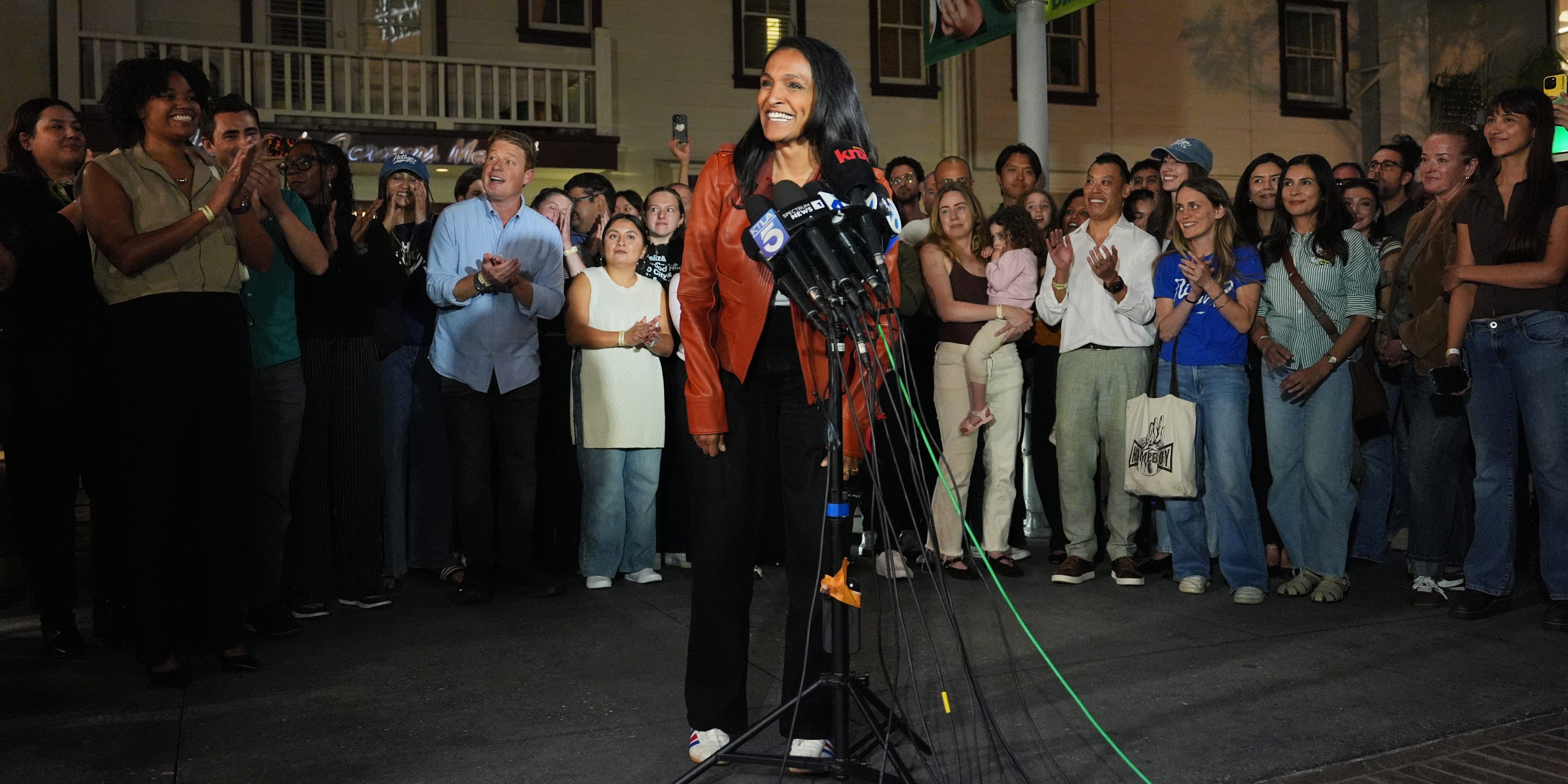
LA Mayor-elect Nithya Raman speaks on Nov. 5, 2026, in Los Angeles. Photo: Jae C. Hong/AP
On paper, the second-largest city in the country has its first democratic socialist mayor.
Los Angeles City Councilmember Nithya Raman declared victory on Thursday over the embattled incumbent Karen Bass, joining a list of socialist mayors who have risen to power in recent years, including Zohran Mamdani in New York; Seattle’s Katie Wilson; and most recently Janeese Lewis George in Washington, D.C., who won in a landslide this week.
Raman, however, did not campaign unabashedly as a socialist. Though she ran as an endorsed member of the Democratic Socialists of America’s Los Angeles chapter, the national DSA threatened to override the local chapter and rescind the endorsement over concerns around her stances on Israel and Palestine.
Unlike her counterpart in New York, to whom she draws most comparisons, Raman did not make sweeping socialist promises, such as free public transit, universal childcare, or taxing the rich. Instead, she focused on what’s wrong with the city. Riding a wave of resentment for Bass’s alleged mismanagements of the Palisades fire and the Lineage Logistics warehouse fire in Boyle Heights, Raman talked about filling potholes, fixing street lights, and making roads safer for pedestrians and cyclists.
In addition to DSA-LA support, she earned the endorsements of popular anti-corruption City Controller Kenneth Mejia and Unite Here 11, a major local hospitality workers union, whose large membership canvassed for her in the general. But she lacked endorsements from most key labor groups and social justice nonprofits, and the organizing base they provide. Her fellow DSA members on the Los Angeles City Council all pulled for Bass, forcing Raman to battle back the perception that she struggles to build coalitions.
While Mamdani, 10 months into his term, now finds himself under pressure from New York’s left for refusing to fire NYPD’s police commissioner, his massive base of organizer support offers a buffer to criticism. Raman won over the city’s voters, but it’s not clear how much time that will buy her to tackle the city’s most vexing problems once she takes office.
“Folks in New York are willing to cut Mamdani more slack on the movement side, because he was one of them on a bunch of issues,” said David Levitus, executive director of LA Forward, a progressive nonprofit that endorsed Raman in the general election. ”I think Nithya” — who did not come from the ranks of DSA organizing like Mamdani — “has more skepticism from parts of the left because of that.”
Raman will face scrutiny from LA’s progressive left on a host of issues: bloated police department spending amounting to roughly a quarter of the city’s nearly $15 billion budget; fear of collaboration between ICE and law enforcement agencies; the 2028 Olympics prompting an expansion of surveillance; rising homelessness; and failing infrastructure.
Weeks before the November election, Raman seemed less concerned with movement-based allegiances or ideological labels, saying she is “a capitalist and I’m also a democratic socialist.” Before the primary in June, she said she was “one of the most independent voices in City Hall” when asked about her membership with DSA. The statements and her votes in city council have prompted intense debate among DSA-LA’s members over whether Raman holds up to democratic socialist ideals.
While most Angelenos do not care about such fine distinctions, Raman’s measured embrace of socialist mantle has created among some activists the perception of a more responsive audience in city hall compared to previous administrations. Yet to others on LA’s progressive left, Raman’s ideological elusiveness reads as political unreliability.
“I don’t think Nithya Raman is accountable to anyone in the movement,” said Kris Rehl, an activist who volunteered for Raman during her 2020 city council run and now runs the mutual aid group LA Street Care. “If you do not subscribe to any ideology, you can’t be held accountable to it.”
Rehl, who advocates for abolishing anti-camping bans that criminalize homeless encampments near schools and daycares, expressed dismay over Raman’s previous votes on expanding the police department despite running on defunding the police in 2020.
Others like Tal Levy, a member of DSA-LA’s electoral politics committee, remain more optimistic about what Raman can deliver as mayor. While DSA-LA is pushing for reallocating funds from the police budget into social services, Levy sees the value of Raman’s pledge to support LA Forward’s initiative of citywide expansion of unarmed crisis response teams, which divert certain 911 calls to teams of social workers and clinicians, rather than police.
“Even if Nithya were a fire-breathing abolitionist, it would still be a long fight to make those changes,” said Levy, who has been organizing with DSA-LA for nearly a decade. “But I believe there is plenty of room for us to make material wins in the short term.”
The Pressure on LA’s First Socialist Mayor
Nithya Raman won the Los Angeles mayoralty carrying the democratic socialist label, though she never ran an openly socialist campaign. She now faces skepticism from the city's progressive left and pressure to turn that label into concrete policy.
Cross Lines newsroom
Share this article
#لوس أنجلوس#نيثيا رامان#الاشتراكيون الديمقراطيون#الانتخابات الأمريكية#كارين باس#زهران ممداني
Original source: The Intercept