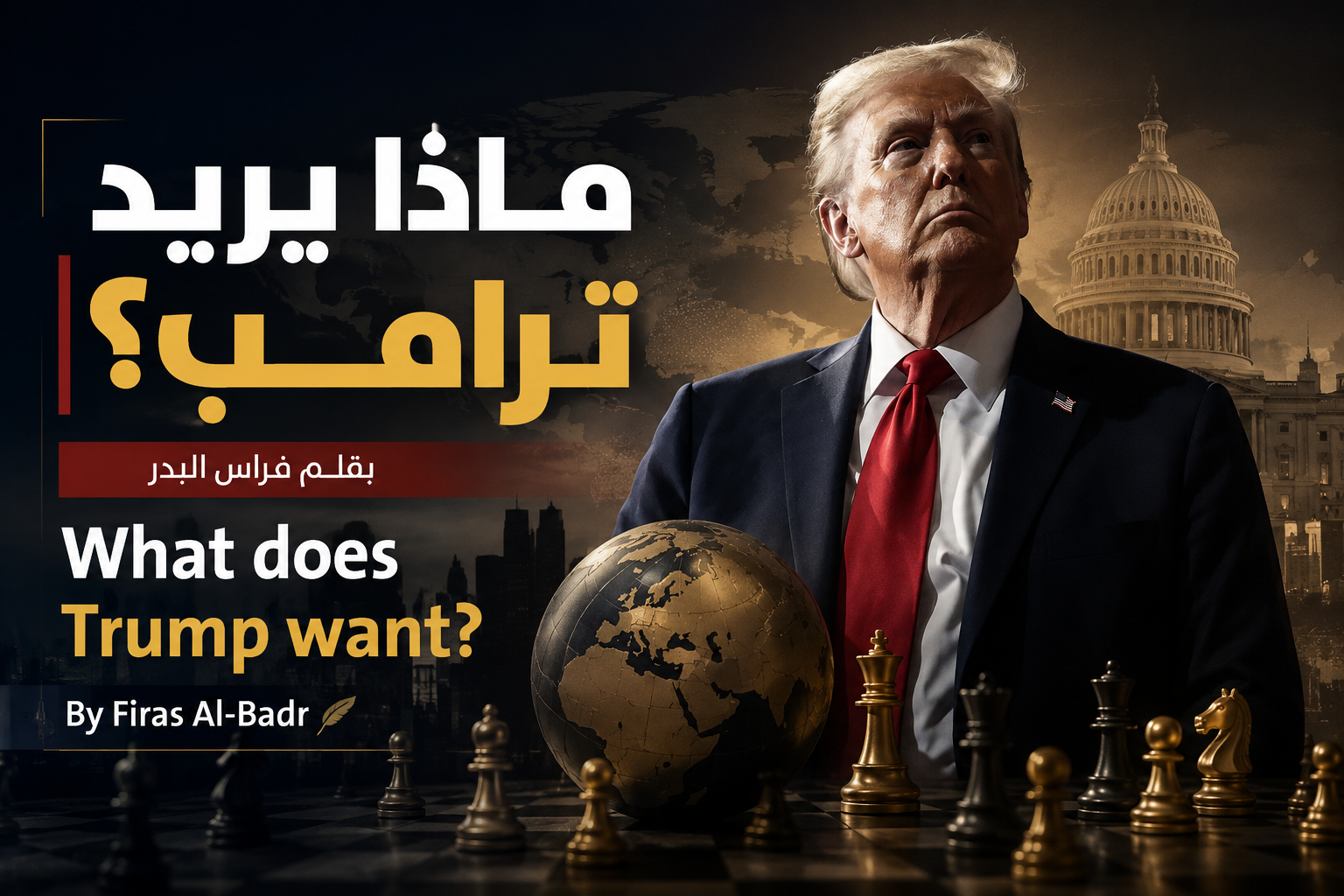
What Does Trump Want?

Firas Majid Al-Badr
Writer at CROSS LINES
A political analysis examining U.S. President Donald Trump's ambitions, the promises and priorities outlined in his first and second presidential campaigns, and the key initiatives he seeks to turn into reality. The article explores the policies and strategic objectives that have remained unfinished, while raising questions about whether certain decisions are driven by Trump's personal vision or shaped by broader political, institutional, and international pressures that influence the direction of his administration
What Does Trump Want? Decoding the "Trumpian Code" Between Two Terms
The presidency of Donald Trump, spanning his first and current second terms, operates within a vortex of international speculation, political contradictions, and pragmatic decisions that alternate between isolationism and heavy-handed intervention. The slogans of his first 2016 campaign, centered around "Make America Great Again" (MAGA), differ fundamentally in depth and application from what the world is witnessing in his current second term. This volatility in handling sensitive files leaves observers in constant confusion regarding the behavior of the man who has led the world's sole superpower for two non-consecutive terms.
Trump Between Two Terms: Pragmatic Dealmaking and Behavioral Contradictions
While Trump focused primarily on domestic issues and reshaping trade agreements during his first term, his second term has been characterized by a more radical momentum that sometimes bypasses his 2024 campaign promises. Skepticism surrounding his slogans has intensified, especially as his administration engaged in unexpected direct confrontations, such as military escalation against Iran and shocking maneuvers in Venezuela. These actions have exposed him to sharp criticism from both domestic Democratic opponents and international allies.
First-Term Portfolios: The Wall and Grand Withdrawals
1. The Immigration Dilemma and Border Security
The southern border with Mexico was the primary emotional and political driver of the 2016 campaign:
Building the Border Wall: Trump partially succeeded in imposing strict restrictions and constructing segments of the wall by relying on executive power.
The Backlash: These extreme protectionist policies led to a severe shortage of manual labor and a stagnation in low-wage jobs, a real crisis that major corporations struggled to overcome.
2. Tearing Up International Commitments and Treaties
The first Trump administration adopted a policy of dismantling the multilateral system through a series of historic withdrawals:
The Nuclear and Arms Control File: Withdrawal from the Iran Nuclear Deal (JCPOA) in 2018, the Intermediate-Range Nuclear Forces (INF) Treaty (2019), and the Open Skies Treaty (2020), alongside letting the "New START" treaty with Russia expire without renewal.
Climate and Health: Withdrawal from the Paris Climate Agreement and the UN Framework Convention, isolating America environmentally, followed by exiting the World Health Organization (WHO) and the UN Human Rights Council.
The Palestinian File: Completely cutting federal funding to the United Nations Relief and Works Agency (UNRWA).
Barack Obama’s Legacy: The Core Engine of Dismantling
Dismantling Barack Obama's legacy served as the ideological fuel for Trump's policies. Although he successfully passed massive tax cuts and rolled back environmental regulations, he faced significant failures in major portfolios:
"Trump could not repeal the Affordable Care Act (Obamacare) due to his inability to mobilize Congress in 2017, and he also failed to abolish the DACA program that protects immigrant children."
Auditing Allies and Adversaries in the Middle East
Iran: Open-Ended Maximum Pressure
Iran shifted from being a target of economic sanctions, oil export zeroing, and leadership assassinations (such as Qasem Soleimani) in the first term, to direct confrontation. This involved military strikes and ongoing tensions, despite stalled electronic and digital mediation attempts via Pakistan and Qatar.
Israel and "Band-Aid" Solutions for the Region
Trump's Middle East philosophy was built on absolute support for Tel Aviv and bypassing the Palestinian cause through the Abraham Accords, based on the principle of "peace for peace."
Historic Decisions: Recognizing Jerusalem as Israel's capital (2017), moving the US Embassy there, recognizing sovereignty over the Syrian Golan Heights (2019), and unveiling the "Deal of the Century" (2020).
Second-Term Rift: The relationship has recently witnessed clear tension following attempts to impose a Gaza peace agreement and establish a peace and reconstruction management council. This is compounded by a sharp rift over Israeli conduct in southern Lebanon and Netanyahu's insistence on creating a "buffer zone" inside Lebanese territory despite Washington-Tehran understandings, leading to a noticeable estrangement between the long-time allies.
Dramatic Shifts in Iraq, Syria, and Afghanistan
Iraq: Trump faced political backlash following assassinations on Iraqi soil, prompting the Iraqi parliament to vote for the withdrawal of foreign forces. However, Trump maintained leverage via the Federal Reserve's control over the US Dollar and Iraqi oil revenues as an economic pressure tool.
Syria (A Diplomatic U-Turn): After a partial troop withdrawal and the implementation of the Caesar Act in his first term, the Syrian arena witnessed a radical shift through the normalization of relations with the new transitional government led by Ahmed Al-Sharaa. This included reopening the US Embassy in Damascus and hosting Al-Sharaa at the White House to support reconstruction, conditioned on counter-terrorism and border stability.
Afghanistan: The Doha negotiations with the Taliban paved the way for the military withdrawal, turning the file in the second term into a complete political and security rupture.
Global Rivals and Geopolitical Ambitions
China: From Trade War to Taiwanese Ambiguity
The trade war entered a dark tunnel with the imposition of 25% tariffs on Chinese goods and the targeting of Huawei. Despite Trump's historic visit to Beijing to ease tensions, the relationship remained volatile and pragmatic, particularly regarding Taiwan, which Trump treats as a "trade bargaining chip," halting a $14 billion arms package to Taiwan over claims that it monopolized the semiconductor industry.
Russia and Ukraine: Difficult Balancing Acts
Despite his conciliatory rhetoric toward Vladimir Putin, Trump previously imposed sanctions on the Nord Stream 2 pipeline and expelled Russian diplomats. In his second term, he pressured to end the war in Ukraine, proposing a 28-point peace draft after meeting Zelenskyy, while threatening to cut off aid to Kyiv if the war did not stop, keeping arms supply policies in a state of constant flux.
The Greenland File: Renewed Strategic Ambitions
Trump revived his "bizarre" proposal to purchase Greenland from Denmark as a strategic necessity to counter Russian and Chinese influence in the Arctic. The Danish refusal led to Trump imposing 25% tariffs on Copenhagen and appointing Louisiana Governor Jeff Landry as a special envoy to the island, amid accusations that Trump attempted to stir internal hybrid unrest there.
Venezuela and the Panama Canal: The Backyard
Under the pretext of countering Chinese economic expansion, Trump pressured the Panamanian government to cancel Chinese contracts at the canal's entrances. This policy culminated in a swift military operation in Venezuela, resulting in a naval blockade and the signing of massive oil agreements favoring giants like ExxonMobil and Chevron to supply 50 million barrels of oil to the US.
Contradictory Rhetoric: Verbal Incontinence or Art of the Deal?
Trump possesses a unique ability to reverse his positions with sudden decisions, prompting Egyptian writer Abdullah Al-Sinnawi to write in Al-Quds Al-Arabi:
"The man suffers from verbal incontinence."
These contradictions are evident in numerous instances:
Calling NATO "obsolete" in 2016, only to recant after members increased defense spending.
Announcing a total troop withdrawal from Syria, then keeping forces to "protect the oil fields."
Banning the TikTok app, only to reverse the decision for economic benefits.
Refusing any negotiations with Iran, only to end up signing a memorandum of understanding via a closed electronic circuit.
Conclusion: What is Trump's Real Political Project?
Ultimately, the grand question remains without a definitive answer: What does Trump actually want?
Does he want to isolate America or lead the world through shock doctrine? Does he aim to weaken China, destroy the Iranian economy, monopolize global oil, or control the destiny of the US dollar?
Reviewing all these files reveals that the Trumpian desire cannot be confined to a stable ideological project; rather, it is a stark model of "unbalanced politics." At the very moment he presents himself as a global peacemaker deserving of the Nobel Prize, he launches swift military operations and imposes suffocating economic blockades. Trump's true project is "Trump himself"—a president managing a superpower with the mindset of a real estate mogul, viewing the entire world as nothing more than a negotiation table open to the terms of his next deal.
The presidency of Donald Trump, spanning his first and current second terms, operates within a vortex of international speculation, political contradictions, and pragmatic decisions that alternate between isolationism and heavy-handed intervention. The slogans of his first 2016 campaign, centered around "Make America Great Again" (MAGA), differ fundamentally in depth and application from what the world is witnessing in his current second term. This volatility in handling sensitive files leaves observers in constant confusion regarding the behavior of the man who has led the world's sole superpower for two non-consecutive terms.
Trump Between Two Terms: Pragmatic Dealmaking and Behavioral Contradictions
While Trump focused primarily on domestic issues and reshaping trade agreements during his first term, his second term has been characterized by a more radical momentum that sometimes bypasses his 2024 campaign promises. Skepticism surrounding his slogans has intensified, especially as his administration engaged in unexpected direct confrontations, such as military escalation against Iran and shocking maneuvers in Venezuela. These actions have exposed him to sharp criticism from both domestic Democratic opponents and international allies.
First-Term Portfolios: The Wall and Grand Withdrawals
1. The Immigration Dilemma and Border Security
The southern border with Mexico was the primary emotional and political driver of the 2016 campaign:
Building the Border Wall: Trump partially succeeded in imposing strict restrictions and constructing segments of the wall by relying on executive power.
The Backlash: These extreme protectionist policies led to a severe shortage of manual labor and a stagnation in low-wage jobs, a real crisis that major corporations struggled to overcome.
2. Tearing Up International Commitments and Treaties
The first Trump administration adopted a policy of dismantling the multilateral system through a series of historic withdrawals:
The Nuclear and Arms Control File: Withdrawal from the Iran Nuclear Deal (JCPOA) in 2018, the Intermediate-Range Nuclear Forces (INF) Treaty (2019), and the Open Skies Treaty (2020), alongside letting the "New START" treaty with Russia expire without renewal.
Climate and Health: Withdrawal from the Paris Climate Agreement and the UN Framework Convention, isolating America environmentally, followed by exiting the World Health Organization (WHO) and the UN Human Rights Council.
The Palestinian File: Completely cutting federal funding to the United Nations Relief and Works Agency (UNRWA).
Barack Obama’s Legacy: The Core Engine of Dismantling
Dismantling Barack Obama's legacy served as the ideological fuel for Trump's policies. Although he successfully passed massive tax cuts and rolled back environmental regulations, he faced significant failures in major portfolios:
"Trump could not repeal the Affordable Care Act (Obamacare) due to his inability to mobilize Congress in 2017, and he also failed to abolish the DACA program that protects immigrant children."
Auditing Allies and Adversaries in the Middle East
Iran: Open-Ended Maximum Pressure
Iran shifted from being a target of economic sanctions, oil export zeroing, and leadership assassinations (such as Qasem Soleimani) in the first term, to direct confrontation. This involved military strikes and ongoing tensions, despite stalled electronic and digital mediation attempts via Pakistan and Qatar.
Israel and "Band-Aid" Solutions for the Region
Trump's Middle East philosophy was built on absolute support for Tel Aviv and bypassing the Palestinian cause through the Abraham Accords, based on the principle of "peace for peace."
Historic Decisions: Recognizing Jerusalem as Israel's capital (2017), moving the US Embassy there, recognizing sovereignty over the Syrian Golan Heights (2019), and unveiling the "Deal of the Century" (2020).
Second-Term Rift: The relationship has recently witnessed clear tension following attempts to impose a Gaza peace agreement and establish a peace and reconstruction management council. This is compounded by a sharp rift over Israeli conduct in southern Lebanon and Netanyahu's insistence on creating a "buffer zone" inside Lebanese territory despite Washington-Tehran understandings, leading to a noticeable estrangement between the long-time allies.
Dramatic Shifts in Iraq, Syria, and Afghanistan
Iraq: Trump faced political backlash following assassinations on Iraqi soil, prompting the Iraqi parliament to vote for the withdrawal of foreign forces. However, Trump maintained leverage via the Federal Reserve's control over the US Dollar and Iraqi oil revenues as an economic pressure tool.
Syria (A Diplomatic U-Turn): After a partial troop withdrawal and the implementation of the Caesar Act in his first term, the Syrian arena witnessed a radical shift through the normalization of relations with the new transitional government led by Ahmed Al-Sharaa. This included reopening the US Embassy in Damascus and hosting Al-Sharaa at the White House to support reconstruction, conditioned on counter-terrorism and border stability.
Afghanistan: The Doha negotiations with the Taliban paved the way for the military withdrawal, turning the file in the second term into a complete political and security rupture.
Global Rivals and Geopolitical Ambitions
China: From Trade War to Taiwanese Ambiguity
The trade war entered a dark tunnel with the imposition of 25% tariffs on Chinese goods and the targeting of Huawei. Despite Trump's historic visit to Beijing to ease tensions, the relationship remained volatile and pragmatic, particularly regarding Taiwan, which Trump treats as a "trade bargaining chip," halting a $14 billion arms package to Taiwan over claims that it monopolized the semiconductor industry.
Russia and Ukraine: Difficult Balancing Acts
Despite his conciliatory rhetoric toward Vladimir Putin, Trump previously imposed sanctions on the Nord Stream 2 pipeline and expelled Russian diplomats. In his second term, he pressured to end the war in Ukraine, proposing a 28-point peace draft after meeting Zelenskyy, while threatening to cut off aid to Kyiv if the war did not stop, keeping arms supply policies in a state of constant flux.
The Greenland File: Renewed Strategic Ambitions
Trump revived his "bizarre" proposal to purchase Greenland from Denmark as a strategic necessity to counter Russian and Chinese influence in the Arctic. The Danish refusal led to Trump imposing 25% tariffs on Copenhagen and appointing Louisiana Governor Jeff Landry as a special envoy to the island, amid accusations that Trump attempted to stir internal hybrid unrest there.
Venezuela and the Panama Canal: The Backyard
Under the pretext of countering Chinese economic expansion, Trump pressured the Panamanian government to cancel Chinese contracts at the canal's entrances. This policy culminated in a swift military operation in Venezuela, resulting in a naval blockade and the signing of massive oil agreements favoring giants like ExxonMobil and Chevron to supply 50 million barrels of oil to the US.
Contradictory Rhetoric: Verbal Incontinence or Art of the Deal?
Trump possesses a unique ability to reverse his positions with sudden decisions, prompting Egyptian writer Abdullah Al-Sinnawi to write in Al-Quds Al-Arabi:
"The man suffers from verbal incontinence."
These contradictions are evident in numerous instances:
Calling NATO "obsolete" in 2016, only to recant after members increased defense spending.
Announcing a total troop withdrawal from Syria, then keeping forces to "protect the oil fields."
Banning the TikTok app, only to reverse the decision for economic benefits.
Refusing any negotiations with Iran, only to end up signing a memorandum of understanding via a closed electronic circuit.
Conclusion: What is Trump's Real Political Project?
Ultimately, the grand question remains without a definitive answer: What does Trump actually want?
Does he want to isolate America or lead the world through shock doctrine? Does he aim to weaken China, destroy the Iranian economy, monopolize global oil, or control the destiny of the US dollar?
Reviewing all these files reveals that the Trumpian desire cannot be confined to a stable ideological project; rather, it is a stark model of "unbalanced politics." At the very moment he presents himself as a global peacemaker deserving of the Nobel Prize, he launches swift military operations and imposes suffocating economic blockades. Trump's true project is "Trump himself"—a president managing a superpower with the mindset of a real estate mogul, viewing the entire world as nothing more than a negotiation table open to the terms of his next deal.
🔗 Share Article
For Context
Related reads from the same topic or latest developments