The U.S.–Venezuela Oil Agreement
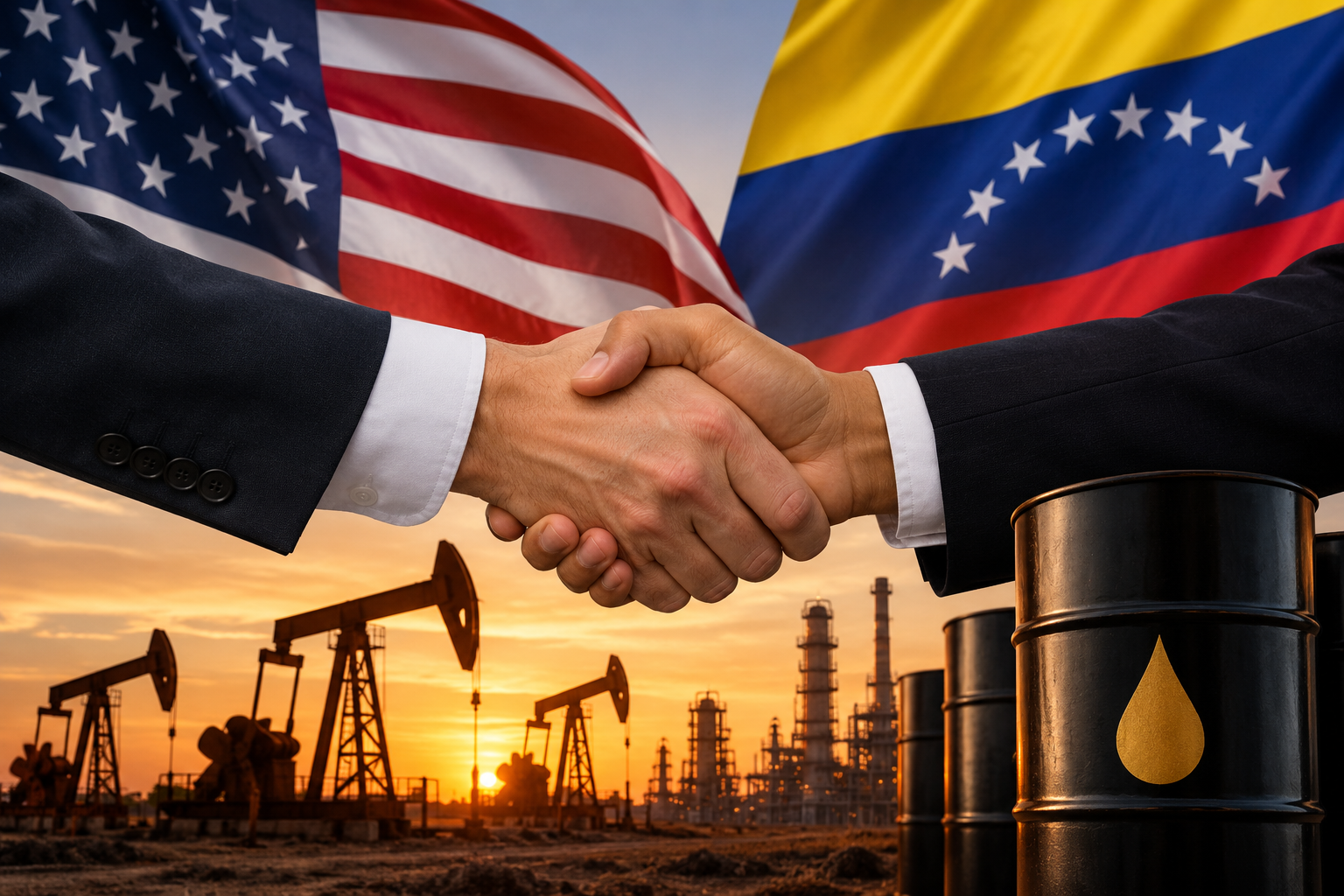
On August 28, 2026, U.S. President Donald Trump announced that the United States had reached a major oil agreement with Venezuela, describing it as “the largest oil deal in history.”
The agreement includes the following:
1. Reserves: The agreement grants Washington control over more than 65 billion barrels of Venezuela’s proven oil reserves, while some news reports have suggested that the volume of reserves brought under U.S. control through the agreement could reach 90 billion barrels. This comes despite Venezuela currently producing only around 1% of global oil output due to the deterioration of its oil infrastructure.
2. Fields and investment: The agreement provides for the development of 17 strategic oil fields, alongside investments exceeding $100 billion and more than $209 billion in tax revenues for the Venezuelan state.
Controlling stake: The U.S. government will retain a 55% controlling stake in a joint venture with a private operator experienced in Venezuela.
The agreement was negotiated by U.S. Secretary of State Marco Rubio and Secretary of War Pete Hegseth, in cooperation with Venezuela’s interim president, Delcy Rodríguez.
The U.S. government’s stake will reportedly be divided between equity ownership and guarantees to purchase the oil produced at cost, with the aim of replenishing the U.S. Strategic Petroleum Reserve. The Pentagon, through its Office of Strategic Capital, will oversee field licensing and assist with financing.
The agreement came nine months after the removal of Nicolás Maduro.
On the Venezuelan side, Rodríguez affirmed that Venezuela would retain ownership of its natural resources. However, the agreement has generated mixed reactions among Venezuelans, with hopes for economic recovery accompanied by concerns over the potential loss of national sovereignty.
There are also indications that the U.S. government’s share will be divided between equity ownership and guarantees to purchase oil production at cost to replenish the U.S. Strategic Petroleum Reserve, while the Pentagon’s Office of Strategic Capital will oversee field licensing and help finance development.
Impact on the Oil Market
The stated objective of the agreement is to increase crude oil production to approximately 1.5 million barrels per day. This would represent only a limited increase compared with the size of the global market, which consumes roughly 100 million barrels per day.
Nevertheless, this would increase the amount of oil available on the market.
The key question is whether this expected increase will be coordinated with OPEC.
The answer could help determine the agreement’s impact on global oil prices. Venezuela, however, is unlikely to comply with production restrictions under such circumstances.
Venezuela is one of the founding members of OPEC, but it has begun considering the possibility of withdrawing from the organization. This comes after the United Arab Emirates’ departure from the organization and amid indications of Iraqi dissatisfaction with production restrictions, developments that could lead to greater price volatility and weaken the alliance built around coordinated production cuts.
A careful examination of recent events shows that, before the U.S.–Iran war, the United States arrested Venezuelan President Nicolás Maduro. The sequence of events appeared to foreshadow a major global political and economic development, as it helped prepare the international environment for the U.S. war against Iran.
With the possibility that the Strait of Hormuz would be closed, gaining control over Venezuelan oil could help the United States absorb the expected oil shock.
The conclusion of this agreement can therefore be viewed as a continuation of those earlier developments.
Analysts believe the agreement could weaken the strategic leverage provided by the Strait of Hormuz, although it would not remove that leverage from Iran’s hands, at least in the short term.
Trump also plans to use Venezuelan oil to replenish the U.S. Strategic Petroleum Reserve, which could ease some pressure on domestic U.S. supplies without immediately producing a major transformation in the global oil market.
Conclusion
For now, the market is absorbing the agreement primarily as a political and strategic development rather than an immediate transformation of the global oil industry.
However, the agreement carries the seeds of potentially much larger structural changes, including the possible fragmentation of OPEC and the large-scale return of U.S. capital to Venezuela.
The consequences of these developments may become visible over months and years rather than days.
The U.S.–Venezuela Oil Agreement
This article examines the U.S.–Venezuela oil agreement and its potential impact on OPEC and the future of the global oil industry.

Dr. Bilal Al-Khalifa
Share this article