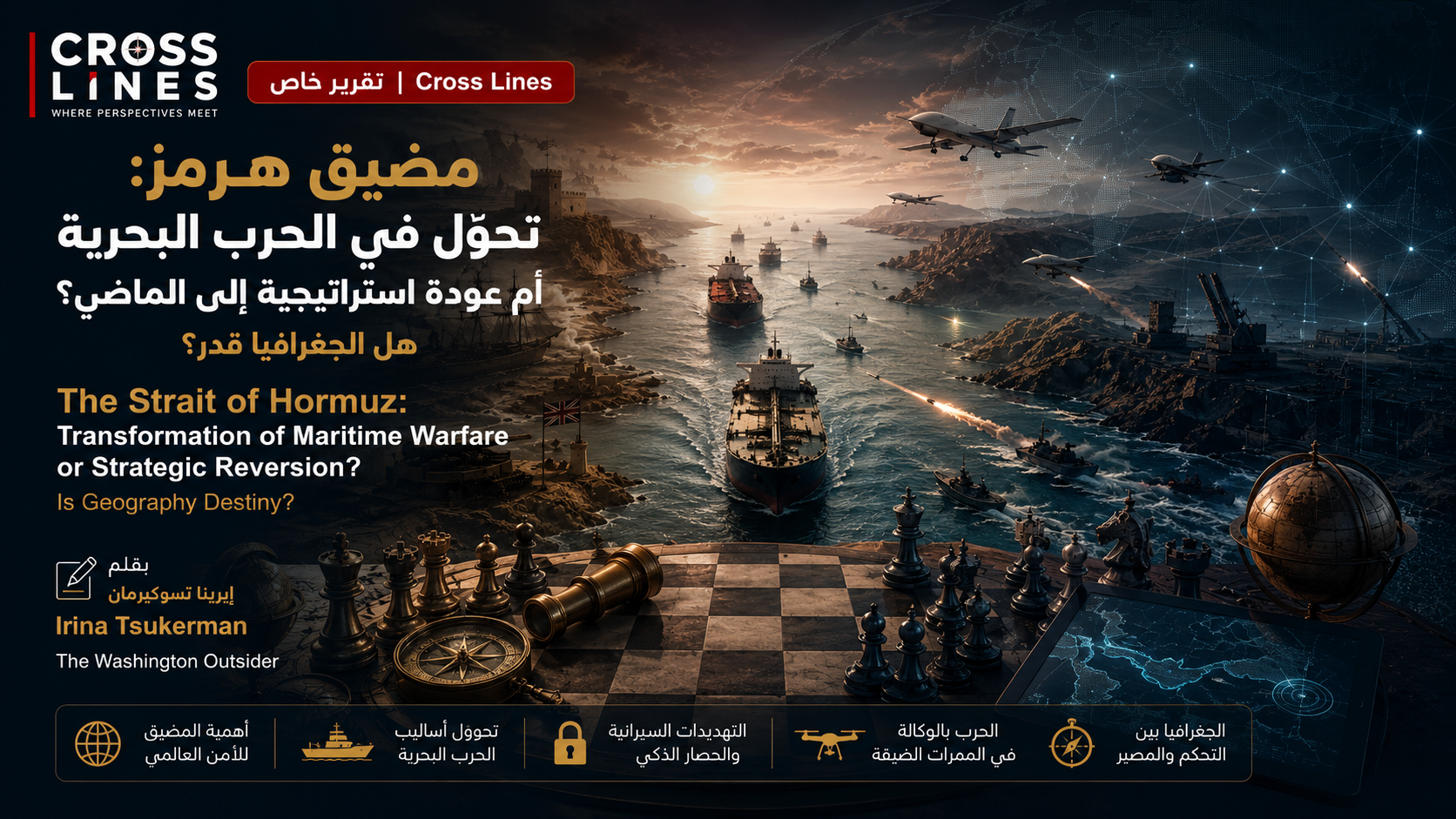
The Strait of Hormuz: Transformation of Maritime Warfare or Strategic Reversion?

Irina Tsukerman
Writer at CROSS LINES
Is Geography Destiny? Few maritime spaces have exerted such persistent influence on global strategy as the Strait of Hormuz, where geography has long shaped imperial ambitions, great power calculations, and the vulnerabilities of global commerce.
Is Geography Destiny?
Few maritime spaces have exerted such persistent influence on global strategy as the Strait of Hormuz, where geography has long shaped imperial ambitions, great power calculations, and the vulnerabilities of global commerce. In 2025, approximately 20 million barrels of oil per day transited this corridor, representing roughly 25 percent of global seaborne oil trade and close to 20 percent of total global consumption. The strait’s importance lies in its role as a narrow passage linking the enclosed waters of the Persian Gulf to the open Indian Ocean, concentrating the movement of energy, goods, and naval forces in a confined space where even limited disruption can carry global consequences.
This significance predates the modern state system. During the Achaemenid Empire in the sixth and fifth centuries BCE, Persian rulers oversaw trade networks linking Mesopotamia to the Indian Ocean, enabling the movement of goods and revenue across vast distances. By the early Islamic period, particularly between the eighth and tenth centuries, the Persian Gulf had become a central artery connecting Basra and Siraf to India, East Africa, and China, allowing political authority to extend beyond territorial boundaries through maritime commerce.
The arrival of European naval powers in the early sixteenth century marked a decisive shift toward the militarization of these routes. In 1515, Portuguese forces under Afonso de Albuquerque seized Hormuz and established a fortified position to regulate passage through the strait. Through naval patrols, coercive licensing, and the threat of force, Portugal shaped trade flows across the Indian Ocean without occupying the surrounding hinterland, demonstrating that control over a chokepoint could substitute for broader territorial control.
The Safavid reconquest of Hormuz in 1622, supported by the English East India Company, revealed how regional and external actors could align to reshape maritime control. This pattern became more formalized during British expansion in the Gulf. From the General Maritime Treaty of 1820 through the Exclusive Agreements of 1892, Britain built a network of political and naval arrangements that secured the Gulf as part of its imperial communications system linking Europe to India, ensuring the movement of goods, troops, and information across imperial space.
Russian ambitions reflected similar constraints. From Peter the Great in the early eighteenth century through expansion campaigns between 1828 and 1878, Russian policymakers pursued access to warm-water routes for year-round naval operations. The inability to secure such access shaped involvement in the Caucasus, Central Asia, and Persia. The Soviet Union continued this effort during the Cold War, seeking Indian Ocean access through positions in Aden and Berbera in the 1960s and 1970s to challenge Western maritime dominance.
Iran’s strategic outlook developed within this environment of external intervention. The 1901 Anglo-Persian Oil concession, the Anglo-Soviet occupation of 1941, and the 1953 coup reinforced the perception that maritime access could be used by outside powers to shape Iran’s position. This experience encouraged a shift toward denial and disruption rather than direct confrontation, focusing on shaping the conditions under which others operate.
The Red Sea and Bab el-Mandeb extended this system westward. The opening of the Suez Canal in 1869 linked the Mediterranean to the Indian Ocean, while British control of Egypt after 1882 and its presence in Aden secured both ends of the route. During the First World War from 1914 to 1918 and the Second World War from 1939 to 1945, control of the Red Sea ensured the continuity of military logistics between Europe and Asia. During the Cold War, the region became a theater of competition involving Egypt, Yemen, Ethiopia, Somalia, the Soviet Union, and Western powers. Across these periods, narrow waterways concentrated strategic influence and amplified the effects of disruption.
The present confrontation in the Strait of Hormuz unfolds within this historical continuum. Technologies have changed, but the strategic importance of constrained maritime movement remains constant, with the strait continuing to concentrate economic dependence, military capability, and political leverage.
From Conventional Deterrence to Asymmetric Persistence
For several decades after the Second World War, the Gulf was treated as a space where overwhelming naval superiority could prevent sustained maritime conflict. That assumption appeared valid during the tanker war phase of the Iran-Iraq War from 1984 to 1988, when more than 400 commercial vessels were attacked without escalating into a prolonged struggle for sea control. The United States intervened in 1987 through Operation Earnest Will, escorting Kuwaiti tankers, and followed with Operation Praying Mantis on April 18, 1988, inflicting heavy damage on Iranian naval forces. The episode reinforced the belief that a superior navy could restore order. The mining of USS Samuel B. Roberts on April 14, 1988, underscored the vulnerability of advanced naval forces to low-cost weapons. Today, drones, missiles, and networked targeting extend that pattern into continuous pressure, where maritime security is managed rather than restored.
Iran adapted differently. Instead of rebuilding a conventional fleet, it developed a distributed maritime approach built on dispersion, mobility, and geography. Through the 1990s and early twenty-first century, the Islamic Revolutionary Guard Corps Navy expanded small fast attack craft, naval mines, and shore-based missile systems. Anti-ship missiles with ranges beyond 300 kilometers extended threat coverage, while improved guidance increased precision. By the 2010s, unmanned aerial systems enabled persistent surveillance and strike capability without large platforms.
Maritime competition shifted from control to disruption. The confined geography of the Gulf limits maneuver and increases predictability, allowing dispersed forces to concentrate effects. Naval mines, used from the Russo-Japanese War through both World Wars, again proved effective. Even limited deployment forces extensive clearance operations and sustained resource commitments.
The Houthi campaign in the Red Sea from November 2023 to early 2026 showed how far this model can extend. Over 113 attacks targeted vessels linked to more than 60 nations using missiles, drones, and small craft. The aim was not closure, but sustained uncertainty. By early 2025, oil flows through Bab el-Mandeb dropped from about 9.3 million barrels per day in 2023 to roughly 4.1 to 4.2 million. Shipping rerouted around the Cape of Good Hope, adding weeks and significant cost.
Earlier parallels are clear. The Barbary corsairs from the sixteenth to early nineteenth centuries operated from Algiers, Tunis, and Tripoli, attacking merchant shipping across the Mediterranean and Atlantic. Their campaigns combined state backing with private incentive, generating revenue through seizure, ransom, and tribute while maintaining constant pressure. European responses alternated between force, negotiation, and tribute, while the First Barbary War from 1801 to 1805 and the Second in 1815 showed the difficulty of eliminating decentralized threats.
A comparable precedent emerged during the British submarine campaign in the Dardanelles (1915 to 1916). British submarines penetrated Ottoman defenses, targeting supply shipping and disrupting logistics without closing the strait. The campaign imposed sustained pressure and risk, showing how maritime disruption can reshape operations without requiring control of the waterway.
Blockade Warfare and the Dynamics of Attrition
Blockade warfare has historically functioned less as immediate denial than as cumulative pressure, reshaping the strategic environment over time. Its origins extend to antiquity, where control of maritime supply determined the endurance of states in prolonged conflict. During the Peloponnesian War from 431 to 404 BCE, Athens sustained itself through naval supply while disrupting adversary trade, until Sparta adapted with Persian support to build a rival fleet. This demonstrated that maritime control requires continuous investment and adaptation.
The Punic Wars from 264 to 146 BCE further showed how disruption could erode a maritime power dependent on trade networks. Carthage relied on sea-based connections across the Mediterranean, while Rome’s gradual naval development and restriction of movement shifted the strategic balance over time.
In the early modern period, maritime control became more structured. The Portuguese cartaz system in the sixteenth century required vessels in the Indian Ocean to obtain licenses, allowing Portugal to regulate trade across a vast domain without constant presence. This principle of controlling key nodes rather than entire sea space carried forward into later blockade strategies.
By the nineteenth century, blockade became central to state strategy. The British blockade of Napoleonic France from 1806 to 1814 restricted access to overseas markets, weakening the economic basis of French power in conjunction with land campaigns. During the First World War from 1914 to 1919, the Allied blockade of Germany imposed widespread shortages, while Germany’s response through unrestricted submarine warfare extended the conflict across global shipping.
The Second World War expanded these dynamics. German U-boat campaigns from 1939 to 1943 sought to sever Britain’s Atlantic supply lines, while Allied convoy systems, supported by radar, sonar, and air power, sustained maritime flow. The outcome depended on endurance, coordination, and adaptation rather than decisive engagement.
The current confrontation in the Strait of Hormuz reflects these patterns through disruption rather than full interdiction. Iran has imposed sustained risk and cost on transit without seeking full closure of the waterway. Naval mines introduced uncertainty that shapes movement, while anti-ship missiles and unmanned systems extended threat across a wider operational space, altering behavior without continuous enforcement.
Economic effects are central. Insurance premiums rise during escalation, and shipping companies reroute around the Cape of Good Hope, adding time and cost that ripple through energy markets and global supply chains. Localized disruption now translates rapidly into global economic consequence.
The distribution of cost reinforces the asymmetry. Relatively low-cost systems can generate conditions requiring sustained investment in surveillance, escort, mine clearance, and defense. Maritime security became a continuous demand. The side able to sustain pressure while managing its own vulnerabilities shapes outcomes over time, underscoring the enduring role of blockade as a tool linking maritime disruption to broader strategic effect.
Chokepoints as Strategic Leverage in a Fragmenting Order
The strategic importance of maritime chokepoints has been recognized across successive historical periods, rooted in the concentration of movement that occurs within narrow waterways. In the ancient world, control of the Hellespont influenced access between the Aegean and Black Seas, defining the outcomes of conflicts between Greek city-states and the Persian Empire. The ability to regulate passage through this corridor carried implications for both trade and military movement, demonstrating the enduring relationship between geography and strategic leverage.
The Bosphorus, similarly, has long functioned as a gateway between regions, influencing the fortunes of empires that controlled its shores. The fall of Constantinople in 1453 transferred control of this passage to the Ottoman Empire, altering trade routes and contributing to the European search for alternative maritime pathways to Asia. This shift illustrates how control of a chokepoint can extend its influence far beyond its immediate surroundings, reshaping patterns of commerce and exploration.
The Dardanelles campaign of 1915 to 1916 provides a more modern example of the difficulty inherent in securing passage through a defended strait. Allied forces sought to establish a maritime route to Russia, yet encountered sustained resistance shaped by geography, fortification, and determined defense. The campaign resulted in significant losses and failed to achieve its objectives, reinforcing the enduring capacity of chokepoints to resist control even when confronted by major powers.
In Southeast Asia, the Malacca Strait has served for centuries as a critical conduit linking the Indian Ocean to the Pacific. During the height of European colonial competition, control of this route supported trade networks that spanned continents. In contemporary terms, approximately 16 million barrels of oil per day transit this strait, underscoring its continued significance. The Taiwan Strait presents a contemporary manifestation of similar dynamics. Its relatively narrow width and central position within East Asian trade routes make it a critical corridor for both commercial shipping and military movement. The strategic importance of this passage reflects its role as both a conduit and a point of potential disruption.
The Bosphorus and the Dardanelles continue to illustrate the interaction between legal frameworks and strategic considerations. The Montreux Convention of 1936 grants Turkey authority over naval transit, enabling it to regulate access in accordance with national interests. This legal structure adds a layer of political influence to the geographic significance of these waterways, demonstrating how control can be exercised through both physical and regulatory means.
The Return of Maritime Disorder and the Erosion of Legal Norms
The governance of the maritime domain has historically rested upon a combination of customary practice, legal codification, and the balance of power among states. In earlier periods, the absence of universally accepted norms allowed for a wide range of activities that blurred the boundaries between commerce and warfare. Privateering during the sixteenth through eighteenth centuries exemplified this ambiguity, as states authorized private actors to attack enemy shipping under formal commissions. These practices extended the reach of maritime conflict beyond state-controlled navies, creating an environment in which economic warfare operated through decentralized means and in which responsibility could be partially disavowed even when strategic intent remained clear.
Throughout the seventeenth and eighteenth centuries, several powers, including France, Spain, and Britain, alternated between punitive expeditions and negotiated arrangements. Tribute payments became a common, if politically uncomfortable, mechanism for securing limited stability. The United States, following its independence, confronted the same challenge, culminating in the First Barbary War from 1801 to 1805 and the Second Barbary War in 1815. These campaigns represented attempts to reassert control over maritime access through direct force. Yet even after these interventions, the suppression of corsair activity required sustained European naval pressure over subsequent decades, illustrating the resilience of decentralized maritime threats once they become embedded within regional political economies.
This historical experience bears a clear relationship to contemporary patterns of maritime disorder. The Barbary corsairs operated in an environment where attribution was often blurred, where state involvement could be denied or partially obscured, and where economic coercion functioned through disruption rather than occupation. These characteristics have reemerged in modern form, shaped by advances in technology but grounded in familiar strategic behavior. The maritime domain once again accommodates actors who combine limited means with persistent pressure, affecting commerce across wide areas without engaging in conventional naval confrontation.
The tanker war phase of the Iran-Iraq conflict between 1984 and 1988 offers a more direct precursor to current developments in the Gulf. During this period, both Iran and Iraq targeted commercial shipping as part of a broader effort to undermine each other’s economic foundations. Over 400 vessels were attacked, including tankers carrying oil from neutral states. Iraq initiated the campaign with air strikes against Iranian shipping and infrastructure, while Iran responded by targeting vessels associated with Gulf states that supported Iraq financially. The international response to the tanker war highlighted both the capacity and the limits of traditional maritime security arrangements.
The tanker war revealed several features that have reappeared in contemporary maritime conflict. First, commercial shipping can be targeted in ways that produce strategic effects without requiring sustained naval engagement. Second, the introduction of risk into a confined maritime space can alter behavior across a much wider system, affecting insurance markets, trade flows, and political decision-making. Third, even a powerful naval presence cannot fully eliminate decentralized threats, particularly when those threats rely on dispersed and adaptable methods.
In the present environment, these historical patterns have converged with modern capabilities. Non-state actors, often aligned with or supported by states, employ drones, missiles, and small craft to affect shipping across extended areas. Attribution remains contested, responses remain constrained, and the legal frameworks developed in earlier periods struggle to address actions that fall between categories of war and criminal activity. The maritime domain once again exhibits characteristics associated with earlier periods of disorder, though expressed through contemporary means.
The erosion of clear norms influences the behavior of major powers as well. In the absence of widely accepted rules, states increasingly rely on unilateral or coalition-based measures to secure access. Naval patrols, escort missions, and targeted strikes serve as immediate responses, yet they operate within a broader environment of uncertainty. The central lesson for the United States is that naval superiority no longer guarantees strategic control over critical waterways. The U.S. Navy can destroy launch sites, intercept missiles, escort commercial vessels, and win tactical engagements, yet still struggle to restore confidence in maritime transit if adversaries can keep imposing intermittent risk at low cost. Hormuz and Bab el-Mandeb show that the future of sea control may be temporary, localized, and expensive, requiring deeper missile magazines, cheaper interceptors, unmanned escort systems, autonomous mine countermeasures, faster ship repair, hardened logistics, and more resilient industrial replenishment. The United States will also need to treat maritime security as a whole-of-government and coalition problem rather than a naval patrol mission alone. Insurance markets, commercial shipping behavior, allied political will, energy pricing, port access, intelligence sharing, and public tolerance for prolonged operations all shape whether a waterway remains functionally open.
For other powers, the lesson is equally stark: chokepoints have become strategic weapons in their own right. Weaker states and proxy forces can exploit geography to impose costs on stronger militaries, while stronger powers may increasingly look to chokepoint control, convoy systems, legal restrictions, and selective denial as instruments of coercion. This points toward a more fragmented maritime order in which freedom of navigation will depend less on abstract legal norms and more on the capacity to enforce access under pressure. States reliant on maritime trade will have to diversify routes, harden supply chains, invest in naval and coast guard capacity, and prepare for prolonged gray-zone disruption, not just short crises. The broader takeaway is that maritime strategy is returning to an older pattern: control of the sea is not a permanent condition, but a contested achievement that has to be produced, defended, financed, and politically sustained.
A U.S.-led coalition would need to move beyond reactive escorts toward a sustained campaign targeting disruption at its source. It should divide the region into operational zones, integrate surveillance and intelligence, and rely on lower-cost defenses against drones and missiles to address cost imbalances. Continuous pressure should target coastal missile, drone, and mine networks. At sea, coordinated convoys, insurance backing, and adaptive routing can restore commercial confidence. Over time, sustained pressure combined with limited negotiations could reduce the effectiveness of disruption and bring maritime risk back to manageable levels, though may not eliminate it entirely.
Few maritime spaces have exerted such persistent influence on global strategy as the Strait of Hormuz, where geography has long shaped imperial ambitions, great power calculations, and the vulnerabilities of global commerce. In 2025, approximately 20 million barrels of oil per day transited this corridor, representing roughly 25 percent of global seaborne oil trade and close to 20 percent of total global consumption. The strait’s importance lies in its role as a narrow passage linking the enclosed waters of the Persian Gulf to the open Indian Ocean, concentrating the movement of energy, goods, and naval forces in a confined space where even limited disruption can carry global consequences.
This significance predates the modern state system. During the Achaemenid Empire in the sixth and fifth centuries BCE, Persian rulers oversaw trade networks linking Mesopotamia to the Indian Ocean, enabling the movement of goods and revenue across vast distances. By the early Islamic period, particularly between the eighth and tenth centuries, the Persian Gulf had become a central artery connecting Basra and Siraf to India, East Africa, and China, allowing political authority to extend beyond territorial boundaries through maritime commerce.
The arrival of European naval powers in the early sixteenth century marked a decisive shift toward the militarization of these routes. In 1515, Portuguese forces under Afonso de Albuquerque seized Hormuz and established a fortified position to regulate passage through the strait. Through naval patrols, coercive licensing, and the threat of force, Portugal shaped trade flows across the Indian Ocean without occupying the surrounding hinterland, demonstrating that control over a chokepoint could substitute for broader territorial control.
The Safavid reconquest of Hormuz in 1622, supported by the English East India Company, revealed how regional and external actors could align to reshape maritime control. This pattern became more formalized during British expansion in the Gulf. From the General Maritime Treaty of 1820 through the Exclusive Agreements of 1892, Britain built a network of political and naval arrangements that secured the Gulf as part of its imperial communications system linking Europe to India, ensuring the movement of goods, troops, and information across imperial space.
Russian ambitions reflected similar constraints. From Peter the Great in the early eighteenth century through expansion campaigns between 1828 and 1878, Russian policymakers pursued access to warm-water routes for year-round naval operations. The inability to secure such access shaped involvement in the Caucasus, Central Asia, and Persia. The Soviet Union continued this effort during the Cold War, seeking Indian Ocean access through positions in Aden and Berbera in the 1960s and 1970s to challenge Western maritime dominance.
Iran’s strategic outlook developed within this environment of external intervention. The 1901 Anglo-Persian Oil concession, the Anglo-Soviet occupation of 1941, and the 1953 coup reinforced the perception that maritime access could be used by outside powers to shape Iran’s position. This experience encouraged a shift toward denial and disruption rather than direct confrontation, focusing on shaping the conditions under which others operate.
The Red Sea and Bab el-Mandeb extended this system westward. The opening of the Suez Canal in 1869 linked the Mediterranean to the Indian Ocean, while British control of Egypt after 1882 and its presence in Aden secured both ends of the route. During the First World War from 1914 to 1918 and the Second World War from 1939 to 1945, control of the Red Sea ensured the continuity of military logistics between Europe and Asia. During the Cold War, the region became a theater of competition involving Egypt, Yemen, Ethiopia, Somalia, the Soviet Union, and Western powers. Across these periods, narrow waterways concentrated strategic influence and amplified the effects of disruption.
The present confrontation in the Strait of Hormuz unfolds within this historical continuum. Technologies have changed, but the strategic importance of constrained maritime movement remains constant, with the strait continuing to concentrate economic dependence, military capability, and political leverage.
From Conventional Deterrence to Asymmetric Persistence
For several decades after the Second World War, the Gulf was treated as a space where overwhelming naval superiority could prevent sustained maritime conflict. That assumption appeared valid during the tanker war phase of the Iran-Iraq War from 1984 to 1988, when more than 400 commercial vessels were attacked without escalating into a prolonged struggle for sea control. The United States intervened in 1987 through Operation Earnest Will, escorting Kuwaiti tankers, and followed with Operation Praying Mantis on April 18, 1988, inflicting heavy damage on Iranian naval forces. The episode reinforced the belief that a superior navy could restore order. The mining of USS Samuel B. Roberts on April 14, 1988, underscored the vulnerability of advanced naval forces to low-cost weapons. Today, drones, missiles, and networked targeting extend that pattern into continuous pressure, where maritime security is managed rather than restored.
Iran adapted differently. Instead of rebuilding a conventional fleet, it developed a distributed maritime approach built on dispersion, mobility, and geography. Through the 1990s and early twenty-first century, the Islamic Revolutionary Guard Corps Navy expanded small fast attack craft, naval mines, and shore-based missile systems. Anti-ship missiles with ranges beyond 300 kilometers extended threat coverage, while improved guidance increased precision. By the 2010s, unmanned aerial systems enabled persistent surveillance and strike capability without large platforms.
Maritime competition shifted from control to disruption. The confined geography of the Gulf limits maneuver and increases predictability, allowing dispersed forces to concentrate effects. Naval mines, used from the Russo-Japanese War through both World Wars, again proved effective. Even limited deployment forces extensive clearance operations and sustained resource commitments.
The Houthi campaign in the Red Sea from November 2023 to early 2026 showed how far this model can extend. Over 113 attacks targeted vessels linked to more than 60 nations using missiles, drones, and small craft. The aim was not closure, but sustained uncertainty. By early 2025, oil flows through Bab el-Mandeb dropped from about 9.3 million barrels per day in 2023 to roughly 4.1 to 4.2 million. Shipping rerouted around the Cape of Good Hope, adding weeks and significant cost.
Earlier parallels are clear. The Barbary corsairs from the sixteenth to early nineteenth centuries operated from Algiers, Tunis, and Tripoli, attacking merchant shipping across the Mediterranean and Atlantic. Their campaigns combined state backing with private incentive, generating revenue through seizure, ransom, and tribute while maintaining constant pressure. European responses alternated between force, negotiation, and tribute, while the First Barbary War from 1801 to 1805 and the Second in 1815 showed the difficulty of eliminating decentralized threats.
A comparable precedent emerged during the British submarine campaign in the Dardanelles (1915 to 1916). British submarines penetrated Ottoman defenses, targeting supply shipping and disrupting logistics without closing the strait. The campaign imposed sustained pressure and risk, showing how maritime disruption can reshape operations without requiring control of the waterway.
Blockade Warfare and the Dynamics of Attrition
Blockade warfare has historically functioned less as immediate denial than as cumulative pressure, reshaping the strategic environment over time. Its origins extend to antiquity, where control of maritime supply determined the endurance of states in prolonged conflict. During the Peloponnesian War from 431 to 404 BCE, Athens sustained itself through naval supply while disrupting adversary trade, until Sparta adapted with Persian support to build a rival fleet. This demonstrated that maritime control requires continuous investment and adaptation.
The Punic Wars from 264 to 146 BCE further showed how disruption could erode a maritime power dependent on trade networks. Carthage relied on sea-based connections across the Mediterranean, while Rome’s gradual naval development and restriction of movement shifted the strategic balance over time.
In the early modern period, maritime control became more structured. The Portuguese cartaz system in the sixteenth century required vessels in the Indian Ocean to obtain licenses, allowing Portugal to regulate trade across a vast domain without constant presence. This principle of controlling key nodes rather than entire sea space carried forward into later blockade strategies.
By the nineteenth century, blockade became central to state strategy. The British blockade of Napoleonic France from 1806 to 1814 restricted access to overseas markets, weakening the economic basis of French power in conjunction with land campaigns. During the First World War from 1914 to 1919, the Allied blockade of Germany imposed widespread shortages, while Germany’s response through unrestricted submarine warfare extended the conflict across global shipping.
The Second World War expanded these dynamics. German U-boat campaigns from 1939 to 1943 sought to sever Britain’s Atlantic supply lines, while Allied convoy systems, supported by radar, sonar, and air power, sustained maritime flow. The outcome depended on endurance, coordination, and adaptation rather than decisive engagement.
The current confrontation in the Strait of Hormuz reflects these patterns through disruption rather than full interdiction. Iran has imposed sustained risk and cost on transit without seeking full closure of the waterway. Naval mines introduced uncertainty that shapes movement, while anti-ship missiles and unmanned systems extended threat across a wider operational space, altering behavior without continuous enforcement.
Economic effects are central. Insurance premiums rise during escalation, and shipping companies reroute around the Cape of Good Hope, adding time and cost that ripple through energy markets and global supply chains. Localized disruption now translates rapidly into global economic consequence.
The distribution of cost reinforces the asymmetry. Relatively low-cost systems can generate conditions requiring sustained investment in surveillance, escort, mine clearance, and defense. Maritime security became a continuous demand. The side able to sustain pressure while managing its own vulnerabilities shapes outcomes over time, underscoring the enduring role of blockade as a tool linking maritime disruption to broader strategic effect.
Chokepoints as Strategic Leverage in a Fragmenting Order
The strategic importance of maritime chokepoints has been recognized across successive historical periods, rooted in the concentration of movement that occurs within narrow waterways. In the ancient world, control of the Hellespont influenced access between the Aegean and Black Seas, defining the outcomes of conflicts between Greek city-states and the Persian Empire. The ability to regulate passage through this corridor carried implications for both trade and military movement, demonstrating the enduring relationship between geography and strategic leverage.
The Bosphorus, similarly, has long functioned as a gateway between regions, influencing the fortunes of empires that controlled its shores. The fall of Constantinople in 1453 transferred control of this passage to the Ottoman Empire, altering trade routes and contributing to the European search for alternative maritime pathways to Asia. This shift illustrates how control of a chokepoint can extend its influence far beyond its immediate surroundings, reshaping patterns of commerce and exploration.
The Dardanelles campaign of 1915 to 1916 provides a more modern example of the difficulty inherent in securing passage through a defended strait. Allied forces sought to establish a maritime route to Russia, yet encountered sustained resistance shaped by geography, fortification, and determined defense. The campaign resulted in significant losses and failed to achieve its objectives, reinforcing the enduring capacity of chokepoints to resist control even when confronted by major powers.
In Southeast Asia, the Malacca Strait has served for centuries as a critical conduit linking the Indian Ocean to the Pacific. During the height of European colonial competition, control of this route supported trade networks that spanned continents. In contemporary terms, approximately 16 million barrels of oil per day transit this strait, underscoring its continued significance. The Taiwan Strait presents a contemporary manifestation of similar dynamics. Its relatively narrow width and central position within East Asian trade routes make it a critical corridor for both commercial shipping and military movement. The strategic importance of this passage reflects its role as both a conduit and a point of potential disruption.
The Bosphorus and the Dardanelles continue to illustrate the interaction between legal frameworks and strategic considerations. The Montreux Convention of 1936 grants Turkey authority over naval transit, enabling it to regulate access in accordance with national interests. This legal structure adds a layer of political influence to the geographic significance of these waterways, demonstrating how control can be exercised through both physical and regulatory means.
The Return of Maritime Disorder and the Erosion of Legal Norms
The governance of the maritime domain has historically rested upon a combination of customary practice, legal codification, and the balance of power among states. In earlier periods, the absence of universally accepted norms allowed for a wide range of activities that blurred the boundaries between commerce and warfare. Privateering during the sixteenth through eighteenth centuries exemplified this ambiguity, as states authorized private actors to attack enemy shipping under formal commissions. These practices extended the reach of maritime conflict beyond state-controlled navies, creating an environment in which economic warfare operated through decentralized means and in which responsibility could be partially disavowed even when strategic intent remained clear.
Throughout the seventeenth and eighteenth centuries, several powers, including France, Spain, and Britain, alternated between punitive expeditions and negotiated arrangements. Tribute payments became a common, if politically uncomfortable, mechanism for securing limited stability. The United States, following its independence, confronted the same challenge, culminating in the First Barbary War from 1801 to 1805 and the Second Barbary War in 1815. These campaigns represented attempts to reassert control over maritime access through direct force. Yet even after these interventions, the suppression of corsair activity required sustained European naval pressure over subsequent decades, illustrating the resilience of decentralized maritime threats once they become embedded within regional political economies.
This historical experience bears a clear relationship to contemporary patterns of maritime disorder. The Barbary corsairs operated in an environment where attribution was often blurred, where state involvement could be denied or partially obscured, and where economic coercion functioned through disruption rather than occupation. These characteristics have reemerged in modern form, shaped by advances in technology but grounded in familiar strategic behavior. The maritime domain once again accommodates actors who combine limited means with persistent pressure, affecting commerce across wide areas without engaging in conventional naval confrontation.
The tanker war phase of the Iran-Iraq conflict between 1984 and 1988 offers a more direct precursor to current developments in the Gulf. During this period, both Iran and Iraq targeted commercial shipping as part of a broader effort to undermine each other’s economic foundations. Over 400 vessels were attacked, including tankers carrying oil from neutral states. Iraq initiated the campaign with air strikes against Iranian shipping and infrastructure, while Iran responded by targeting vessels associated with Gulf states that supported Iraq financially. The international response to the tanker war highlighted both the capacity and the limits of traditional maritime security arrangements.
The tanker war revealed several features that have reappeared in contemporary maritime conflict. First, commercial shipping can be targeted in ways that produce strategic effects without requiring sustained naval engagement. Second, the introduction of risk into a confined maritime space can alter behavior across a much wider system, affecting insurance markets, trade flows, and political decision-making. Third, even a powerful naval presence cannot fully eliminate decentralized threats, particularly when those threats rely on dispersed and adaptable methods.
In the present environment, these historical patterns have converged with modern capabilities. Non-state actors, often aligned with or supported by states, employ drones, missiles, and small craft to affect shipping across extended areas. Attribution remains contested, responses remain constrained, and the legal frameworks developed in earlier periods struggle to address actions that fall between categories of war and criminal activity. The maritime domain once again exhibits characteristics associated with earlier periods of disorder, though expressed through contemporary means.
The erosion of clear norms influences the behavior of major powers as well. In the absence of widely accepted rules, states increasingly rely on unilateral or coalition-based measures to secure access. Naval patrols, escort missions, and targeted strikes serve as immediate responses, yet they operate within a broader environment of uncertainty. The central lesson for the United States is that naval superiority no longer guarantees strategic control over critical waterways. The U.S. Navy can destroy launch sites, intercept missiles, escort commercial vessels, and win tactical engagements, yet still struggle to restore confidence in maritime transit if adversaries can keep imposing intermittent risk at low cost. Hormuz and Bab el-Mandeb show that the future of sea control may be temporary, localized, and expensive, requiring deeper missile magazines, cheaper interceptors, unmanned escort systems, autonomous mine countermeasures, faster ship repair, hardened logistics, and more resilient industrial replenishment. The United States will also need to treat maritime security as a whole-of-government and coalition problem rather than a naval patrol mission alone. Insurance markets, commercial shipping behavior, allied political will, energy pricing, port access, intelligence sharing, and public tolerance for prolonged operations all shape whether a waterway remains functionally open.
For other powers, the lesson is equally stark: chokepoints have become strategic weapons in their own right. Weaker states and proxy forces can exploit geography to impose costs on stronger militaries, while stronger powers may increasingly look to chokepoint control, convoy systems, legal restrictions, and selective denial as instruments of coercion. This points toward a more fragmented maritime order in which freedom of navigation will depend less on abstract legal norms and more on the capacity to enforce access under pressure. States reliant on maritime trade will have to diversify routes, harden supply chains, invest in naval and coast guard capacity, and prepare for prolonged gray-zone disruption, not just short crises. The broader takeaway is that maritime strategy is returning to an older pattern: control of the sea is not a permanent condition, but a contested achievement that has to be produced, defended, financed, and politically sustained.
A U.S.-led coalition would need to move beyond reactive escorts toward a sustained campaign targeting disruption at its source. It should divide the region into operational zones, integrate surveillance and intelligence, and rely on lower-cost defenses against drones and missiles to address cost imbalances. Continuous pressure should target coastal missile, drone, and mine networks. At sea, coordinated convoys, insurance backing, and adaptive routing can restore commercial confidence. Over time, sustained pressure combined with limited negotiations could reduce the effectiveness of disruption and bring maritime risk back to manageable levels, though may not eliminate it entirely.
🔗 Share Article
Source: The Washington Outsider Substack
For Context
Related reads from the same topic or latest developments