PoliticsAvailable in English
Trump Can Push Past Israeli-Palestinian Paralysis
Editorial
Cross Lines editing
Source
Foreign Policy
Foreign Policy

Foreign Policy
Original Source
Dennis Ross argues that Israeli-Palestinian diplomacy has reached its lowest point three years after October 7, and that breaking the deadlock requires practical steps, sustained U.S. pressure, and greater Arab involvement. He calls for expanding existing cooperation on functional issues and turning Trump's Gaza peace plan into tangible changes on the ground.
Trump Can Push Past Israeli-Palestinian Paralysis
!Foreign Policy
Foreign Policy Get analysis and alerts more quickly in the mobile app.
Install
Back to Foreign Policy Magazine home page
* Latest
* Regions
+ Asia & the Pacific
+ China
+ Middle East & Africa
+ Americas
+ Europe
* Newsletters
Editors’ Picks
Evening roundup with our editors’ favorite stories of the day
!World Brief Icon
World Brief
Your guide to the most important world stories of the day
!China Brief Icon
China Brief
The latest news, analysis, and data from the country each week
Situation Report
Weekly update on what’s driving U.S. national security policy
FP Weekend
A curation of our best book reviews, deep dives, and other reads
!Africa Brief Icon
Africa Brief
Essential analysis of the stories shaping geopolitics on the continent
!South Asia Brief Icon
South Asia Brief
Weekly update on developments in India and its neighbors
The Reading List
Curated guides on geopolitics and current affairs
FP Bookshelf
A monthly guide to FP’s book reviews, excerpts, and reading recommendations
!Latin America Brief Icon
Latin America Brief
One-stop digest of politics, economics, and culture
!Southeast Asia Brief Icon
Southeast Asia Brief
A weekly dispatch with news from the region’s 11 countries
The New Geopolitics
A five-part masterclass in IR theory with Harvard Professor Stephen M. Walt
View All Newsletters
* FP Live
* Latest
* Trending:
* U.S. midterms
* India's protests
Search this website
* Preferences
* My FP Feed
* Saved Articles
* Newsletters
* Magazine Archive
* Subscription Settings
* FAQs
* Log Out
Sign In
Sign In
Team access Team access
Subscribe Subscribe Team access Team access
Argument: Trump Can Push Past Israeli-Palestinian Paralysis
*
*
* Facebook
* Bluesky
* X
* LinkedIn
* WhatsApp
* Reddit
Save
1. Create an FP account to save articles to read later.
Sign Up
ALREADY AN FP SUBSCRIBER? LOGIN
PDF
1. **Downloadable PDFs** are a benefit of an FP subscription.
Subscribe Now
ALREADY AN FP SUBSCRIBER? LOGIN
Gift
*
*
* WhatsApp
1. Gifting articles is a subscriber benefit.
Subscribe Now
ALREADY AN FP SUBSCRIBER? LOGIN
2. This article is an Insider exclusive.
Contact us at [email protected] to learn about upgrade options, unlocking the ability to gift this article.
Argument
An expert’s point of view on a current event.
Trump Can Push Past Israeli-Palestinian Paralysis
Practical steps, U.S. pressure, and greater Arab involvement are needed to overcome trauma and despair.
By **Dennis Ross**, a distinguished fellow at the Washington Institute for Near East Policy.
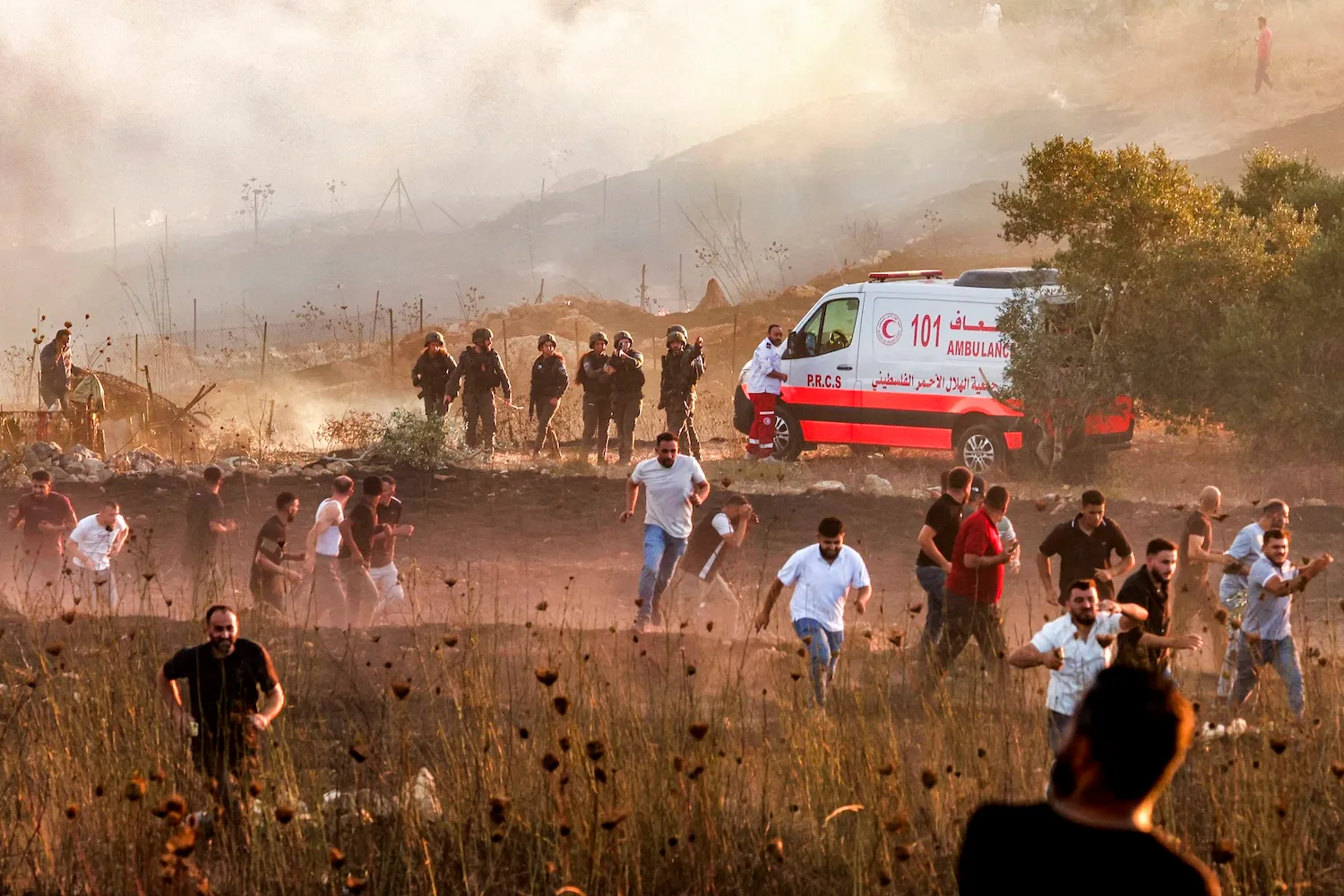
!A group of people scatter and run across a dry, grassy field amid haze and smoke. In the background, uniformed personnel in tactical gear stand in a line, while a white and red ambulance with Arabic writing and "101 AMBULANCE" on the side is parked nearby on a hillside under a hazy sky.
*A group of people scatter and run across a dry, grassy field amid haze and smoke. In the background, uniformed personnel in tactical gear stand in a line, while a white and red ambulance with Arabic writing and "101 AMBULANCE" on the side is parked nearby on a hillside under a hazy sky.*
Israeli soldiers use tear gas to disperse Palestinians near Nablus in the occupied West Bank on July 18. Jaafar Ashtiyeh/AFP via Getty Images
1. Get audio access with any FP subscription.
Subscribe Now
ALREADY AN FP SUBSCRIBER? LOGIN
October 19, 2026, 10:18 AM
Three years after Oct. 7, 2023, the prospects for meaningful Israeli-Palestinian diplomatic progress appear worse than ever. Israelis look at the way Hamas celebrated killing innocents and brutalizing hostages and conclude that they could never be safe alongside an independent Palestinian state. Palestinians look at many Israelis’ indifference to their deaths and continued suffering in Gaza and are equally convinced that Israel will never accept their independence or let them live with security and dignity.
Peacemaking in such an environment seems hopeless—and hopelessness provides fertile ground for the extremists to promote violence, claiming the conflict can only end with the destruction of the other side. Which is why, as daunting as the current environment is, it is more important than ever to show that practical, positive changes are possible.
First, it is important to recognize that actual cooperation is taking place between Israelis and Palestinians even now, for example, in managing the sewage problem in Gaza. Sewage from Gaza flows directly to the Israeli coastline and, from time to time, has necessitated closing Israel’s nearby desalination plant at Ashkelon. Not surprisingly, there are nongovernmental organizations (NGOs), like the Arava Institute in Israel, that bring Israelis and Palestinians together to work on water, sanitation, health, environment, and related economic issues and challenges.
All this needs to become far more visible. The Trump administration—whether through Jared Kushner’s team or through the State Department’s Bureau of Near Eastern Affairs, or through the U.S. embassy—should promote, participate in, and publicize such meetings. It should also provide funds, or solicit them from partners, for NGOs whose mission is to foster cooperation between Israelis and Palestinians on functional issues.
Second, the realities on the ground must be transformed. In Gaza, U.S. President Donald Trump’s 20-point peace plan produced a cease-fire a year ago and helped secure the release of the remaining hostages. The basic formula built into the Trump plan was the demilitarization of Gaza in return for reconstruction and Israeli withdrawal. A year later, Palestinians in Gaza are still living in wretched conditions, and Hamas coercively controls about 30 percent to 35 percent of the territory, including a vast majority of its population.
The promise of the 20 points remains on paper but not on the ground, where there has been no disarmament, no reconstruction, and no Israel Defense Forces withdrawal. Similarly, the National Committee for the Administration of Gaza (NCAG)—the 15-member body of Palestinian technocrats designed to govern Gaza on a transitional basis—remains in Cairo, not Gaza. So long as it is not in Gaza, it cannot begin to demonstrate that there is an alternative to Hamas rule. (The initial tranche of Palestinian police who are to provide security for the NCAG also remains in Cairo.) Moreover, the International Stabilization Force (ISF), which is to back up the Palestinian police, monitor Hamas’s disarming, and oversee the borders to prevent smuggling, is only now organizing and will not deploy to Gaza until the NCAG and the Palestinian police are entering the strip.
After long months of talks and prodding, Nickolay Mladenov, the Board of Peace’s high representative, working with Egypt, Qatar, and Turkey, reached agreement with Hamas on a 15-point road map to
!Foreign Policy
Foreign Policy Get analysis and alerts more quickly in the mobile app.
Install
Back to Foreign Policy Magazine home page
* Latest
* Regions
+ Asia & the Pacific
+ China
+ Middle East & Africa
+ Americas
+ Europe
* Newsletters
Editors’ Picks
Evening roundup with our editors’ favorite stories of the day
!World Brief Icon
World Brief
Your guide to the most important world stories of the day
!China Brief Icon
China Brief
The latest news, analysis, and data from the country each week
Situation Report
Weekly update on what’s driving U.S. national security policy
FP Weekend
A curation of our best book reviews, deep dives, and other reads
!Africa Brief Icon
Africa Brief
Essential analysis of the stories shaping geopolitics on the continent
!South Asia Brief Icon
South Asia Brief
Weekly update on developments in India and its neighbors
The Reading List
Curated guides on geopolitics and current affairs
FP Bookshelf
A monthly guide to FP’s book reviews, excerpts, and reading recommendations
!Latin America Brief Icon
Latin America Brief
One-stop digest of politics, economics, and culture
!Southeast Asia Brief Icon
Southeast Asia Brief
A weekly dispatch with news from the region’s 11 countries
The New Geopolitics
A five-part masterclass in IR theory with Harvard Professor Stephen M. Walt
View All Newsletters
* FP Live
* Latest
* Trending:
* U.S. midterms
* India's protests
Search this website
* Preferences
* My FP Feed
* Saved Articles
* Newsletters
* Magazine Archive
* Subscription Settings
* FAQs
* Log Out
Sign In
Sign In
Team access Team access
Subscribe Subscribe Team access Team access
Argument: Trump Can Push Past Israeli-Palestinian Paralysis
*
*
* Bluesky
* X
Save
1. Create an FP account to save articles to read later.
Sign Up
ALREADY AN FP SUBSCRIBER? LOGIN
1. **Downloadable PDFs** are a benefit of an FP subscription.
Subscribe Now
ALREADY AN FP SUBSCRIBER? LOGIN
Gift
*
*
1. Gifting articles is a subscriber benefit.
Subscribe Now
ALREADY AN FP SUBSCRIBER? LOGIN
2. This article is an Insider exclusive.
Contact us at [email protected] to learn about upgrade options, unlocking the ability to gift this article.
Argument
An expert’s point of view on a current event.
Trump Can Push Past Israeli-Palestinian Paralysis
Practical steps, U.S. pressure, and greater Arab involvement are needed to overcome trauma and despair.
By **Dennis Ross**, a distinguished fellow at the Washington Institute for Near East Policy.
!A group of people scatter and run across a dry, grassy field amid haze and smoke. In the background, uniformed personnel in tactical gear stand in a line, while a white and red ambulance with Arabic writing and "101 AMBULANCE" on the side is parked nearby on a hillside under a hazy sky.
*A group of people scatter and run across a dry, grassy field amid haze and smoke. In the background, uniformed personnel in tactical gear stand in a line, while a white and red ambulance with Arabic writing and "101 AMBULANCE" on the side is parked nearby on a hillside under a hazy sky.*
Israeli soldiers use tear gas to disperse Palestinians near Nablus in the occupied West Bank on July 18. Jaafar Ashtiyeh/AFP via Getty Images
1. Get audio access with any FP subscription.
Subscribe Now
ALREADY AN FP SUBSCRIBER? LOGIN
October 19, 2026, 10:18 AM
Three years after Oct. 7, 2023, the prospects for meaningful Israeli-Palestinian diplomatic progress appear worse than ever. Israelis look at the way Hamas celebrated killing innocents and brutalizing hostages and conclude that they could never be safe alongside an independent Palestinian state. Palestinians look at many Israelis’ indifference to their deaths and continued suffering in Gaza and are equally convinced that Israel will never accept their independence or let them live with security and dignity.
Peacemaking in such an environment seems hopeless—and hopelessness provides fertile ground for the extremists to promote violence, claiming the conflict can only end with the destruction of the other side. Which is why, as daunting as the current environment is, it is more important than ever to show that practical, positive changes are possible.
Three years after Oct. 7, 2023, the prospects for meaningful Israeli-Palestinian diplomatic progress appear worse than ever. Israelis look at the way Hamas celebrated killing innocents and brutalizing hostages and conclude that they could never be safe alongside an independent Palestinian state. Palestinians look at many Israelis’ indifference to their deaths and continued suffering in Gaza and are equally convinced that Israel will never accept their independence or let them live with security and dignity.
Peacemaking in such an environment seems hopeless—and hopelessness provides fertile ground for the extremists to promote violence, claiming the conflict can only end with the destruction of the other side. Which is why, as daunting as the current environment is, it is more important than ever to show that practical, positive changes are possible.
First, it is important to recognize that actual cooperation is taking place between Israelis and Palestinians even now, for example, in managing the sewage problem in Gaza. Sewage from Gaza flows directly to the Israeli coastline and, from time to time, has necessitated closing Israel’s nearby desalination plant at Ashkelon. Not surprisingly, there are nongovernmental organizations (NGOs), like the Arava Institute in Israel, that bring Israelis and Palestinians together to work on water, sanitation, health, environment, and related economic issues and challenges.
All this needs to become far more visible. The Trump administration—whether through Jared Kushner’s team or through the State Department’s Bureau of Near Eastern Affairs, or through the U.S. embassy—should promote, participate in, and publicize such meetings. It should also provide funds, or solicit them from partners, for NGOs whose mission is to foster cooperation between Israelis and Palestinians on functional issues.
Second, the realities on the ground must be transformed. In Gaza, U.S. President Donald Trump’s 20-point peace plan produced a cease-fire a year ago and helped secure the release of the remaining hostages. The basic formula built into the Trump plan was the demilitarization of Gaza in return for reconstruction and Israeli withdrawal. A year later, Palestinians in Gaza are still living in wretched conditions, and Hamas coercively controls about 30 percent to 35 percent of the territory, including a vast majority of its population.
The promise of the 20 points remains on paper but not on the ground, where there has been no disarmament, no reconstruction, and no Israel Defense Forces withdrawal. Similarly, the National Committee for the Administration of Gaza (NCAG)—the 15-member body of Palestinian technocrats designed to govern Gaza on a transitional basis—remains in Cairo, not Gaza. So long as it is not in Gaza, it cannot begin to demonstrate that there is an alternative to Hamas rule. (The initial tranche of Palestinian police who are to provide security for the NCAG also remains in Cairo.) Moreover, the International Stabilization Force (ISF), which is to back up the Palestinian police, monitor Hamas’s disarming, and oversee the borders to prevent smuggling, is only now organizing and will not deploy to Gaza until the NCAG and the Palestinian police are entering the strip.
After long months of talks and prodding, Nickolay Mladenov, the Board of Peace’s high representative, working with Egypt, Qatar, and Turkey, reached agreement with Hamas on a 15-point road map to
Share Article
Tags:#ترامب#غزة#الإسرائيليون والفلسطينيون#خطة السلام#حماس#مجلس السلام
Source: Foreign Policy
For Context
Related reads from the same topic or latest developments