InternationalAvailable in English
Exclusive: Full text of the Mecca defence pact signed by Turkey, Saudi Arabia and Pakistan
Editorial
Cross Lines editing
Source
Middle East Eye
Middle East Eye
M
Middle East Eye
Original Source
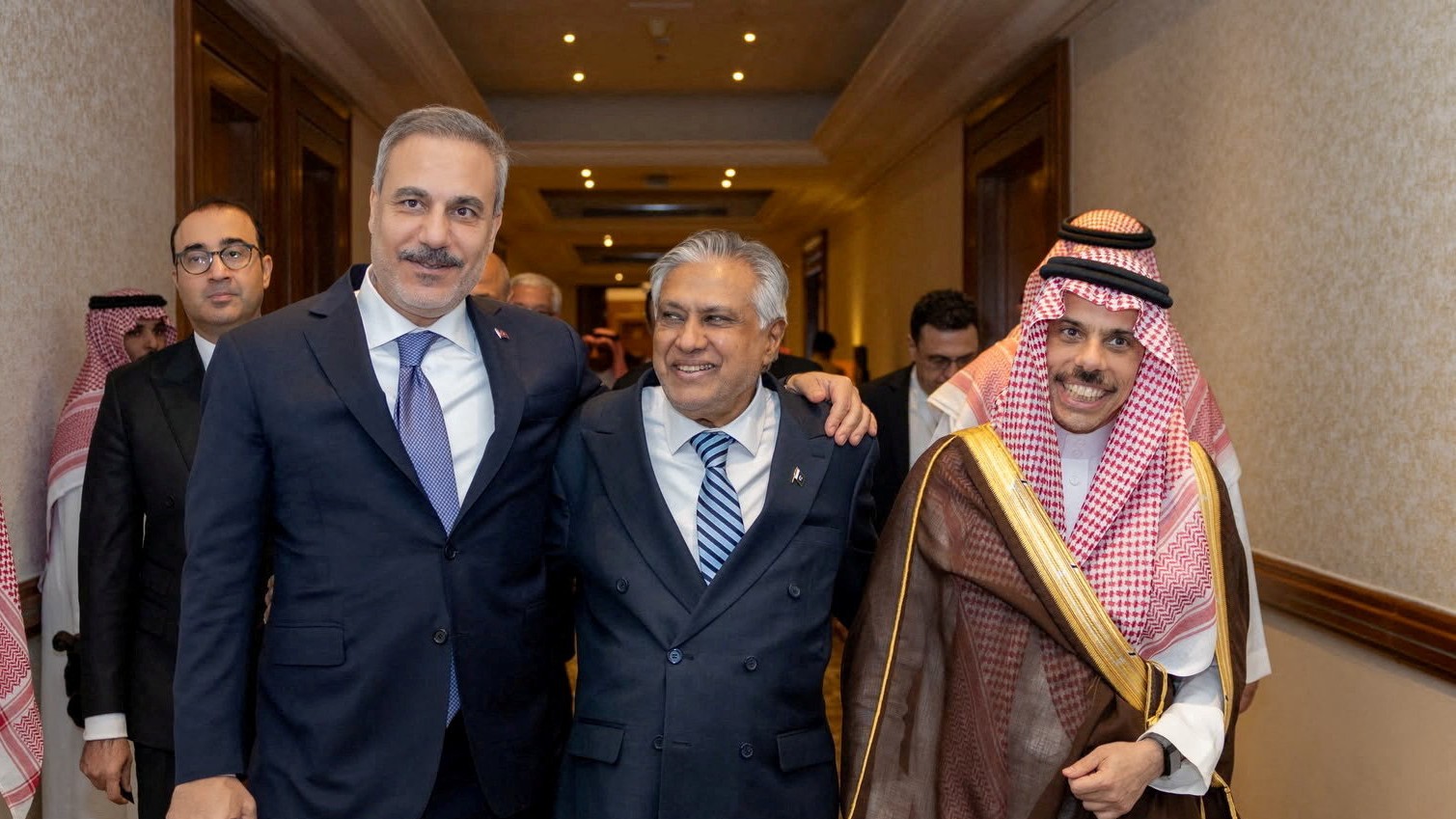
The Turkish government has submitted the text of the Mecca Defence Pact, signed by Turkey, Saudi Arabia and Pakistan in August, to parliament, committing the three states to mutual defence similar to NATO's Article 5. The pact does not name any specific threat, but provides for military support, intelligence sharing and cooperation on defence industries.
The Turkish government submitted the text of the Mecca Defence Pact to the Turkish parliament on Tuesday.
The pact, signed by Turkey, Saudi Arabia and Pakistan in August, establishes a new international defence alliance that commits the signatories to one another’s defence, similar to Article 5 of the North Atlantic Treaty.
The text of the agreement, obtained exclusively by Middle East Eye, does not identify any specific country or region as a threat, but emphasises that all participating countries will take the necessary measures to support one another in the event of an armed attack against their independence, sovereignty or territorial integrity.
“If the territorial integrity, sovereignty, or internationally recognised borders of any of the ‘Parties’ are threatened or endangered, the ‘Parties’ shall use all necessary means to eliminate such threat(s) or danger(s),” the treaty’s first article states.
Article 2 states that “an externally originating armed attack against any of the ‘Parties’ shall be considered an attack against all the ‘Parties’.”
“If one of the ‘Parties’ is subjected to an armed attack or military aggression by another country or group of countries, the ‘Parties’ shall immediately assist the attacked ‘Party’, making full use of all means of mutual assistance that they can provide to one another.”
The article adds that the parties shall determine the scope and nature of the support to be provided following an objective assessment of the assistance required, and shall cooperate within the limits of their available resources, “including military means and capabilities”.
The agreement also provides for cooperation in developing defence industries, training armed forces and supplying one another with equipment, fuel and other defence material. It also establishes a framework for intelligence sharing.
The agreement, which consists of 16 articles, has no expiration date.
It allows signatories to withdraw only after 10 years have elapsed from its entry into force, provided they give the other parties written notice of their intention to withdraw at least three months in advance.
Below is an unofficial translation of the full text of the pact:
The Government of the Republic of Turkiye, the Government of the Islamic Republic of Pakistan, and the Government of the Kingdom of Saudi Arabia (hereinafter referred to as a “Party”, the “Parties”, or the “Core Parties”),
Taking into consideration mutual respect for sovereignty, the principles of the Charter of the United Nations, international law, and the relevant principles of domestic law; and agreeing to bring the existing mechanisms of cooperation, coordination, and integration relating to the defence partnership among the “Parties” into a joint defence agreement,
Reaffirming their willingness to further develop relations among the “Parties”, in accordance with their common interests, on the basis of cooperation, coordination, and integration encompassing the interoperability, readiness, and effectiveness of their armed forces, thereby strengthening the existing bonds of friendship and brotherhood among the “Parties” and their peoples,
Reaffirming the importance of the principles of non-interference in one another’s internal affairs, sovereign equality, territorial integrity, and the inviolability of internationally recognised borders, and declaring that implementing the necessary measures of mutual support is essential in the event of an armed attack against their independence, sovereignty, and territorial integrity,
Stating the importance of joint efforts and coordination, in accordance with international law and the Charter of the United Nations, to ensure global and regional peace, stability, and security,
Expressing their desire to deepen existing cooperation among the competent authorities of the “Parties” in combating terrorism,
Emphasising the importance of strengthening existing cooperation among the “Parties” in regional and international organisations in order to adopt a common position on international matters,
Noting the need to further develop defence and defence-industry cooperation among the “Parties”,
Have agreed as follows:
Article 1
The “Parties” shall cooperate to ensure and safeguard one another’s independence, sovereignty, territorial integrity, and the inviolability of their internationally recognised borders. If the territorial integrity, sovereignty, or internationally recognised borders of any of the “Parties” are threatened or endangered, the “Parties” shall use all necessary means to eliminate such threat(s) or danger(s).
Article 2
An externally originating armed attack against any of the “Parties” shall be considered an attack against all the “Parties.” If one of the “Parties” is subjected to an armed attack or military aggression by another country or group of countries, the “Parties” shall immediately assist the attacked “Party,” making full use of all means of mutual assistance that they can provide to one another. For this purpose, to enable the exercise of the right of self-defence recognised by Article 51 of the Charter of the United Nations, the “Parties” shall determine the scope and nature of the support to be provided following an objective assessment of the assistance required, and shall cooperate within the limits of their available resources, including military means and capabilities.
Article 3
Pursuant to Article 2 of this Agreement, the “Parties” shall cooperate closely in the fields of defence, defence industry, and security; develop relations among their Armed Forces; and carry out agreed activities aimed at strengthening cooperation in defence.
Article 4
The “Parties” shall hold regular consultations on international security matters. They shall continuously and effectively assist one another and cooperate in developing individual and joint measures based on common assessments, in order to protect their vital interests and national security and eliminate threats and dangers to their national security.
Article 5
The “Parties” shall strengthen existing cooperation and joint efforts, including at the operational level, in combating terrorism in all its forms and manifestations that adversely affect regional and international stability and security.
Article 6
In wartime and peacetime, the “Parties” shall encourage reciprocal personnel exchanges among defence institutions, joint training programmes and exercises, and deployments and activities aimed at increasing the interoperability of the “Parties’” armed forces, in order to develop their defence capabilities.
Article 7
To strengthen their defence capabilities, the “Parties” shall, on the basis of mutual agreement, support technology sharing among defence-industry institutions, joint technology development, joint production, and cooperation among defence-industry organisations in the following areas:
a) Encouraging joint production in the field of defence;
b) Implementing defence innovation through joint research and development projects in technologies requiring specialised expertise;
c) Training personnel and supporting the military industry within the territories of the “Parties” through experts from any “Party”;
d) Sharing expertise and lessons learned in the fields of defence industry, defence research and development, and innovation;
e) Other areas of cooperation mutually agreed upon by the “Parties”.
Article 8
1. The “Core Parties” shall establish a “Strategic Political and Defence Committee”, comprising the Foreign Ministers, Defence Ministers, and Chiefs of General Staff of the “Parties” to provide strategic direction for joint defence, develop defence and security cooperation among the “Parties” and address obstacles that may arise during the implementation of this Agreement. The Committee shall meet twice a year, with hosting rotating among the “Parties”. The leaders of the “Parties” may meet once a year if deemed necessary.
2. The “Strategic Polit
Share Article
Tags:#ميثاق مكة#تركيا#السعودية#باكستان#الدفاع المشترك#التحالفات العسكرية
Source: Middle East Eye
For Context
Related reads from the same topic or latest developments