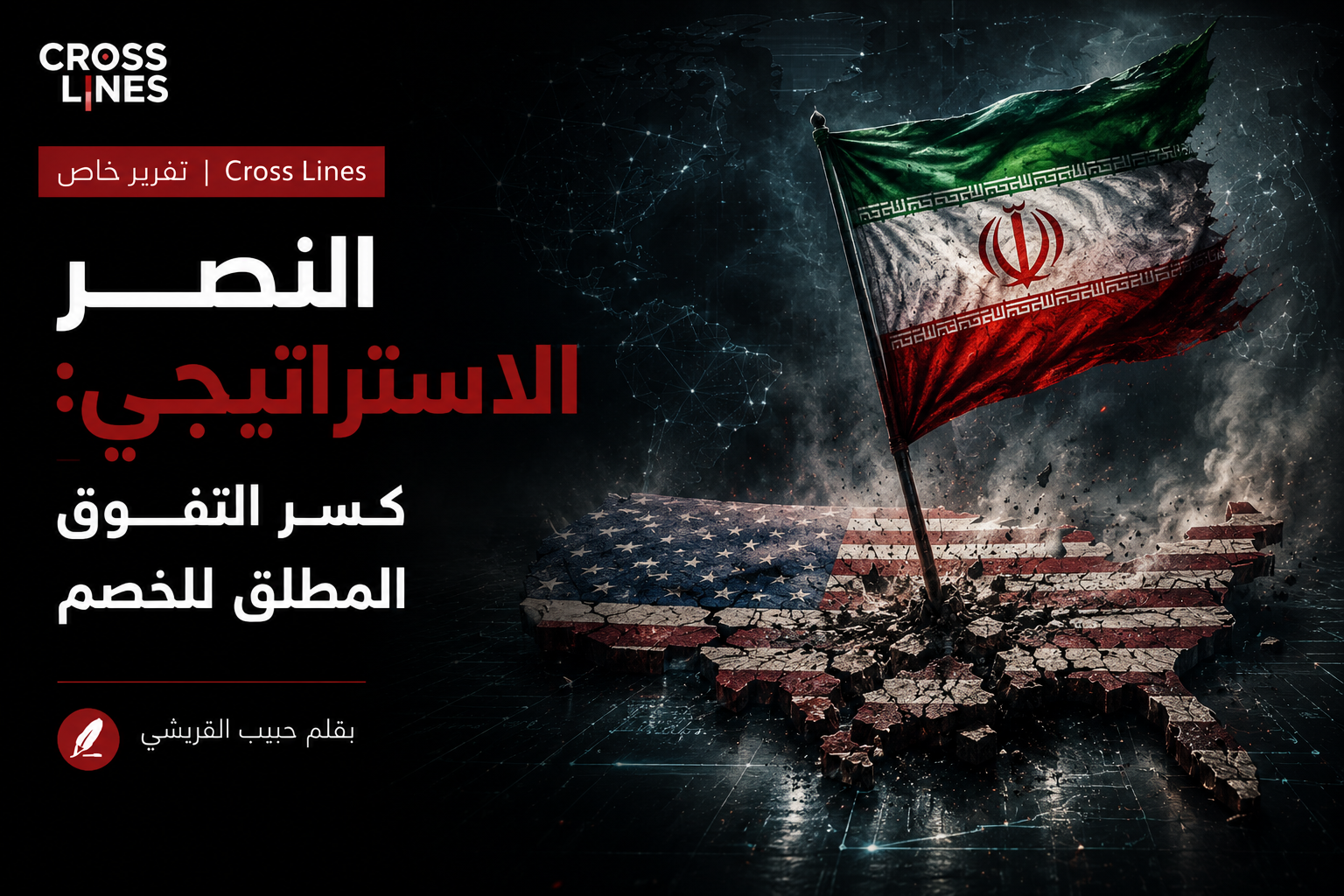
Strategic Victory: Breaking the Opponent’s Absolute Superiority

Habib Al-Quraishi
Writer at CROSS LINES
Modern wars are not measured solely by the number of strikes or the scale of destruction, but by a state’s ability to preserve its political and strategic objectives and prevent its adversaries from achieving their core goals.
Modern wars are not measured solely by the number of strikes or the scale of destruction, but by a state’s ability to preserve its political and strategic objectives and prevent its adversaries from achieving their core goals.
Tehran emerged from the confrontation with strategic gains, because the declared objective of its adversaries was not merely to weaken Iran’s military capabilities, but to alter the balance of power in the region and place pressure on the Iranian system. The survival of the state, its ability to respond, and its capacity to impose costs on the other side are presented as evidence of the failure of any project aimed at toppling Iran or fully containing its influence.
One of the most prominent elements of Iran’s strength was its ability to shift the confrontation into the realm of mutual deterrence. Iran demonstrated that it possesses missile capabilities and the means to target sites linked to the United States and Israel, making any comprehensive war costly for all parties involved. Moreover, the continuation of the conflict without the other side achieving its maximum objectives is interpreted in Tehran as a success in breaking the notion of the opponent’s absolute superiority.
Geography and politics also played an important role. Iran did not rely solely on direct military power, but also on its regional position, its network of relationships, and its ability to influence key issues across the region. Its supporters argue that the survival of its regional influence and the resilience of its political system represent gains that go beyond the outcomes of battlefield engagements.
Thus, it can be said that Iran presented the outcome of the war as a strategic victory because it preserved its existence and imposed itself as an actor that cannot be bypassed. Others, however, view the confrontation as closer to a costly draw for both sides, as neither party was able to fully impose its conditions.
The essence of the battle was not merely a confrontation between two armies, but a struggle between two projects: one seeking to reshape the balance of power in the Middle East, and an Iranian project seeking to consolidate its regional position and prevent its containment. From this perspective, the discussion of Iran’s victory is tied more to its ability to survive, deter, and frustrate the adversaries’ maximum objectives, rather than to a traditional military victory.
Tehran emerged from the confrontation with strategic gains, because the declared objective of its adversaries was not merely to weaken Iran’s military capabilities, but to alter the balance of power in the region and place pressure on the Iranian system. The survival of the state, its ability to respond, and its capacity to impose costs on the other side are presented as evidence of the failure of any project aimed at toppling Iran or fully containing its influence.
One of the most prominent elements of Iran’s strength was its ability to shift the confrontation into the realm of mutual deterrence. Iran demonstrated that it possesses missile capabilities and the means to target sites linked to the United States and Israel, making any comprehensive war costly for all parties involved. Moreover, the continuation of the conflict without the other side achieving its maximum objectives is interpreted in Tehran as a success in breaking the notion of the opponent’s absolute superiority.
Geography and politics also played an important role. Iran did not rely solely on direct military power, but also on its regional position, its network of relationships, and its ability to influence key issues across the region. Its supporters argue that the survival of its regional influence and the resilience of its political system represent gains that go beyond the outcomes of battlefield engagements.
Thus, it can be said that Iran presented the outcome of the war as a strategic victory because it preserved its existence and imposed itself as an actor that cannot be bypassed. Others, however, view the confrontation as closer to a costly draw for both sides, as neither party was able to fully impose its conditions.
The essence of the battle was not merely a confrontation between two armies, but a struggle between two projects: one seeking to reshape the balance of power in the Middle East, and an Iranian project seeking to consolidate its regional position and prevent its containment. From this perspective, the discussion of Iran’s victory is tied more to its ability to survive, deter, and frustrate the adversaries’ maximum objectives, rather than to a traditional military victory.
🔗 Share Article
For Context
Related reads from the same topic or latest developments