The Sanctity of Humanity and the Mirrors of the Soul: When Religions Confront the Digital Age
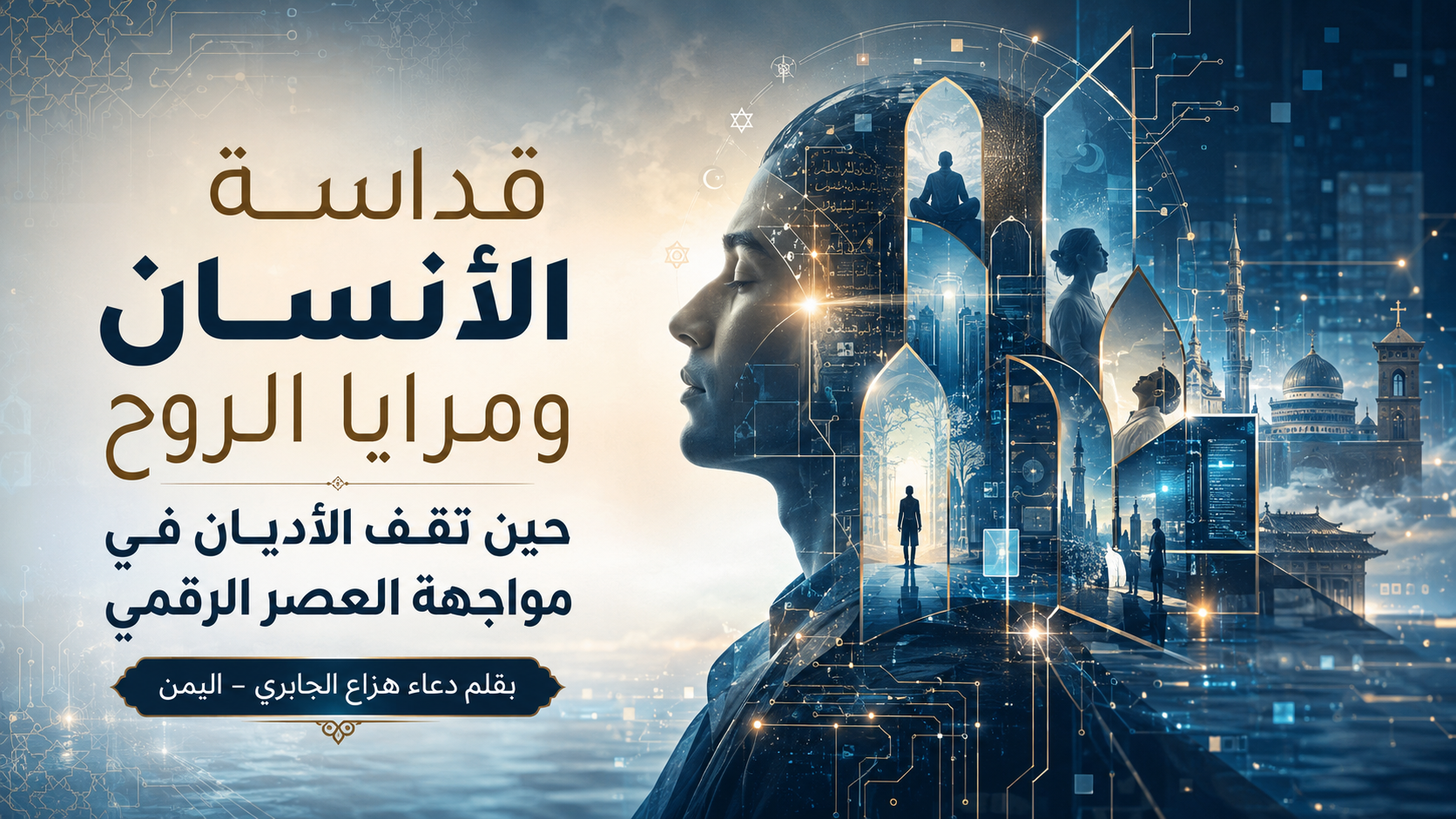

Doaa Hazza Al-Jabri
Writer at CROSS LINES
There was a time when humanity looked toward the heavens in search of answers to its greatest questions: Who are we?
There was a time when humanity looked toward the heavens in search of answers to its greatest questions: Who are we? Where are we going? What makes the human being different from every other creature?
The twenty-first century, however, has introduced a question that no previous civilization had ever confronted. It is a question posed not only by philosophers or religious scholars, but increasingly by machines themselves. Artificial intelligence—with all the promise it carries and all the fears it inspires—has become a new mirror through which humanity is compelled to redefine itself.
Today, as Al-Azhar and the Vatican engage in dialogue on the ethical and human implications of artificial intelligence, the conversation extends far beyond technology, programming, or economics. They are not merely discussing digital tools capable of writing texts or analyzing vast quantities of data. Rather, they are confronting an existential transformation that reaches the very essence of what it means to be human.
The machine that once functioned simply as an extension of human hands has gradually become an extension of the human mind—and, in the imagination of some, even a potential competitor.
Yet the deeper question is not whether machines can think, but what thinking itself truly means.
Human intelligence has never been defined solely by computational power or the speed with which information is processed. It is memory and emotion, doubt and certainty, suffering and hope. It is wisdom accumulated through experience across the passage of time.
Algorithms may be capable of storing millions of books in an instant, but they cannot understand the tear that falls from the eye of a mother waiting for her child to return. Nor can they comprehend the heavy silence that accompanies humanity's deepest losses.
It is here that religious and ethical concern emerges.
Since their inception, religions have sought to protect the human spirit from being reduced to mere material existence. They defend the intrinsic dignity of every individual as a moral being endowed with conscience, responsibility, and the freedom to choose.
Artificial intelligence introduces an entirely new dilemma: What happens when machines become capable of imitating human language, generating realistic images, fabricating convincing falsehoods, and perhaps influencing the destinies of societies and nations?
The greatest danger facing our world today is not that machines will one day conquer humanity, as science fiction has often imagined. Rather, it is that human beings may voluntarily surrender their own role to them.
Every civilization begins to decline when it loses the courage to ask difficult questions. Every intellect grows old when it becomes satisfied with ready-made answers.
Even if machines can generate knowledge, wisdom will remain an exclusively human quality. Wisdom is not born from the accumulation of information, but from lived experience, hardship, compassion, and the ability to distinguish between what is merely possible and what is truly just.
Nevertheless, the anxiety surrounding artificial intelligence should not be dismissed.
Humanity has entered a new era in which the defining struggle is no longer between East and West, nor between competing political ideologies. Instead, it is increasingly a contest between two fundamentally different visions of the human person.
One sees humanity as nothing more than a biological system whose functions can ultimately be replicated by machines.
The other believes that every human being possesses an inner mystery that no algorithm can fully comprehend and no line of code can ever reproduce.
For this reason, Al-Azhar and the Vatican are not standing in opposition to artificial intelligence itself. Rather, they are confronting the timeless question that has accompanied humanity throughout history:
How can human beings continue to develop their tools without losing their souls?
In the end, machines may succeed in imitating our voices, reproducing our ideas, and even mirroring aspects of our intelligence. But they will remain incapable of replicating that ancient existential restlessness that has driven humanity, since the dawn of civilization, to gaze into the unknown in search of the meaning of existence.
The twenty-first century, however, has introduced a question that no previous civilization had ever confronted. It is a question posed not only by philosophers or religious scholars, but increasingly by machines themselves. Artificial intelligence—with all the promise it carries and all the fears it inspires—has become a new mirror through which humanity is compelled to redefine itself.
Today, as Al-Azhar and the Vatican engage in dialogue on the ethical and human implications of artificial intelligence, the conversation extends far beyond technology, programming, or economics. They are not merely discussing digital tools capable of writing texts or analyzing vast quantities of data. Rather, they are confronting an existential transformation that reaches the very essence of what it means to be human.
The machine that once functioned simply as an extension of human hands has gradually become an extension of the human mind—and, in the imagination of some, even a potential competitor.
Yet the deeper question is not whether machines can think, but what thinking itself truly means.
Human intelligence has never been defined solely by computational power or the speed with which information is processed. It is memory and emotion, doubt and certainty, suffering and hope. It is wisdom accumulated through experience across the passage of time.
Algorithms may be capable of storing millions of books in an instant, but they cannot understand the tear that falls from the eye of a mother waiting for her child to return. Nor can they comprehend the heavy silence that accompanies humanity's deepest losses.
It is here that religious and ethical concern emerges.
Since their inception, religions have sought to protect the human spirit from being reduced to mere material existence. They defend the intrinsic dignity of every individual as a moral being endowed with conscience, responsibility, and the freedom to choose.
Artificial intelligence introduces an entirely new dilemma: What happens when machines become capable of imitating human language, generating realistic images, fabricating convincing falsehoods, and perhaps influencing the destinies of societies and nations?
The greatest danger facing our world today is not that machines will one day conquer humanity, as science fiction has often imagined. Rather, it is that human beings may voluntarily surrender their own role to them.
Every civilization begins to decline when it loses the courage to ask difficult questions. Every intellect grows old when it becomes satisfied with ready-made answers.
Even if machines can generate knowledge, wisdom will remain an exclusively human quality. Wisdom is not born from the accumulation of information, but from lived experience, hardship, compassion, and the ability to distinguish between what is merely possible and what is truly just.
Nevertheless, the anxiety surrounding artificial intelligence should not be dismissed.
Humanity has entered a new era in which the defining struggle is no longer between East and West, nor between competing political ideologies. Instead, it is increasingly a contest between two fundamentally different visions of the human person.
One sees humanity as nothing more than a biological system whose functions can ultimately be replicated by machines.
The other believes that every human being possesses an inner mystery that no algorithm can fully comprehend and no line of code can ever reproduce.
For this reason, Al-Azhar and the Vatican are not standing in opposition to artificial intelligence itself. Rather, they are confronting the timeless question that has accompanied humanity throughout history:
How can human beings continue to develop their tools without losing their souls?
In the end, machines may succeed in imitating our voices, reproducing our ideas, and even mirroring aspects of our intelligence. But they will remain incapable of replicating that ancient existential restlessness that has driven humanity, since the dawn of civilization, to gaze into the unknown in search of the meaning of existence.
🔗 Share Article
For Context
Related reads from the same topic or latest developments