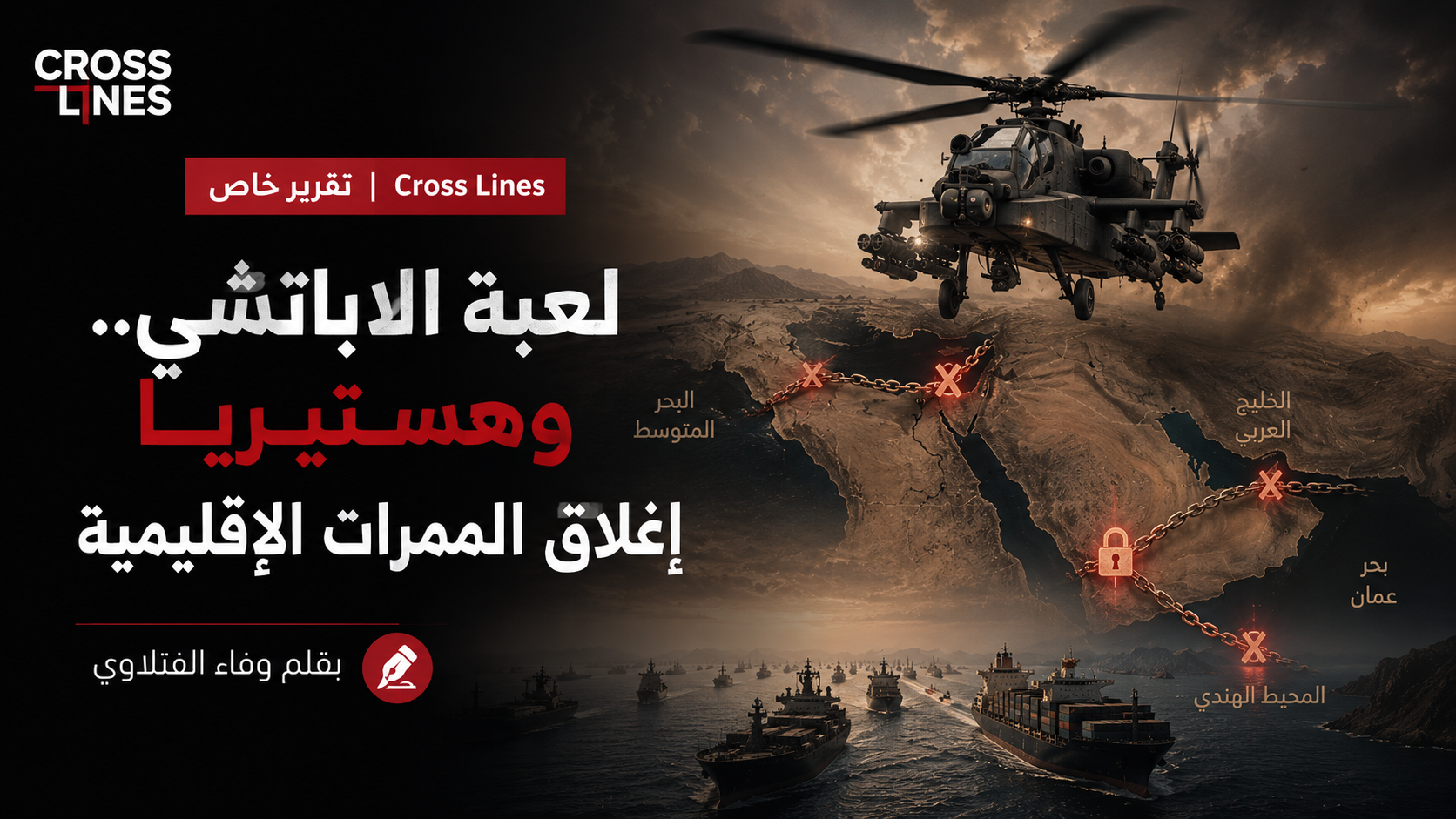
The Apache Game... and the Hysteria of Closing Regional Passages

Wafaa Al-Fatlawi
Writer at CROSS LINES
**The Apache Game and the Hysteria of Closing Regional Corridors** **By writer and media figure: Wafaa Al-Fatlawi** The region is witnessing an accelerating geopolitical escalation following targeted U.S.
**The Apache Game and the Hysteria of Closing Regional Corridors**
**By writer and media figure: Wafaa Al-Fatlawi**
The region is witnessing an accelerating geopolitical escalation following targeted U.S. strikes carried out after direct threats, in parallel with Israeli moves that included attacks on multiple fronts. This reflects the widening scope of tension and its entry into a highly complex phase in 2026.
According to strategic readings, Washington is operating within a vision based on reimposing the “deterrence equation” through a policy of “calculated pressure,” combining limited military responses with diplomatic messages in order to improve the terms of any future negotiations without sliding into a comprehensive and costly war for all parties. In contrast, Benjamin Netanyahu’s government is moving within a context that blends security considerations with domestic political calculations, as the Israeli right seeks to maintain open military pressure across multiple fronts as a tool to strengthen its internal position amid escalating political crises in Tel Aviv.
Domestically in Washington, Donald Trump’s administration in 2026 is facing growing pressure to balance the economic cost of military escalation and the nuclear file. This pushes it toward a policy of “managing the crisis rather than resolving it,” while keeping escalation within controlled levels that remain on the edge of brinkmanship without triggering a full-scale explosion. The most dangerous aspect of this complex regional scene is that continued escalation, especially if developments move toward disrupting navigation in the Strait of Hormuz, would represent a catastrophic turning point.
Given the dependence of global energy supplies on this vital passage, any disruption there would immediately affect oil prices, as is happening now, and would dramatically increase the cost of shipping and maritime insurance. Gulf states would be among the first to be affected, with threats to their oil infrastructure, while the shockwaves would extend to European and Asian economies.
Here, the decisive Iraqi question emerges: where does Baghdad stand in the face of the nightmare of closing the Strait of Hormuz? The Iraqi state, already suffering from liquidity crises and rising challenges in regularly securing public-sector salaries in 2026 despite repeated government reassurances, relies on the southern ports connected to maritime traffic through the Strait of Hormuz for more than 90 percent of its oil exports. At the same time, Iraq does not possess an oil fleet capable of securing part of its logistical needs, despite Iran’s continued permission for Iraqi oil tankers to pass through the strait.
This means, in practical terms, that the regional “brinkmanship game” is not an external detail, but rather a direct threat to Iraq’s lifeline, touching its national and economic security with extreme precision and placing the public budget at the mercy of any miscalculation in regional equations.
Despite the complexity of the fronts and the rising level of tension, indicators still rule out the outbreak of a full-scale war, while the scenario of limited strikes and calculated responses remains ongoing.
The option of de-escalation remains possible, but it depends on the success of international mediation efforts in containing the tension. Between these two paths, the clearest truth remains that Baghdad must arrange its internal cards intelligently and stay away from the burning lines of fire, because fragile economies cannot withstand the hysteria of regional wars.
**By writer and media figure: Wafaa Al-Fatlawi**
The region is witnessing an accelerating geopolitical escalation following targeted U.S. strikes carried out after direct threats, in parallel with Israeli moves that included attacks on multiple fronts. This reflects the widening scope of tension and its entry into a highly complex phase in 2026.
According to strategic readings, Washington is operating within a vision based on reimposing the “deterrence equation” through a policy of “calculated pressure,” combining limited military responses with diplomatic messages in order to improve the terms of any future negotiations without sliding into a comprehensive and costly war for all parties. In contrast, Benjamin Netanyahu’s government is moving within a context that blends security considerations with domestic political calculations, as the Israeli right seeks to maintain open military pressure across multiple fronts as a tool to strengthen its internal position amid escalating political crises in Tel Aviv.
Domestically in Washington, Donald Trump’s administration in 2026 is facing growing pressure to balance the economic cost of military escalation and the nuclear file. This pushes it toward a policy of “managing the crisis rather than resolving it,” while keeping escalation within controlled levels that remain on the edge of brinkmanship without triggering a full-scale explosion. The most dangerous aspect of this complex regional scene is that continued escalation, especially if developments move toward disrupting navigation in the Strait of Hormuz, would represent a catastrophic turning point.
Given the dependence of global energy supplies on this vital passage, any disruption there would immediately affect oil prices, as is happening now, and would dramatically increase the cost of shipping and maritime insurance. Gulf states would be among the first to be affected, with threats to their oil infrastructure, while the shockwaves would extend to European and Asian economies.
Here, the decisive Iraqi question emerges: where does Baghdad stand in the face of the nightmare of closing the Strait of Hormuz? The Iraqi state, already suffering from liquidity crises and rising challenges in regularly securing public-sector salaries in 2026 despite repeated government reassurances, relies on the southern ports connected to maritime traffic through the Strait of Hormuz for more than 90 percent of its oil exports. At the same time, Iraq does not possess an oil fleet capable of securing part of its logistical needs, despite Iran’s continued permission for Iraqi oil tankers to pass through the strait.
This means, in practical terms, that the regional “brinkmanship game” is not an external detail, but rather a direct threat to Iraq’s lifeline, touching its national and economic security with extreme precision and placing the public budget at the mercy of any miscalculation in regional equations.
Despite the complexity of the fronts and the rising level of tension, indicators still rule out the outbreak of a full-scale war, while the scenario of limited strikes and calculated responses remains ongoing.
The option of de-escalation remains possible, but it depends on the success of international mediation efforts in containing the tension. Between these two paths, the clearest truth remains that Baghdad must arrange its internal cards intelligently and stay away from the burning lines of fire, because fragile economies cannot withstand the hysteria of regional wars.
🔗 Share Article
For Context
Related reads from the same topic or latest developments